
Understanding Proration: Calculations & Examples
In accounting and financeCorporate Finance OverviewCorporate finance deals with the capital structure of a corporation, including its funding and the actions that management takes to increase the value of, prorated means adjusted for a specific time period. For example, if an employee is due a salary of $80,000 per year, and they join the company on July 1, their prorated salary for that year would be $40,000.

How to Prorate a Number
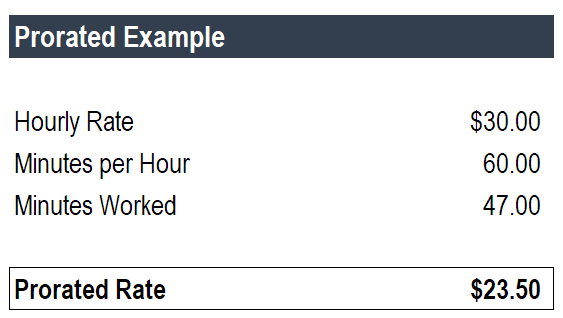
Let’s look at an example. Susan is supposed to earn $30 per hour, paid to the nearest minute. She works 47 minutes. What is her prorated compensationCompensationCompensation and salary guides for jobs in corporate finance, investment banking, equity research, FP&A, accounting, commercial banking, FMVA graduates,?
To calculate the answer, follow the steps below:
- Take her hourly rate of $30 and divide it by 60 to find her rate per minute.
- Multiple her rate per minute by 47 to arrive at the answer:
= ($30 / 60) x 47 = $23.50
Download CFI’s free Prorate Calculator.
When is Prorating Used?
There are many examples of times when a prorated number is required. Let’s review a list of the most common situations.
Examples include:
- When an employee worked for less than a year
- When an employee worked for less than a month
- When a contractor worked for less than an hour
- When a monthly subscription began mid-month
- When a utility company bills for less than a full month of service
- When a tenant moves into a rental space mid-month
While there are lots of situations that require prorating numbers, there are also many instances where numbers are not prorated. One of the most common is that of payment of stock dividends. Shareholders are paid a dividend based on the date of record when they became shareholders, not based on how long they have owned their shares. Everyone who is a shareholder as of the date of record receives the same dividend amount per shareDividend Per Share (DPS)Dividend Per Share (DPS) is the total amount of dividends attributed to each individual share outstanding of a company. Calculating the dividend per share when they are paid.
Using Prorated in a Conversation
Here is an example of a conversation between an Analyst (A) and a Vice President (VP), talking about numbers in a financial model.
VP: Did you update the model to include the new office lease figures?
A: Yes, I increased the office rent number to reflect the higher rate starting in July.
VP: Did you prorate it?
A: Yes, I prorated it based on a move-in date of July 23.
VP: Okay great, thanks!
Additional Resources
CFI is the official global provider of the Financial Modeling and Valuation Analyst (FMVA)Become a Certified Financial Modeling & Valuation Analyst (FMVA)®CFI's Financial Modeling and Valuation Analyst (FMVA)® certification will help you gain the confidence you need in your finance career. Enroll today!®Become a Certified Financial Modeling & Valuation Analyst (FMVA)®CFI's Financial Modeling and Valuation Analyst (FMVA)® certification will help you gain the confidence you need in your finance career. Enroll today! designation, a leading financial analyst certification program. To continue learning and advancing your career, the following additional CFI resources will be helpful:
- Financial Accounting TheoryFinancial Accounting TheoryFinancial Accounting Theory explains the why behind accounting - the reasons why transactions are reported in certain ways. This guide will
- Analysis of Financial StatementsAnalysis of Financial StatementsHow to perform Analysis of Financial Statements. This guide will teach you to perform financial statement analysis of the income statement,
- Accrual AccountingAccrual AccountingIn financial accounting, accruals refer to the recording of revenues that a company has earned but has yet to receive payment for, and the
- List of All Accounting ResourcesAccountingAccounting is a term that describes the process of consolidating financial information to make it clear and understandable for all
-

Understanding Guarantees: Protecting Lenders and Borrowers
A guarantee is a legal promise made by a third party (guarantor) to cover a borrower’s debt or other types of liability in case of the borrower’s defaultDebt DefaultA debt default happens
-

MiFID II Explained: A Comprehensive Guide for Investors
MiFID II is the revision of the Markets in Financial Instruments Directive (MiFID), originally published in 2004. It is the foundation of financial legislation for the European UnionEconomic UnionAn e
Accounting
- Understanding Financial Hardship: Causes, Impacts & Relief
- Understanding Auditors: Roles, Responsibilities & Audit Processes
- EBITDARM Explained: A Comprehensive Guide to Financial Analysis
- Eurocurrency Explained: What It Is & How It Works
- Factset: Financial Data & Analytics Solutions for Investment Professionals
- Understanding Finance: A Comprehensive Overview of Key Concepts
- Accounting Explained: Understanding Financial Records & Reporting
- Understanding Financial Audits: A Comprehensive Guide
- Understanding Finance: A Comprehensive Overview
-
 Comprehensive Financial Planning: Your Path to Financial Security
A financial plan is a document that covers an individual’s current financial situation, short-term and long-term economic goals, and an in-depth strategy to achieve the goals. A finan...
-
 Understanding Financial Systems: Institutions & Key Players
A financial system is a network of financial institutions – such as insurance companies, stock exchanges, and investment banksList of Top Investment BanksList of the top 100 investment banks in ...