
Understanding Guarantees: Protecting Lenders and Borrowers
A guarantee is a legal promise made by a third party (guarantor) to cover a borrower’s debt or other types of liability in case of the borrower’s defaultDebt DefaultA debt default happens when a borrower fails to pay his or her loan at the time it is due. The time a default happens varies, depending on the terms agreed upon by the creditor and the borrower. Some loans default after missing one payment, while others default only after three or more payments are missed.. Loans guaranteed by a third party are called guaranteed loans.

The guarantee can be limited or unlimited. An unlimited guarantee implies that the guarantor will cover the full amount of liability, while in a limited guarantee, the guarantor will cover only a portion of the liability.
Advantages of Guarantees
A guarantee serves as additional protection in a loan, making a loan more attractive to potential lenders. The lenders are more willing to provide guaranteed loans even to candidates with a poor credit profile,FICO ScoreA FICO score, more commonly known as a credit score, is a three-digit number that is used to assess how likely a person is to repay the credit if the individual is given a credit card or if a lender loans them money. FICO scores are also used to help determine the interest rate on any credit extended as the presence of a guarantor diminishes the probability of a lender of not being repaid.
A guaranteed loan is a viable option for borrowers with poor or no credit history. In such a case, the guarantor’s promise may allow borrowers to obtain loans that would otherwise be inaccessible.
The guarantee may be provided by an individual, company, or financial institutionFinancial IntermediaryA financial intermediary refers to an institution that acts as a middleman between two parties in order to facilitate a financial transaction. The institutions that are commonly referred to as financial intermediaries include commercial banks, investment banks, mutual funds, and pension funds..
Types of Guarantees
Guarantees take several forms. The most common types include the following:
1. Personal guarantee
A personal guarantee is a promise to repay liabilities that is made by an individual on behalf of another individual or organizationTypes of OrganizationsThis article on the different types of organizations explores the various categories that organizational structures can fall into. Organizational structures. A company’s executive or founder may become a personal guarantor to his or her company to be eligible to obtain a loan.
In making a personal guarantee, an individual promises to repay the outstanding loan amount in case of the borrower’s default or pledges his or her own assets, which can be used to repay the loan to the lender.
2. Bank guarantee
A bank guarantee is a promise from a bank to cover the liabilities of a debtor in case of the debtor’s failure to fulfill contractual obligations with another party. It is usually provided by commercial banks to companies involved in transactions with unfamiliar parties or foreigners.
3. Financial guarantee
A financial guarantee can be regarded as a form of a bank guarantee. Essentially, it is an obligation of a specialized insurance company to repay the remaining interest payments and the principal amount of a bond or similar financial instrument to the lender in case of the borrower’s default. Note that the financial guarantee can be used in transactions that involve various financial instruments and structured products.
More Resources
CFI offers the Financial Modeling & Valuation Analyst (FMVA)™Become a Certified Financial Modeling & Valuation Analyst (FMVA)®CFI's Financial Modeling and Valuation Analyst (FMVA)® certification will help you gain the confidence you need in your finance career. Enroll today! certification program for those looking to take their careers to the next level. To keep learning and advancing your career, the following CFI resources will be helpful:
- Debt ScheduleDebt ScheduleA debt schedule lays out all of the debt a business has in a schedule based on its maturity and interest rate. In financial modeling, interest expense flows
- GuarantorGuarantorA guarantor is a third party that pays for a debt if the borrower misses their payments. They are usually a form of insurance for the lender.
- Loan CovenantLoan CovenantA loan covenant is an agreement stipulating the terms and conditions of loan policies between a borrower and a lender. The agreement gives lenders leeway in providing loan repayments while still protecting their lending position. Similarly, due to the transparency of the regulations, borrowers get clear expectations of
- Intercreditor AgreementIntercreditor AgreementAn Intercreditor Agreement, commonly referred to as an intercreditor deed, is a document signed between one or more creditors, stipulating in advance how their competing interests are resolved and how to work in tandem in service to their mutual borrower.
-
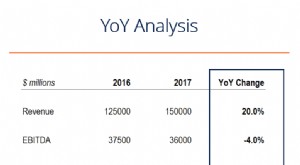
YoY Analysis: Understanding Year-over-Year Growth & Financial Insights
YoY stands for Year over Year and is a type of financial analysisAnalysis of Financial StatementsHow to perform Analysis of Financial Statements. This guide will teach you to perform financial stateme
-

Defining Financial Success: Goals & Strategies for a Secure Future
Monetary success is difficult to define in concrete terms. Even though everyone has their own definitions, there is plenty of advice on how to plan for a better financial futu
finance
- Understanding Auditors: Roles, Responsibilities & Audit Processes
- EBITDARM Explained: A Comprehensive Guide to Financial Analysis
- Eurocurrency Explained: What It Is & How It Works
- Factset: Financial Data & Analytics Solutions for Investment Professionals
- Understanding Finance: A Comprehensive Overview of Key Concepts
- Understanding Financial Crises: Causes, Impacts, and Examples
- Financial Engineering: Principles, Applications & Career Paths
- Financial Guarantee: Definition, Types & How They Work
- Understanding Your Financial Health: A Comprehensive Guide
-
 MiFID II Explained: A Comprehensive Guide for Investors
MiFID II is the revision of the Markets in Financial Instruments Directive (MiFID), originally published in 2004. It is the foundation of financial legislation for the European UnionEconomic UnionAn e...
-
 Financial Analysis: A Comprehensive Guide for Professionals
Financial analysis involves using financial dataFinancial DataWhere to find data for financial analysts - Bloomberg, CapitalIQ, PitchBook, EDGAR, SEDAR and more sources of financial data for financial...