
Stock-Based Compensation (SBC): A Comprehensive Guide
Stock Based Compensation (also called Share-Based Compensation or Equity Compensation) is a way of paying employees, executives, and directors of a company with equity in the business. It is typically used to motivate employees beyond their regular cash-based compensationCompensationCompensation and salary guides for jobs in corporate finance, investment banking, equity research, FP&A, accounting, commercial banking, FMVA graduates, (salary and bonus) and to align their interests with those of the company’s shareholders. Shares issued to employees are usually subject to a vesting period before they are earned and can be sold.

Types of Equity Compensation
Compensation that’s based on the equity of a business can take several forms.
Common types of compensation include:
- Shares
- Restricted Share Units (RSUs)
- Stock Options
- Phantom Shares
- Employee Stock Ownership Plan (ESOP)
How it Works
Companies compensate their employees by issuing them stock optionsStock OptionA stock option is a contract between two parties which gives the buyer the right to buy or sell underlying stocks at a predetermined price and within a specified time period. A seller of the stock option is called an option writer, where the seller is paid a premium from the contract purchased by the stock option buyer. or restricted shares. The shares typically vest over a few years, meaning, they are not earned by the employee until a specified period of time has passed. If the employee quits the company before the shares have vested, they forfeit those shares. As long as the employee stays long enough with the company, all of their shares will vest. They can hold the shares indefinitely, or sell them to convert them into cash.
Stock-Based Compensation Example
The easiest way to understand how it works is with an example. Let’s look at Amazon’s 2017 annual report and examine how much they paid out in equity to employees, directors, and executives, as well as how they accounted for it on their financial statements.
As you can see in the cash flow statement below, net income must be adjusted by adding back all non-cash items, including stock-based compensation, to arrive at cash from operating activities.
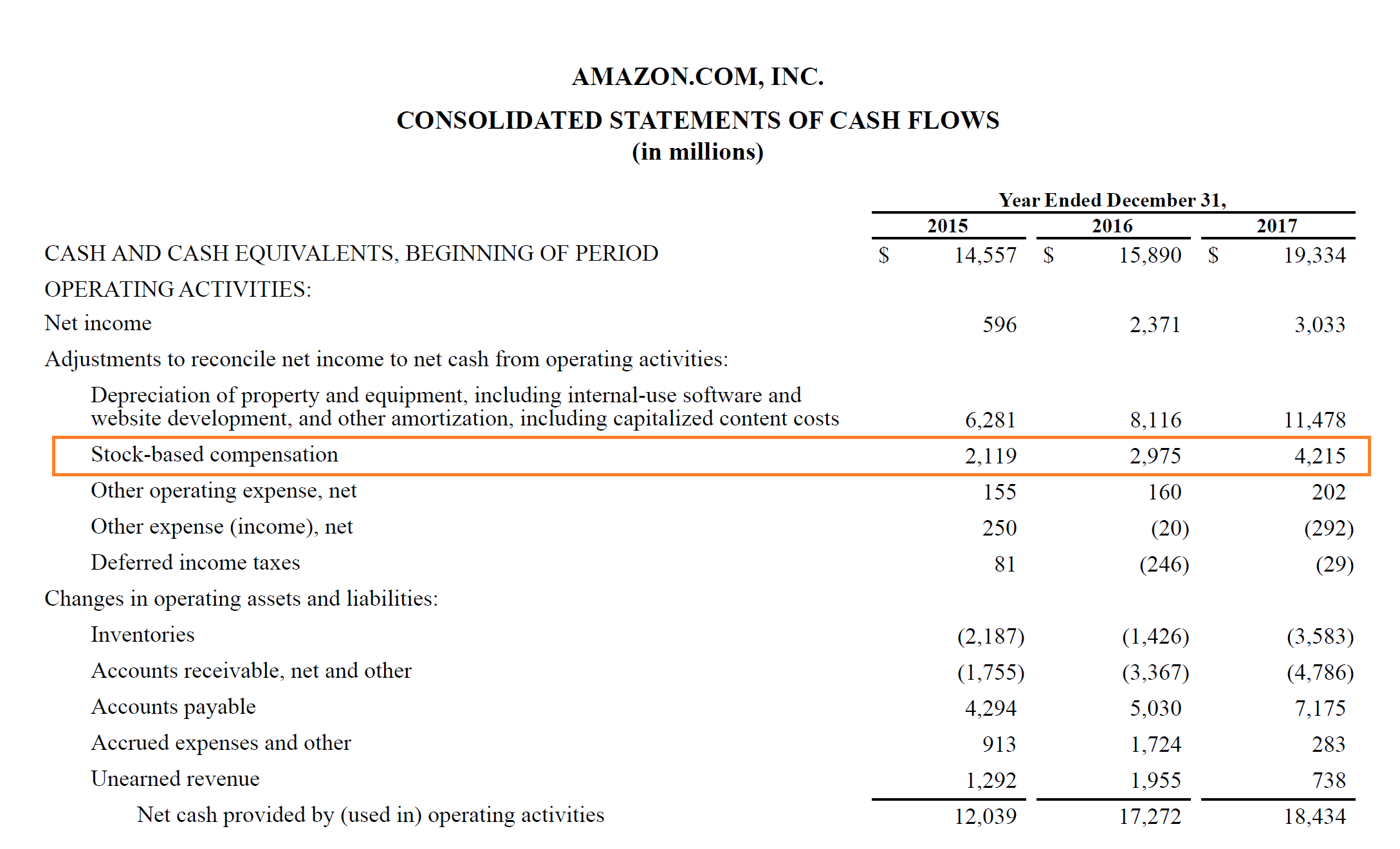
In 2017, Amazon paid $4.2 billion of share-based compensation to its employees.
Since the company has approximately 560,000 employees, that works out to about $7,500 per employee on average.
Advantages of Stock Based Compensation
There are many advantages to this type of remuneration, including:
- Creates an incentive for employees to stay with the company (they have to wait for shares to vest)
- Aligns the interests of employees and shareholders – both want to see the company prosper and the share price rise
- Doesn’t require cash
Disadvantages of Share Based Compensation
Challenges and issues with equity remuneration include:
- Dilutes the ownership of existing shareholders (by increasing the number of shares outstanding)
- May not be useful for recruiting or retaining employees if the share price is decreasing
Implications in Financial Modeling & Analysis
When building a discounted cash flow (DCF) modelDCF Model Training Free GuideA DCF model is a specific type of financial model used to value a business. The model is simply a forecast of a company’s unlevered free cash flow to value a business, it’s important to factor in share compensation. As you saw in the example from Amazon above, the expense is added back to arrive at cash flow, since it’s a non-cash expense.
While the expense does not require any cash, it does have a capital structure impact on the business, since the number of shares outstanding increases.
Analysts need to decide how to address this issue, and there are two common solutions:
- Treat the expense as a cash item (don’t add it back).
- Add it back and increase the number of shares outstanding by the number of shares awarded to employees (both vested and non-vested).
Additional Resources
CFI is the creator of the Financial Modeling & Valuation Analyst (FMVA)Become a Certified Financial Modeling & Valuation Analyst (FMVA)®CFI's Financial Modeling and Valuation Analyst (FMVA)® certification will help you gain the confidence you need in your finance career. Enroll today!®Become a Certified Financial Modeling & Valuation Analyst (FMVA)®CFI's Financial Modeling and Valuation Analyst (FMVA)® certification will help you gain the confidence you need in your finance career. Enroll today! certificationBecome a Certified Financial Modeling & Valuation Analyst (FMVA)®CFI's Financial Modeling and Valuation Analyst (FMVA)® certification will help you gain the confidence you need in your finance career. Enroll today!, designed to transform anyone into a world-class financial analyst.
To continue learning and advancing your career, these CFI resources will be helpful:
- Financial Modeling GuideFree Financial Modeling GuideThis financial modeling guide covers Excel tips and best practices on assumptions, drivers, forecasting, linking the three statements, DCF analysis, more
- Investment Banking Salary GuideInvestment Banking Salary GuideOur investment banking salary guide covers several jobs in the investment banking sector and their corresponding ranges of salaries for 2018. There are three main areas in an investment bank: investment banking division, sales and trading, and asset management.
- Financial Analyst Salary GuideFinancial Analyst Salary GuideIn this financial analyst salary guide, we cover several financial analyst jobs and their corresponding midpoint salaries for 2018. Financial analysts are responsible for examining financial data and their findings are used to help businesses come up with decisions, mainly for investing.
- Investment Banking Job DescriptionInvestment Banking Job DescriptionThis Investment Banking Job description outlines the main skills, education, and work experience required to become an IB analyst or associate
-

Understanding Overweight Stocks: A Comprehensive Guide
An overweight stockCommon StockCommon stock is a type of security that represents ownership of equity in a company. There are other terms – such as common share, ordinary share, or voting share
-

Stock Indexes Explained: A Beginner's Guide to Market Benchmarks
A stock index, also called a share index or stock market index, consists of constituent stocks used to provide an indication of an economy, market, or sector. A stock index is commonly used by investo
Accounting
- Understanding Stock Performance: A Guide for Investors
- Treasury Stock: Definition, Purpose & Impact on Share Count
- Authorized Stock: Understanding Share Issuance Limits
- Treasury Stock: Definition, Purpose & Implications
- Floating Stock Explained: Understanding Publicly Traded Shares
- Treasury Stock Method: Calculating Diluted Earnings Per Share
- Understanding Ordinary Shares: A Beginner's Guide to Common Stock
- Understanding Stock Dilution: Causes, Effects & How to Protect Yourself
- Short Selling Explained: A Comprehensive Guide for Investors
-
 Understanding Downtrends: Definition, Identification & Reversal
A downtrend describes the movement of a stock towards a lower price from its previous state. It will exist as long as there is a continuation of lower highs and lower lows in the stock chart. The down...
-
 Understanding Non-Assessable Stock: Limited Liability Explained
Non-assessable stock is a class of stock ownership where the stock owner is limited in their liability to the amount paid for the stock. It means that in the instance of bankruptcyBankruptcyBankruptcy...