
Understanding Step Costs: A Guide for Business Growth
Step costs, also called stair-step costs, are costs that do not change in direct proportion to increasing levels of activity. In other words, step costs are constant at a certain activity level but increase or decrease when an activity threshold is met.

Understanding Step Costs
Step costs are extremely important to consider when a company is about to reach a new activity level. If neglected, they can cause a business to miss out on profits.
John operates a company that produces pens. A machine costing $15,000 is capable of producing up to 1,000 pens. Assume that there are no additional costs related to producing pens (no raw materials, labor, etc.). As such, the cost of machinery is an example of a step cost. The information is illustrated below:
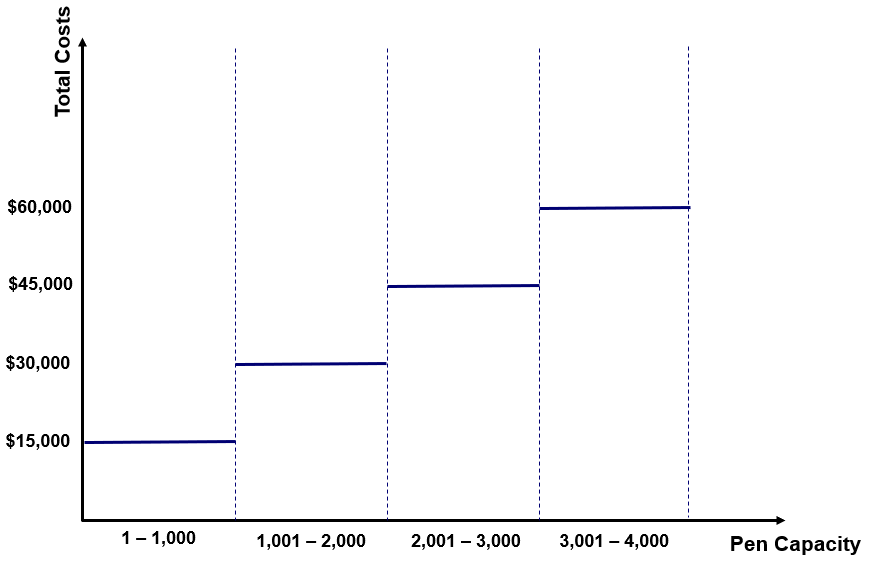
As shown in the illustration, the cost of machineryCapital ExpendituresCapital expenditures refer to funds that are used by a company for the purchase, improvement, or maintenance of long-term assets to improve closely resembles steps. At a production of 500 or 750 pens, only one machine is required. The total cost is, therefore, $15,000. However, at the production of 1,500, the company must purchase an additional machine to expand its production capacity. At a production of 1,500 pens, the total cost is $30,000 ($15,000 x 2 machines). Therefore, it is an example of a step cost: costs that are constant at a certain level of activity and rise or decrease when a certain activity threshold is met.
Importance of Step Costs
Step costs are extremely important to consider when a company is about to reach a new activity level. If neglected, they can cause a business to lose unnecessary profits.
Continuing with the example above. Assume that John initially forecasted that the demand for pens would be 1,050 next year. Additionally, assume that each pen can be sold for $20.
To an individual who does not understand step costs, they may recommend purchasing two machines to meet the demand for 1,050 pens. The revenuesRevenue StreamsRevenue Streams are the various sources from which a business earns money from the sale of goods or provision of services. The types of generated from 1,050 pens are $21,000 (1,050 x $20). However, total costs (two machines) are $30,000. The purchase of the second machine that would only generate revenue for the sale of 50 additional pens would make the company much less profitable.
To an individual who understands step costs, they would recommend purchasing one machine and producing 1,000 pens and not 1,050. The revenues generated from 1,000 pens are $20,000 (1,000 x $20) and the total costs (one machine) are $15,000. The company would be generating $5,000 in profits at the given production level.
As shown above, investing in an additional machine would cause the company to lose profits! Therefore, it is key to consider whether incurring a step cost would be accretiveAccretionAccretion is a finance term that refers to the increment in the value of a bond after purchasing it at a discount and holding it until the maturity date. A to profits or not. In the example above, an additional 50 pens (revenues of $100) would be generated through a second machine costing $15,000. In such a scenario, it would not be worthwhile for the company to incur the additional cost to produce an additional 50 pens.
Example
Consider a company with a cost structure in the production of widgets as follows:
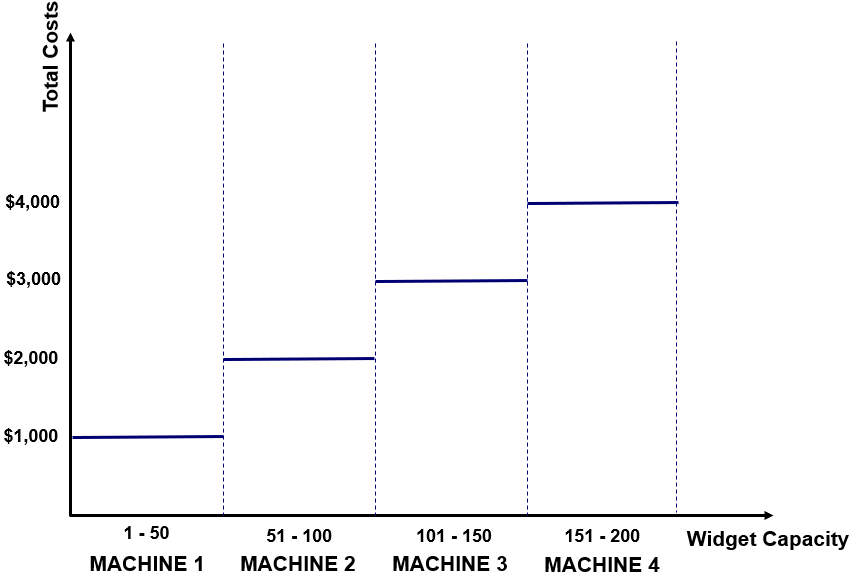
Assuming that the sale price of widgets is $30 and the company currently utilizes three machines and sells 125 widgets. Would you recommend the company to continue utilizing three machines or to cut down to two and only sell 100 widgets (the production capacity for two machines)?
Three machines with sales of 125 widgets
The total costs for the three machines are $3,000. The sales generated from 125 widgets are $3,750 (125 x $30). Therefore, the profit is $750.
Two machines with sales of 100 widgets
The total costs for the two machines are $2,000. The sales generated from 100 widgets are $3,000 (100 x $30). Therefore, the profit is $1,000.
Therefore, the company should only operate two machines and produce 100 widgets.
Step Costs in the News
Step costs are common – the cost of a new production facility, the cost of a new machine, supervision costs, marketing costs, etc., are all step costs.
For example, on July 17, 2019, FortisBC announced the completion of a $400-million expansion project that increased the company’s capacity from 35,000 a ton to 250,000 a ton. As such, the facility expansion project by FortisBC is a step cost.
Related Readings
CFI offers the Financial Modeling & Valuation Analyst (FMVA)Become a Certified Financial Modeling & Valuation Analyst (FMVA)®CFI's Financial Modeling and Valuation Analyst (FMVA)® certification will help you gain the confidence you need in your finance career. Enroll today!®Become a Certified Financial Modeling & Valuation Analyst (FMVA)®CFI's Financial Modeling and Valuation Analyst (FMVA)® certification will help you gain the confidence you need in your finance career. Enroll today! certification program for those looking to take their careers to the next level. To keep learning and advancing your career, the following CFI resources will be helpful:
- Activity-Based CostingActivity-Based CostingActivity-based costing is a more specific way of allocating overhead costs based on “activities” that actually contribute to overhead costs. An activity is
- Cost of Goods Manufactured (COGM)Cost of Goods Manufactured (COGM)Cost of Goods Manufactured (COGM) is a term used in managerial accounting that refers to a schedule or statement that shows the total
- Fixed and Variable CostsFixed and Variable CostsCost is something that can be classified in several ways depending on its nature. One of the most popular methods is classification according
- Target CostingTarget CostingTarget costing is not just a method of costing, but rather a management technique wherein prices are determined by market conditions, taking
-

Understanding Accounting Policies: A Guide for Businesses
Accounting policies are rules and guidelines that are selected by a company for use in preparing and presenting its financial statements. Accounting policies are important, as they set a framework, wh
-

Accounting Profit Explained: Calculation & Importance
Accounting profit is the net income for a company and is calculated by subtracting expenses from revenues, with guidance from the Generally Accepted Accounting Principles (GAAP)GAAPGAAP, G
Accounting
- Understanding Agency Costs: Protecting Shareholder Interests
- Understanding Fixed Costs: Definition, Examples & Importance
- Understanding Proceeds: Definition, Types & Calculation
- Understanding Explicit Costs: Definition & Examples
- Understanding Inventoriable Costs: Definition & Examples
- Period Costs: Definition, Examples & Impact on Financial Statements
- Understanding Product Costs: Direct Materials, Labor & Overhead
- Understanding Variable Costs: Definition & Examples
- Understanding Switching Costs: Barriers to Customer Loyalty
-
 Understanding Step-Up Features in Variable Annuities
Variable annuities are investments issued by insurance companies that provide a regular stream of payments to you. In their simplest form, variable annuities have variable payments. In other words, th...
-
 Absorption Costing: A Comprehensive Guide for Businesses
Absorption costing is a costing system that is used in valuing inventoryInventoryInventory is a current asset account found on the balance sheet, consisting of all raw materials, work-in-progress...