
Treasury Stock Method: Calculating Diluted Earnings Per Share
The treasury stock method is a way for companies to calculate how many additional shares may be generated from outstanding in-the-money warrants and options. The new additional shares are then used in calculating the company’s diluted earnings per shareEarnings Per Share Formula (EPS)EPS is a financial ratio, which divides net earnings available to common shareholders by the average outstanding shares over a certain period of time. The EPS formula indicates a company’s ability to produce net profits for common shareholders. (EPS).
The treasury stock method implies that the money obtained by the company from the exercising of an in-the-money option is used for stock repurchases. Repurchasing those shares turns them into treasury stock, hence the name.

Generally Accepted Accounting Principles (GAAP) mandates that companies must provide details on their diluted EPS. Therefore, the GAAP method is utilized to compute this figure for financial reporting.
EPS is diluted due to outstanding in-the-money optionsStock OptionA stock option is a contract between two parties which gives the buyer the right to buy or sell underlying stocks at a predetermined price and within a specified time period. A seller of the stock option is called an option writer, where the seller is paid a premium from the contract purchased by the stock option buyer. and warrants. These allow investors who own them to buy a number of common shares at a price below lower than the current market price.
To learn more, launch our free accounting and finance courses!
Treasury Stock Method Formula:
Additional shares outstanding = Shares from exercise – repurchased shares
Additional shares outstanding = n – (n x K / P)
Additional shares outstanding = n (1 – K/P)
Where:
- n = shares from options or warrants that are exercised
- K = Average exercise share price
- P = Average share price for the period
To learn more, launch our free accounting and finance courses!
Implementing the Treasury Stock Method
The treasury stock method has certain assumptions:
- The company repurchases common shares using an average price dictated by the market using the capital obtained when investors exercise their options
- When exercising warrants and options, the exercise date assumed is the start of the reporting period.
Example
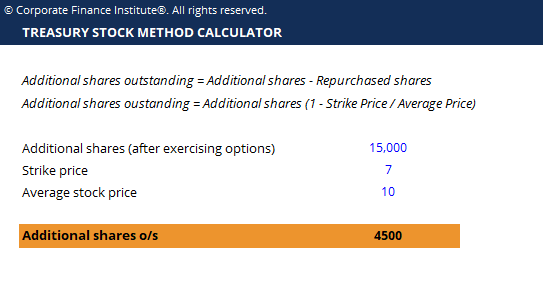
For example, a company has an outstanding total of in-the-money options and warrants for 15,000 shares. The exercise price of each of these options is $7. The average market price, however, for the reporting period is $10. Assuming all the options and warrants outstanding are exercised, the company will generate 15,000 x $7 = $105,000 in proceeds. Using these proceeds, the company can buy $105,000 / $10 = 10,500 shares at the average market price. Thus, the net increase in shares outstanding is 15,000 – 10,500 = 4,500.
This can also be found by simply using the last formula provided above. The net increase in shares outstanding is 15,000 (1 – 7/10) = 4,500.
Alternatively, use our free treasury stock method calculator to determine the effect of this example on shares outstanding.
Download the Free Treasury Stock Method Template
Enter your name and email in the form below and download the free template now!
Effect on Diluted EPS
The exercise of in-the-money options and warrants is the most dilutive of all potentially dilutive actions. As a summary, EPS is found by taking net income and dividing it by weighted average shares outstanding, or WASO.
Using the treasury stock method, there is no effect on net incomeNet IncomeNet Income is a key line item, not only in the income statement, but in all three core financial statements. While it is arrived at through, as all proceeds from the repurchase are assumed to be depleted in repurchasing treasury stock off the market. However, there is an effect on shares outstanding, or the WASO.
Since net income, the numerator, has a change of zero under the treasury stock method and the weighted average shares outstanding, the denominator, increases, there is a guaranteed decrease in the diluted EPS.
To learn more, launch our free accounting and finance courses!
More Resources
We hope this has been a helpful guide to the treasury stock method of calculating diluted shares outstanding. If you’re interested in advancing your career in corporate finance, these CFI articles will help you on your way:
- What is Financial Modeling?What is Financial ModelingFinancial modeling is performed in Excel to forecast a company's financial performance. Overview of what is financial modeling, how & why to build a model.
- Types of Financial ModelsTypes of Financial ModelsThe most common types of financial models include: 3 statement model, DCF model, M&A model, LBO model, budget model. Discover the top 10 types
- IPO ProcessIPO ProcessThe IPO Process is where a private company issues new and/or existing securities to the public for the first time. The 5 steps discussed in detail
- M&A ProcessMergers Acquisitions M&A ProcessThis guide takes you through all the steps in the M&A process. Learn how mergers and acquisitions and deals are completed. In this guide, we'll outline the acquisition process from start to finish, the various types of acquirers (strategic vs. financial buys), the importance of synergies, and transaction costs
-

Understanding the Cost of Preferred Stock: A Key Capital Metric
The cost of preferred stock to a company is effectively the price it pays in return for the income it gets from issuing and selling the stock. In other words, it’s the amount of money the compan
-

Direct Capitalization Method: Definition & Application
The direct capitalization method is obtained by taking the income recorded over time and dividing it by the respective capitalization rates taken over the same period. The cap rate is obtained by divi
Accounting
- Treasury Stock: Definition, Purpose & Impact on Share Count
- Authorized Stock: Understanding Share Issuance Limits
- Treasury Stock: Definition, Purpose & Implications
- Floating Stock Explained: Understanding Publicly Traded Shares
- Cost Recovery Method: Understanding Revenue Recognition
- Direct Method for Cash Flow Statements: A Comprehensive Guide
- Stock-Based Compensation (SBC): A Comprehensive Guide
- Treasury Stock Method Explained: Diluted Earnings Per Share
- Understanding Stock Dilution: Causes, Effects & How to Protect Yourself
-
 Understanding Stock Market Proxies: A Comprehensive Guide
If you've ever tried to explain how the stock market did on a particular day, you'll know that it's a deceptively tricky question to answer. There are hundreds of thousands of publicly tra...
-
 Understanding Stock Market Volume: A Comprehensive Guide
Financial market data After price, volume is one of the most commonly quoted data points related to the stock market. Reflecting the overall activity in a stock or market, volume is the busin...