
Sum of Years Depreciation (SYD): Definition & Calculation
Sum of Years Depreciation (SYD) is a method of accelerated depreciation. Similar to the double declining balanceDouble Declining Balance DepreciationThe double declining balance depreciation method is a form of accelerated depreciation that doubles the regular depreciation approach. It is method, sum of years depreciation aims to depreciate a company’s assets at an accelerated rate. Companies may choose the SYD method as the practice will result in a larger depreciation tax shieldTax ShieldA Tax Shield is an allowable deduction from taxable income that results in a reduction of taxes owed. The value of these shields depends on the effective tax rate for the corporation or individual. Common expenses that are deductible include depreciation, amortization, mortgage payments and interest expense in the first few years of the asset’s life.
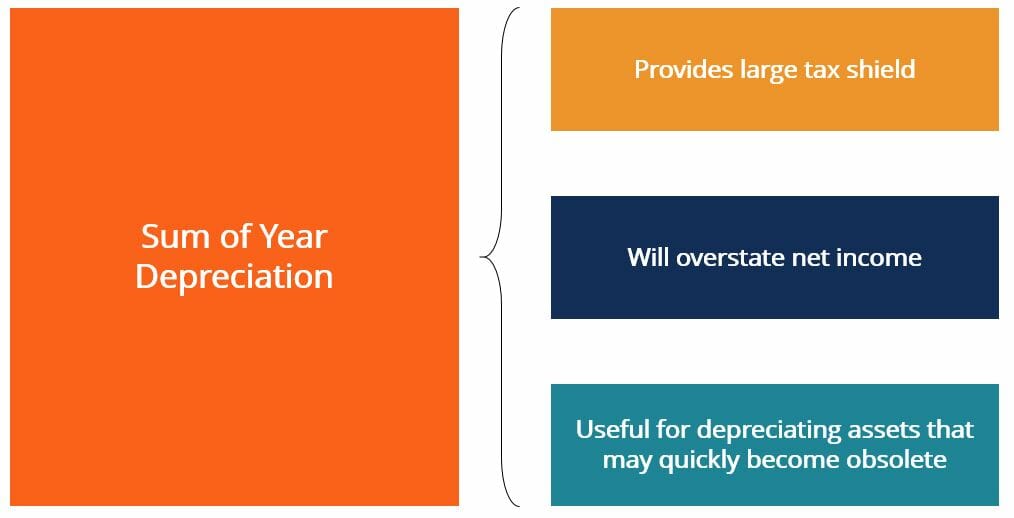
Organizations that face difficult tax environments may choose to depreciate their assets in an accelerated way in order to realize larger tax savings and benefit from the resulting understated net income figure shown on the company’s financial statements Three Financial StatementsThe three financial statements are the income statement, the balance sheet, and the statement of cash flows. These three core statements arein the first few years of owning the assets. In later years, when the depreciation amount is smaller, the net income will be overstated.
The sum of years method of depreciation is also popular with firms that are looking to write off equipment that has a high probability of becoming obsolete before the salvage valueSalvage ValueSalvage value is the estimated amount that an asset is worth at the end of its useful life. Salvage value is also known as scrap value is reached. For example, a company may choose this method to depreciate assets such as computers, which may become obsolete very quickly given the rate of technological advancements in the world today.
How It Works
The sum of years depreciation method works by depreciating the asset’s depreciable amount by a depreciation factor unique to each year. The depreciable amount is equal to the asset’s total acquisition cost less the asset’s salvage value. The total acquisition cost refers to the total capital expenditure that the company had to undertake in order to gain possession of said assets.
The total cost would include the purchase price of the asset, any shipping costs associated with moving the asset to the company, and any installation costs. The depreciation factor is the useful life of the asset (in years) divided by the sum of all the useful years. The formula below summarizes the process:
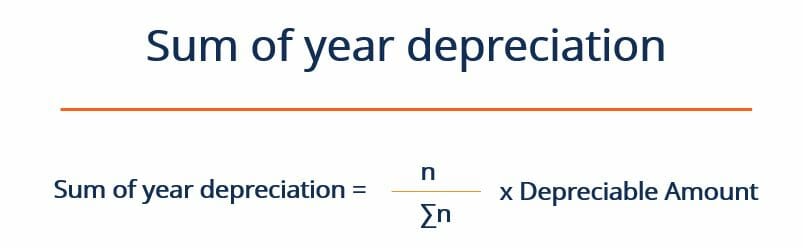
Where:
- n – Useful life of the asset (ex. 4 years)
- ∑n – Sum of years (e.g., 4 years: 1+2+3+4 = 10)
- Depreciable amount – (Total Acquisition Cost – Salvage Value)
Sum of Years Depreciation Example
Consider coffee company Mega Coffee, which is ready to expand into its new office headquarters. The company is considering investing in the latest available computers in order to make sure that its business runs smoothly. The material cost of all the computers is $2,500,000.
However, Mega Coffee needs to pay $100,000 in shipping costs in order to move this massive order of computers across the country in due time. In addition, Mega Coffee is faced with a $400,000 installation charge to ensure that its computers are installed correctly and function at full capacity.
Mega Coffee believes that at the end of the computers’ 5-year useful life, they will be worth $200,000. The company decides to depreciate the assets using the SYD method as it faces a fairly harsh tax environment. Also, there is a high probability that the computers will become obsolete before their useful life is up. Create a depreciation schedule to model how these assets can be depreciated.
Solution
The first step is to identify the main inputs needed for this calculation. These are summarized in the table below:
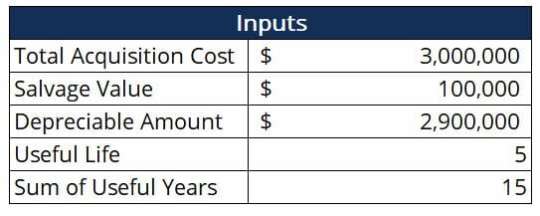
Where:
- Total acquisition cost – $2,500,000 + $100,000 + $400,000 = $3,000,000
- Depreciable Amount – $3,000,000 – $100,000 = $2,900,000
- Sum of useful years – 1+2+3+4+5 = 15
Once we have established the relevant parameters, we can calculate the depreciation expense for each year as follows:
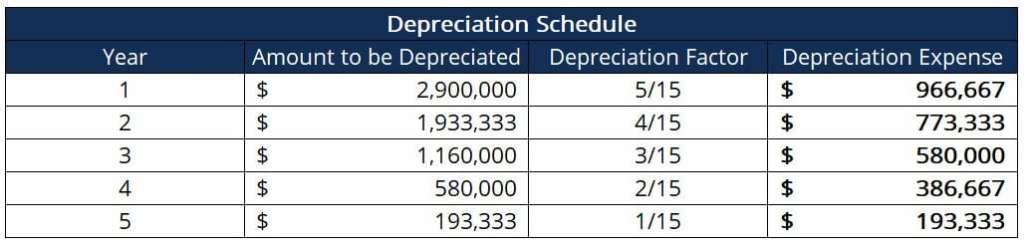
Notice how the depreciation expense in year 1 ($966,667) is about five times greater than the depreciation expense in year 5 ($193,333). Thus, if the computers were to become obsolete after year 3, a huge part of their value would have already been depreciated. It means that the company would have already realized most of the tax benefits associated with depreciation, and thus would be more inclined to invest in more advanced technology.
Additional Resources
CFI offers the Financial Modeling & Valuation Analyst (FMVA)®Become a Certified Financial Modeling & Valuation Analyst (FMVA)®CFI's Financial Modeling and Valuation Analyst (FMVA)® certification will help you gain the confidence you need in your finance career. Enroll today! certification program for those looking to take their careers to the next level. To learn more about related topics, check out the following CFI resources:
- Depreciation ExpenseDepreciation ExpenseWhen a long-term asset is purchased, it should be capitalized instead of being expensed in the accounting period it is purchased in.
- Accumulated DepreciationAccumulated DepreciationAccumulated depreciation is the total amount of depreciation expense allocated to a specific asset since the asset was put into use.
- IFRS StandardsIFRS StandardsIFRS standards are International Financial Reporting Standards (IFRS) that consist of a set of accounting rules that determine how transactions and other accounting events are required to be reported in financial statements. They are designed to maintain credibility and transparency in the financial world
- Cash Flow StatementCash Flow StatementA cash flow Statement contains information on how much cash a company generated and used during a given period.
-
Understanding Depreciation Methods: A Comprehensive Guide
There are several types of depreciation expenseDepreciation ExpenseWhen a long-term asset is purchased, it should be capitalized instead of being expensed in the accounting period it is purchased in.
-
Double Declining Balance Depreciation: Definition & Calculation
The double declining balance depreciation method is a form of accelerated depreciationDepreciation MethodsThe most common types of depreciation methods include straight-line, double declining balance,
Accounting
- Accelerated Depreciation: A Comprehensive Guide
- Accounting vs. Tax Depreciation: Key Differences Explained
- Understanding Accumulated Depreciation: A Comprehensive Guide
- Understanding Allowed Depreciation: Tax Deductions for Businesses
- Contra Asset Accounts: Definition & Accounting Explained
- Understanding Depreciation Expense: A Comprehensive Guide
- Listed Property Explained: Tax Implications & Business Use
- Understanding MACRS Depreciation: A Guide for U.S. Taxpayers
- Tax Depreciation Explained: A Comprehensive Guide for Taxpayers
-
 Understanding Dollar Value: Factors Influencing Appreciation & Depreciation
The dollar's worth is determined by the amount of goods, services and foreign currency it can purchase. The value of the dollar can change significantly over time. To illustrate, according to the ...
-
 Half-Year Convention for Depreciation: Understanding the Rules
The half-year convention for depreciation assumes fixed assetsFixed AssetsFixed assets refer to long-term tangible assets that are used in the operations of a business. They provide long-term financia...