
Understanding Dormant Accounts: Definition, Implications, and State Regulations
A dormant account refers to an account that has shown no activities – such as deposits and withdrawals – for a long period of time. Financial institutions need to make attempts to contact the owners of dormant accounts. If a dormant account has been unclaimed for a certain period of time, the resources held in that account must be transferred to the state’s treasury.

Summary
- An account will turn into a dormant account if it has not had any activities – such as deposits, withdrawals, money transfers, or checks written – for a long period of time.
- Financial institutions and the individual states determine whether an account is dormant, depending on their own policies.
- Financial institutions may charge service fees on dormant accounts. Also, they may automatically close a dormant account with zero balance.
Understanding Dormant Accounts
An account will turn into a dormant account if there has been no activity present for a long period of time. The activities include making deposits, withdrawals, and money transfers, or even simply logging into the account. The automatic posting of interests and dividends cannot be considered an activity.
Besides checking and saving accounts, other types of accounts can also become dormant accounts after being inactive for a certain period. Examples include pension fund accounts, 401(k) accounts401(k) PlanThe 401(k) plan is a retirement savings plan that enables employees to save a portion of their salary before taxes throguh contributing to a retirement fund, brokerage accounts, and other accounts carried by financial institutions.
The inactive period that turns a general account into a dormant account might be determined by the account providers. Different financial institutions have different dormant account periods, and the policies might change.
For example, the Canadian Imperial Bank of Commerce (CIBC) used to consider an interest-bearing account as a dormant account if it had been inactive (no deposits, withdrawals, or checks written) for 12 months. The bank also considers a non-interest-bearing account to be dormant after being inactive for six months. In February 2020, CIBC changed its policy, extending the period to 24 months for all personal deposit accounts.
Treatment of Dormant Accounts
According to their respective policies, different financial institutions treat their dormant accounts differently. Service feesService ChargeA service charge, also called a service fee, refers to a fee collected to pay for services that relate to a product or service that is being purchased. might be collected on dormant accounts. Usually, the longer an account has been dormant, the higher the annual service fees that are charged.
Banks generally offer bank statements monthly for record-keeping for active accounts. They may charge to offer quarterly statements automatically for dormant accounts. If a dormant account has zero balance, the bank may close the account after a period of time. Accountholders can claim and re-activate their accounts by making deposits, withdrawals, transferring, or making bill payments, as well as contacting the service provider.
In the U.S., state laws set the inactive periods for dormant accounts. For example, brokerage, checking, and savings accountsSavings AccountA savings account is a typical account at a bank or a credit union that allows an individual to deposit, secure, or withdraw money when the need arises. A savings account usually pays some interest on deposits, although the rate is quite low. become dormant after being inactive for at least five years in Delaware. In California, the period of dormancy is much shorter, which is only three years.
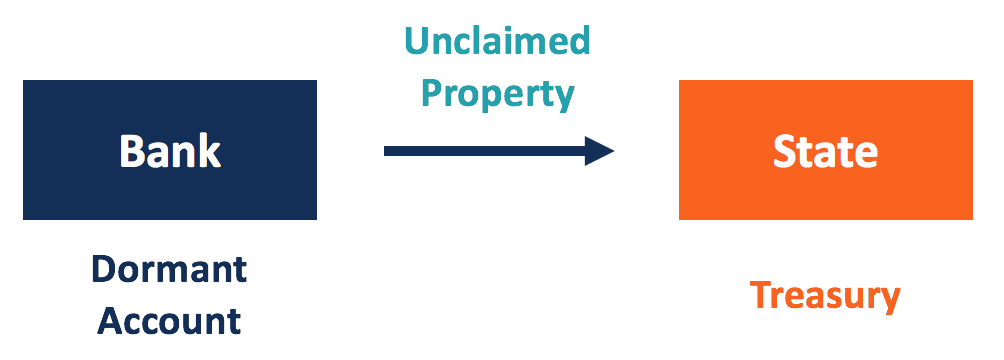
Financial institutions are also required to make attempts to contact the holders of dormant accounts through their most recent contact information. If an account has been dormant for a certain period and the financial institution cannot get in touch with the account holder, the resources held in that account will be considered unclaimed assets. The assets will be transferred to the state’s treasury according to the state’s law.
Escheatment Statute of Dormant Accounts
States apply the escheatmentEscheatmentEscheatment is the process through which unclaimed assets are turned over to the state. Every year, many bank accounts remain unclaimed and properties are statute to dormant accounts. The escheatment statute gives governments the right to assets when the assets have been unclaimed. Financial institutions are required to transfer the unclaimed property from dormant accounts to the state’s fund for safekeeping.
The states will be responsible for record-keeping and returning the property if it is claimed. Owners need to file applications to claim the property.
Dormant accounts do not fall under the jurisdiction of the statute of limitations. The statute sets a period within which actions must be taken to enforce rights. It means the states will perpetually keep the unclaimed property collected from dormant accounts. Owners or beneficiaries can claim and recover their property at any time.
Related Readings
CFI is the official provider of the global Commercial Banking & Credit Analyst (CBCA)™Program Page - CBCAGet CFI's CBCA™ certification and become a Commercial Banking & Credit Analyst. Enroll and advance your career with our certification programs and courses. certification program, designed to help anyone become a world-class financial analyst. To keep advancing your career, the additional CFI resources below will be useful:
- Account BalanceAccount BalanceAn account balance is the amount of money present in a financial repository during the current accounting period. It is the net difference between the
- Automated Clearing House (ACH)Automated Clearing House (ACH)The Automated Clearing House network, also known as ACH, is a channel run by the National Automated Clearing House Association (NACHA), which transfers
- Checking Accounts vs Savings AccountsChecking Accounts vs Savings AccountsA bank client can choose to open checking accounts vs savings accounts depending on several factors, such as purpose, ease of access, or other attributes. A checking account is a type of bank account that is used for everyday transactions. It is the most basic account that banks, credit unions, and small lenders offer.
- Deferment PeriodDeferment PeriodA deferment period is a length of time where the borrower does not have to pay interest or repay the remaining amount on a loan. Before the
-

Drawing Account Explained: Understanding Owner Withdrawals
A drawing account is a financial account that essentially records owners’ drawings, i.e., the assets, mainly including money, that are withdrawn from a business by its owner(s) for their persona
-

Education IRA: Tax-Advantaged Savings for Education Expenses
An education IRA is an individual savings account used for education expensesExpensesAn expense is a type of expenditure that flows through the income statement and is deducted from revenue to arrive
finance
- UTMA Account: A Comprehensive Guide for Custodians
- Understanding Account Balances: A Comprehensive Guide
- Understanding Account Numbers: Your Key to Financial Records
- Understanding Account Statements: A Comprehensive Guide
- Understanding Appropriation Accounts: Distribution of Funds & Profits
- Understanding Checking Accounts: A Comprehensive Guide
- Understanding Deposits: Bank Accounts & Security Funds | [Your Brand/Company Name]
- Savings Accounts: Your Guide to Secure Savings & Growth
- Margin Accounts: Borrowing to Invest & Increase Buying Power
-
 Understanding Bank Statements: A Comprehensive Guide
A bank statement is a monthly financial document that provides a summary of the account holder’s activity. Bank statements are generally prepared by the bank for the account holder at the end of...
-
 Demand Deposits: Definition, Function & Examples
A demand deposit is money deposited into a bank account with funds that can be withdrawn on-demand at any time. The depositor will typically use demand deposit funds to pay for everyday expenses. For ...