
Understanding Year-to-Date (YTD): A Comprehensive Guide
Year to Date (YTD) refers to the period from the beginning of the current year to a specified date before the year’s end. In other words, year to date is based on the number of days from the beginning of the calendar year (or fiscal yearFiscal Year (FY)A fiscal year (FY) is a 12-month or 52-week period of time used by governments and businesses for accounting purposes to formulate annual) up until a specified date. It is commonly used in accountingAccountingAccounting is a term that describes the process of consolidating financial information to make it clear and understandable for all and financeFinanceCFI's Finance Articles are designed as self-study guides to learn important finance concepts online at your own pace. Browse hundreds of articles! for financial reporting purposes.
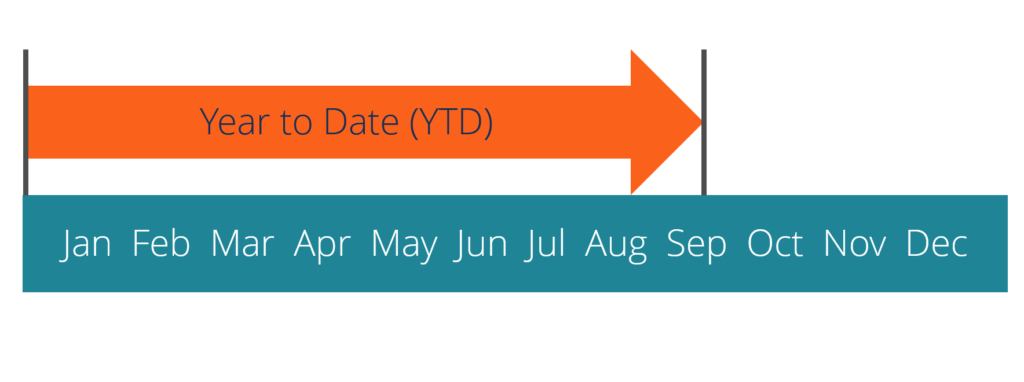
Year to Date: Fiscal Year vs. Calendar Year
The YTD can be used in reference to a calendar year or a fiscal yearFiscal Year (FY)A fiscal year (FY) is a 12-month or 52-week period of time used by governments and businesses for accounting purposes to formulate annual. This is important to realize, as not all companies follow a fiscal year beginning on January 1.
Therefore, if someone uses YTD while referring to the calendar year, it is the time period between January 1 and the specified date. If someone uses YTD in reference to a fiscal year, it is the time period between a company’s fiscal year start and the specified date.
For example, Company A’s fiscal year starts on January 31. It is now March 30. The YTD with reference to the calendar and fiscal year up until March 30 is as follows:
- Company A Calendar YTD: Period from January 1 to March 30.
- Company A Fiscal YTD: Period from January 31 to March 30.
When the YTD is not specifically referenced to a calendar or fiscal year, it is safe to assume that the YTD is in reference to the calendar year.
Formula for Year to Date Returns on a Portfolio
The formula for calculating the YTD return on a portfolio with reference to the calendar year is as follows:

Note: The YTD formula can be applied to any situation in which an individual wants to measure the change in value from the beginning of the year to a specified date. For example, instead of calculating the YTD on a portfolio, the formula can be used to calculate the YTD on sales figuresSales RevenueSales revenue is the income received by a company from its sales of goods or the provision of services. In accounting, the terms "sales" and, company costs, earningsRetained EarningsThe Retained Earnings formula represents all accumulated net income netted by all dividends paid to shareholders. Retained Earnings are part, stock returns, bond returns, etc.
Download the Free Template
Enter your name and email in the form below and download the free template now!
Example of Year to Date Portfolio Returns
On January 1, 2018, Colin invested $50,000 in stocks and $200,000 in bonds to form a diversified portfolio. The portfolio allocation is 20% ($50,000/$250,000) in stocks and 80% ($200,000/$250,000) in bonds. After keeping the portfolio for several months, Colin would like to determine the year to date return on his portfolio. The value change of stocks and bonds in Colin’s portfolio is provided as follows:
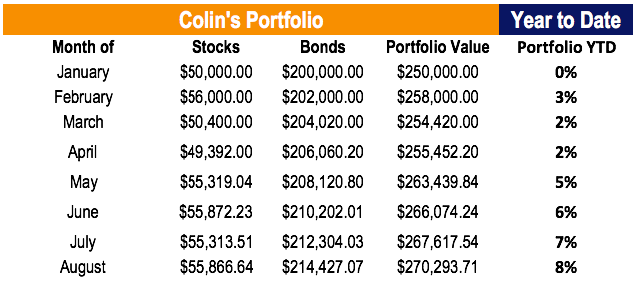
If Colin wants to calculate the year to date return up until the month of August, it would be calculated as follows:

Therefore, by holding the portfolio from January 1 to August, Colin’s year-to-date return on his portfolio is 8.117%.
The year to date calculation for other months is similar – only the numerator will change. For example, the year to date return up to March will be:

Example of YTD on Stock Returns
Consider a stock whose share price at the beginning of the calendar year was $17.50. On February 9, the company paid out dividends per share of $0.50. The current date is March 15, with a share price of $18.50. Colin would like to calculate his year to date return on this stock.

Therefore, the stock generated a year to date return of 8.571%. Note that all gains from holding the stock, including dividends received, are included in the calculation of return on investment.
Other Resources
CFI offers the Financial Modeling & Valuation Analyst (FMVA)®Become a Certified Financial Modeling & Valuation Analyst (FMVA)®CFI's Financial Modeling and Valuation Analyst (FMVA)® certification will help you gain the confidence you need in your finance career. Enroll today! certification program for those looking to take their careers to the next level with financial modeling courses and training. To keep learning and advancing your career, the following free CFI resources will be helpful:
- CalendarizationCalendarizationThe process of standardizing financial statements is called calendarization. To make comparable companies “equal,” the financial data of each company
- Year on Year (YOY) AnalysisYoY (Year over Year)YoY stands for Year over Year and is a type of financial analysis used for comparing time series data. It is useful for measuring growth and detecting trends.
- Projecting Income Statement Line ItemsProjecting Income Statement Line ItemsWe discuss the different methods of projecting income statement line items. Projecting income statement line items begins with sales revenue, then cost
- Analysis of Financial StatementsAnalysis of Financial StatementsHow to perform Analysis of Financial Statements. This guide will teach you to perform financial statement analysis of the income statement,
-

2021 401(k) & IRA Contribution Deadline: What You Need to Know
The 401k contribution deadline is at the end of the calendar year. However, the IRS allows contributions to IRA accounts up to the tax filing deadline of the coming year. For the 2021 tax year, you ca
-

Tax Season Prep: Essential Steps for a Smooth Filing Process
div.cust
Accounting
- Understanding YTD Dividends: A Guide for Investors
- Understanding Trade Settlement: A Comprehensive Guide
- Understanding Ex-Dividend Dates: A Comprehensive Guide
- What is Value Date?
- Understanding Call Dates: What You Need to Know
- Callable CD Explained: Understanding Early Redemption
- Understanding Settlement Dates: A Comprehensive Guide
- Calendarization of Financial Statements: Standardization Explained
- Understanding Fiscal Years (FY): Definition & Importance
-
 Dating Preferences: Are Your Lists Holding You Back?
When the one walks into your life — or maybe when you swipe onto their profile — you just know. Right? That's what you may have heard about falling in love, to a certain extent. That's also wh...
-
 Understanding Dividend Dates: A Comprehensive Guide
In order to understand dividend-paying stocks, knowledge of important dividend dates is crucial. A dividend typically comes in the form of a cash distribution that is paid from the company’s ear...