
Understanding Ex-Dividend Dates: A Comprehensive Guide
Ex-dividend date represents the date on or after which a security is traded without a previously declared dividend or distribution. The security is said to trade ex-dividend up to the payment date of that dividend. The date is also called the “ex-date.”
If an investor buys the stock on or after the ex-dividend date, they will not be eligible for the dividend payment. Any investor who bought the stock before the ex-date will be eligible for the dividend payment.
In the past, the investor needed to purchase the stock two days before the record date or one day before the ex-date to qualify. However, as of September 2017, it was shortened to one business day before the record date or on the ex-dividend date.
Summary
- The ex-dividend date is when the stock starts trading without the value of the previously declared dividend or distribution.
- Any investors who purchase the stock or ETF before the ex-date is entitled to its dividend.
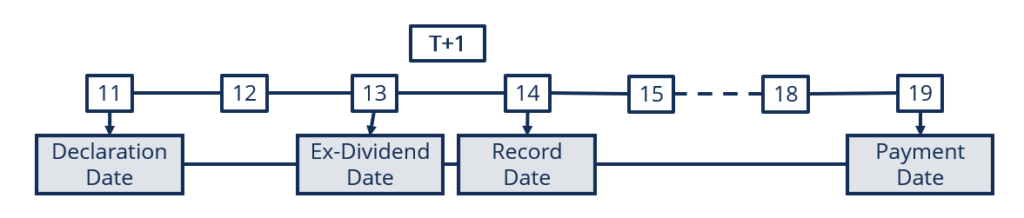
- Other important dates include the record date, which is “T+1” of the ex-dividend date, the declaration date, and the payment date.
What is a Dividend?
A dividend is authorized by the board of directorsBoard of DirectorsA board of directors is a panel of people elected to represent shareholders. Every public company is required to install a board of directors. of a company and is a distribution of a percentage of the company’s retained earnings for the period. Dividends are periodically paid, usually monthly, quarterly, or annually to shareholders of record. Dividends are not permanent, and are adjusted by the board of directors periodically..
Many high growth companies will choose not to distribute dividends but rather reinvest the retained earnings back into the company to foster growth. The shareholder’s value will hopefully grow and investors will see an appreciation of stock value and future returns and dividends.
Dividends are usually paid in cash, however, they can also be in other forms such as property, or shares. Other entities such as mutual funds or ETFs can pay dividends or distributions to their owners.
Record Date
The record date or date of record is the date when the investors who own the stock are eligible to receive dividends. The company identifies who these investors are on the said date. These are the investors who will receive the dividend or distribution when it is eventually released, even if they subsequently sell the underlying stock
The U.S. Securities and Exchange CommissionSecurities and Exchange Commission (SEC)The US Securities and Exchange Commission, or SEC, is an independent agency of the US federal government that is responsible for implementing federal securities laws and proposing securities rules. It is also in charge of maintaining the securities industry and stock and options exchanges imposes a T+1 rule that marks when an investor must have purchased a stock to be on record. It means the share must be purchased one or more days before the record date to be guaranteed the dividend benefit. It is also known as the “T+1 settlement” and investors should be mindful so as to ensure they time their trades appropriately.
For example, if an investor bought the stock one day before the record date and sold the stock the next day, they would still be considered the record holder and will receive the dividends on the payment date.
Other Noteworthy Dates
Other noteworthy dates that coincide with the ex-dividend date include the “declaration date” and the “date of payment.”
The declaration date is when the board of directors announces a dividend that will be paid to their shareholders. The record date and ex-dividend date are also set simultaneously on the declaration date. Declarations will most often be announced in a press release and directly to shareholders through a notification.
The dividend payment date is the date when the dividend is paid out to those shareholders listed on the date of record. The cash is distributed by checks or are credited to the investors’ accounts.
Below is an example of a dividend timeline starting at the declaration date and ending with the dividend payment.
Stock Reaction to Ex-Dividend
A stock’s price will usually fluctuate as the ex-dividend nears. As it approaches the date, the stock will typically increase in price by the expected dividend amount. After the ex-dividend date, when future investors are not entitled to receive the dividend, the stock price will usually fall by the estimated dividend payment amount.
This is because the stock retains the value of the dividend up until the ex-dividend date, as shareholders will pay a premium for the dividend income. On the ex-dividend date investors will discount the stock for the absence of the dividend payment and it will fall in price.
Shorting the Stock
Investors often choose to short stocks. Shorting a stock is the act of selling it and then repurchasing it at a hopefully lower future price. The stock must be “borrowed” from a shareholder so that the individual shorting it can sell it without owning it.
A third-party brokerageBrokerageA brokerage provides intermediary services in various areas, e.g., investing, obtaining a loan, or purchasing real estate. A broker is an intermediary who generally handles the process. If the price of the stock falls, then the shorter will profit. If the price goes up, then they will incur a loss.
If the underlying stock declares a dividend while an investor has shorted the stock, the investor is on the hook to pay the dividend to the owner of the shares. Administratively, the third-party brokerage firm also handles this payment transaction.
Related Readings
CFI offers the Commercial Banking & Credit Analyst (CBCA)™Program Page - CBCAGet CFI's CBCA™ certification and become a Commercial Banking & Credit Analyst. Enroll and advance your career with our certification programs and courses. certification program for those looking to take their careers to the next level. To keep learning and advancing your career, the following resources will be helpful:
- Accelerate DividendAccelerated DividendAn accelerated dividend is a dividend that is paid out ahead of a change in the way the dividends are treated, such as a change in the tax rate of dividends. The dividend payments are made early in order to protect shareholders and mitigate the negative impact that a change in dividend policy brings about.
- DPS CalculatorDividend Per Share (DPS) CalculatorThis Dividend Per Share (DPS) Calculator template will help you calculate the total amount of dividend attributed to each individual share outstanding of a company. Calculating the dividend per share allows an investor to determine the amount of cash he or she will receive on a per share basis.
- Important Dividend DatesImportant Dividend DatesIn order to understand dividend-paying stocks, knowledge of important dividend dates is crucial. A dividend typically comes in the form of a cash distribution that is paid from the company's earnings to investors.
- Retained EarningsRetained EarningsThe Retained Earnings formula represents all accumulated net income netted by all dividends paid to shareholders. Retained Earnings are part
-

Dividend Growth Rate (DGR): Definition & Calculation
The dividend growth rate (DGR) is the percentage growth rate of a company’s dividendDividendA dividend is a share of profits and retained earnings that a company pays out to its shareholders. Wh
-
Understanding Forward Dividend Yield: A Key Metric for Investors
Forward dividend yield refers to the projection of a company’s yearly dividend. It’s calculated as a percentage of the current share price. For many investors, the dividends paid out by co
finance
- Understanding Dividends: A Comprehensive Guide
- Understanding Dividend Dates: A Comprehensive Guide
- Stock Dividends: Definition, Types & How They Work
- What is Value Date?
- Understanding Dividend Yield: A Comprehensive Guide
- Understanding the Ex-Dividend Date: A Comprehensive Guide
- Understanding Settlement Dates: A Comprehensive Guide
- Qualified Dividends: Tax Benefits & Requirements Explained
- Special Dividends: Understanding One-Time Payments to Shareholders
-
 Deemed Dividends: Understanding Tax Implications for Investors
What Is a Deemed Dividend? A deemed dividend is a tax instrument used by publicly traded corporations as a means of shifting tax liability from shareholders during the sale of company stock. ...
-
 Understanding Trade Settlement: A Comprehensive Guide
A stock trader looking at the stock market data. Trade settlement is the process of transferring securities into the account of a buyer and cash into the seller's account following a trad...