
Negative Interest Rates: Explained | Causes, Effects & History
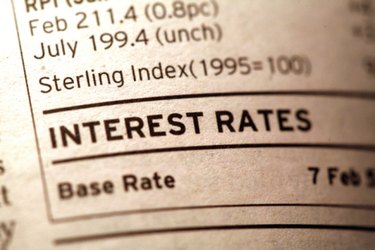
Just as the name suggests, negative interest rates are interest rates that fall below zero. Although rare, the concept dates back to the 19th century when German economist Silvio Gesell lobbied for negative interest rates during times of economic trouble to prevent financial institutions from holding on to money instead of lending it.
Purpose
The discussion of negative interest rates usually begins when the overall economy isn't performing well, or a country is in a recession. Some people believe that if interest rates drop below zero, it will stimulate growth and improve the economy. To better understand the concept of negative interest rates, however, it helps to comprehend the difference between nominal interest rates and real interest rates.
Nominal Interest Rates
A nominal interest rate is the rate stated on borrower's note or investment agreement. Negative nominal interest rates may seem impossible because no one would want to invest or lend money with a promise of receiving less back than their initial investment. However, nominal negative interest rates could occur if, for example, the currency being held is somehow lost, stolen or destroyed.
Real Interest Rates
Real interest rates are simply nominal interest rates minus the rate of inflation. Real interest rates reflect the actual cost of the loan to the borrower and the actual yield or return to the lender. Negative real interest rates would occur if, for example, the nominal rate on a bond was 3 percent, and the rate of inflation was 4 percent, making the real interest rate on the bond -1 percent.
An Uncommon Practice
Both negative nominal interest rates and negative real interest rates are extremely rare. However, two cases of negative real interest rates have occurred in the last 45 years. In 1998, Japanese banks paid banks in the Western world to hold money for them during their economic crisis, and in the 1970s, the same situation occurred when banks in Switzerland charged customers to hold their money instead of paying interest.
-

Interest Rate Futures: Definition, How They Work & Investing
Interest rate futures are futures contracts based on interest-bearing financial instruments. This futures contractFutures ContractA futures contract is an agreement to buy or sell an underlying asset
-
What are Swap Contracts?
Swap contracts are financial derivatives that allow two transacting agents to “swap” revenue streamsRevenue StreamsRevenue Streams are the various sources from which a business earns money
budgeting
- Understanding Competitive Interest Rates: What You Need to Know
- Understanding the Advantages of Low Interest Rates
- Maturity Ladder: A Comprehensive Guide for Investors
- Negative Impacts of Low Interest Rates: Economic Risks & Investment Implications
- Understanding Interest Rate Gaps: A Guide for Financial Institutions
- Negative Interest Rates Explained: How They Work & Impact
- Negative Interest Rates Explained: Impact & Implications
- Understanding Interest Rates: A Simple Explanation
- Negative Interest Rates: Explained & How They Impact Your Finances
-
 Understanding Fixed Income Securities: A Comprehensive Guide
Fixed income securities are a type of debt instrument that provides returns in the form of regular, or fixed, interest payments and repayments of the principal when the security reaches maturity. The ...
-
 Interest Rate Derivatives (IRDs): A Comprehensive Guide
Interest rate derivatives (IRD) are a derivative product that is based on a benchmark interest rate or group of interest rates. They are used by traders and borrowers to hedge their positions or specu...