
What are Swap Contracts?
Swap contracts are financial derivatives that allow two transacting agents to “swap” revenue streamsRevenue StreamsRevenue Streams are the various sources from which a business earns money from the sale of goods or provision of services. The types of arising from some underlying assets held by each party. For example, consider the case of an American business that borrowed money from a US-based bank (in USD) but wants to do business in the UK. The company’s revenue and costs are in different currencies. It needs to make interest payments in USD whereas it generates revenues in GBP. However, it is exposed to risk arising from the fluctuation of the USD/GBP exchange rate.
The company can use a USD/GBP currency swap to hedge against the risk. In order to complete the transaction, the business needs to find someone who is willing to take the other side of the swap. For example, it can look for a UK business that sells its products in the US. It should be clear from the structure of currency swaps that the two transacting parties must have opposing views on the market movement of the USD/GBP exchange rate.
Summary:
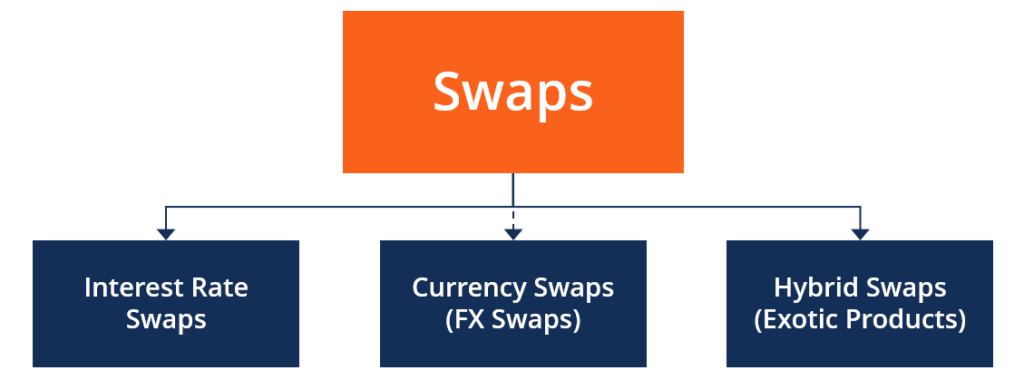
- Swap contracts are financial derivatives that allow two transacting agents to “swap” revenue streams arising from some underlying assets held by each party.
- Interest rate swaps allow their holders to swap financial flows associated with two separate debt instruments.
- Currency swaps allow their holders to swap financial flows associated with two different currencies.
- Hybrid swaps allow their holders to swap financial flows associated with different debt instruments that are also denominated in different currencies.
Types of Swap Contracts
1. Interest Rate Swaps
Interest rate swaps allow their holders to swap financial flows associated with two separate debt instruments. Interest rate swaps are most commonly used by businesses that either generate revenues linked to a variable interest rateFloating Interest RateA floating interest rate refers to a variable interest rate that changes over the duration of the debt obligation. It is the opposite of a fixed rate. debt instrument and incur costs linked to a fixed interest rate debt instrument or generate revenues linked to a fixed interest rate debt instrument and incur costs linked to a variable interest rate debt instrument.
Consider a private mortgage provider that provides first-time home-buyers with financing. The private mortgage provider gives variable rate mortgage loans at a 0.25% premium over the existing interest rate, i.e., if the central bank sets an interest rate of 2%, then the private mortgage provider can give a loan at 2.25%. Clearly, the private mortgage provider’s revenue is linked to the interest rate set by the central bankFederal Reserve (The Fed)The Federal Reserve is the central bank of the United States and is the financial authority behind the world’s largest free market economy..
In order to start operations and provide loans, the private mortgage provider borrows $2 billion from a large investment bank at a fixed interest rate of 2.1% for 15 years. The mortgage provider must pay the investment bank $42 million a year for the next 15 years and also make a lump sum payment of $2 billion at the end of the loan period. Thus, the mortgage provider’s costs are fixed. However, its revenues depend on the interest paymentsInterest PayableInterest Payable is a liability account shown on a company’s balance sheet that represents the amount of interest expense that has accrued it receives from its customers, which, in turn, is linked to the interest rate set by the central bank.
Thus, the mortgage provider’s revenues are variable. If the central bank lowers the interest rate to below 1.85%, then the mortgage provider would not be able to meet its loan obligations. It can use interest rate swaps to swap his fixed interest rate payments for variable interest rate payments.
Suppose the mortgage provider buys an interest rate swap at a 0.23% premium. It implies that the party on the other side of the transaction has agreed to pay the investment bank $42 million a year for the next 15 years, whereas the mortgage provider has agreed to pay the swap seller the bank rate +0.23% on $2 billion for the next 15 years. The transaction can only take place if the mortgage provider and the swap seller have opposing views on whether the central bank will raise or lower the interest rate over the next 15 years.
2. Currency Swaps (FX Swaps)
Currency swaps allow their holders to swap financial flows associated with two different currencies. Consider the example described above: An American business that borrowed money from a US-based bank (in USD) but wants to do business in the UK. The business’ revenue and costs are in different currencies.
The business needs to make interest payments in USD, whereas it generates revenues in GBP. However, it is exposed to risk arising from the fluctuation of the USD/GBP exchange rate. The business can use a USD/GBP currency swap to hedge against such a risk. If the business sells £50 million worth of goods in the UK and the exchange rate falls from £1=$1.23 to £1=$1.22, then the business’s revenue falls from $61.50 million to $61 million.
In order to protect against such a risk (the USD depreciating against the GBP), the business can use a USD/GBP swap. The seller of the swap agrees to give the business $61.5 million for £50 million regardless of what the actual exchange rate is. The transaction can only take place if the business and the swap seller have opposing views on whether the USD/GBP exchange rate will appreciate or depreciate.
3. Hybrid Swaps (Exotic Products)
Hybrid swaps allow their holders to swap financial flows associated with different debt instruments that are also denominated in different currencies. For example, an American variable rate mortgage provider that does business in the UK can swap a fixed interest rate loan denominated in USD for a variable interest rate loan denominated in GBP. Other examples of hybrids include swapping a variable interest rate loan denominated in USD for a variable interest rate loan denominated in JPY.
More Resources
CFI offers the Financial Modeling & Valuation Analyst (FMVA)™Become a Certified Financial Modeling & Valuation Analyst (FMVA)®CFI's Financial Modeling and Valuation Analyst (FMVA)® certification will help you gain the confidence you need in your finance career. Enroll today! certification program for those looking to take their careers to the next level. To keep learning and advancing your career, the following resources will be helpful:
- Credit Default SwapCredit Default SwapA credit default swap (CDS) is a type of credit derivative that provides the buyer with protection against default and other risks. The buyer of a CDS makes periodic payments to the seller until the credit maturity date. In the agreement, the seller commits that, if the debt issuer defaults, the seller will pay the buyer all premiums and interest
- Hedging ArrangementHedging ArrangementHedging arrangement refers to an investment whose aim is to reduce the level of future risks in the event of an adverse price movement of an asset. Hedging provides a sort of insurance cover to protect against losses from an investment.
- International Swaps and Derivatives Association (ISDA)International Swaps and Derivatives Association (ISDA)The International Swaps and Derivatives Association (ISDA) is a trade collective made up of more than 800 participants from almost 60 countries
- USD/CAD Currency CrossUSD/CAD Currency CrossThe USD/CAD currency pair represents the quoted rate for exchanging US to CAD, or, how many Canadian dollars one receives per US dollar. For example, a USD/CAD rate of 1.25 means 1 US dollar is equivalent to 1.25 Canadian dollars. The USD/CAD exchange rate is affected by economic and political forces on both
-
Interest Rate Call Options: Understanding & Benefits
An interest rate option is a derivative whose contract value is based on interest rates. There are two types of interest rate options, calls and puts. An interest rate call option gives the individual
-
Understanding Trading Instruments: A Comprehensive Guide
Trading instruments are all the different types of assets and contracts that can be traded. Trading instruments are classified into various categories, some more popular than others. They range from e
invest
- Understanding Interest Rates: A Comprehensive Guide
- Interest Rate Swaps: A Comprehensive Guide
- Swap Rate Explained: Understanding Fixed Exchange Rates in Derivatives
- Understanding Financial Derivatives: A Comprehensive Guide
- Interest Rate Collar: Definition, Strategy & Benefits
- Interest Rate Derivatives (IRDs): A Comprehensive Guide
- Interest Rate Futures: Definition, How They Work & Investing
- Understanding Interest Rate Options: A Comprehensive Guide
- Understanding Interest Rate Sensitivity: A Key Concept for Investors
-
 Currency Futures Contracts: A Comprehensive Guide
Currency futures contracts also referred to as foreign exchangeForeign ExchangeForeign exchange (Forex or FX) is the conversion of one currency into another at a specific rate known as the foreign exc...
-
 Understanding Forward Points: A Guide for Investors
Forward points are basis points that are added or subtracted to the spot rate, which is the market price quote of a commodityCommoditiesCommodities are another class of assets just like stocks and bon...