
Asset & Liability Management (ALM): A Comprehensive Guide
Asset and liability management (ALM) is a practice used by financial institutions to mitigate financial risks resulting from a mismatch of assets and liabilities. ALM strategies employ a combination of risk managementRisk ManagementRisk management encompasses the identification, analysis, and response to risk factors that form part of the life of a business. It is usually done with and financial planning and are often used by organizations to manage long-term risks that can arise due to changing circumstances.
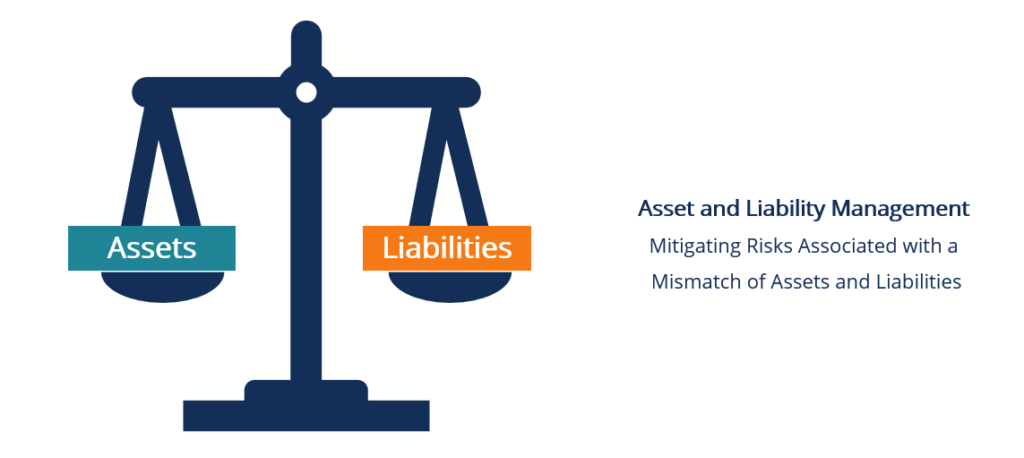
The practice of asset and liability management can include many factors, including strategic allocation of assets, risk mitigation, and adjustment of regulatory and capital frameworks. By successfully matching assets against liabilities, financial institutions are left with a surplus that can be actively managed to maximize their investment returns and increase profitability.
Summary
- Asset and liability management (ALM) is a practice used by financial institutions to mitigate financial risks resulting from a mismatch of assets and liabilities.
- By strategically matching of assets and liabilities, financial institutions can achieve greater efficiency and profitability while also reducing risk.
- Some of the most common risks addressed by ALM are interest rate risk and liquidity risk.
Understanding Asset and Liability Management
At its core, asset and liability management is a way for financial institutions to address risks resulting from a mismatch of assets and liabilities. Most often, the mismatches are a result of changes to the financial landscape, such as changing interest ratesInterest RateAn interest rate refers to the amount charged by a lender to a borrower for any form of debt given, generally expressed as a percentage of the principal. or liquidity requirements.
A full ALM framework focuses on long-term stability and profitability by maintaining liquidity requirements, managing credit quality, and ensuring enough operating capital. Unlike other risk management practices, ALM is a coordinated process that uses frameworks to oversee an organization’s entire balance sheet. it ensures that assets are invested most optimally, and liabilities are mitigated over the long-term.
Traditionally, financial institutions managed risks separately based on the type of risk involved. Yet, with the evolution of the financial landscape, it is now seen as an outdated approach. ALM practices focus on asset management and risk mitigation on a macro level, addressing areas such as market, liquidityLiquidityIn financial markets, liquidity refers to how quickly an investment can be sold without negatively impacting its price. The more liquid an investment is, the more quickly it can be sold (and vice versa), and the easier it is to sell it for fair value. All else being equal, more liquid assets trade at a premium and illiquid assets trade at a discount., and credit risks.
Unlike traditional risk management practices, ALM is an ongoing process that continuously monitors risks to ensure that an organization is within its risk tolerance and adhering to regulatory frameworks. The adoption of ALM practices extends across the financial landscape and can be found in organizations, such as banks, pension funds, asset managers, and insurance companies.
Pros and Cons of Asset and Liability Management
Implementing ALM frameworks can provide benefits for many organizations, as it is important for organizations to fully understand their assets and liabilities. One of the benefits of implementing ALM is that an institution can manage its liabilities strategically to better prepare itself for future uncertainties.
Using ALM frameworks allows an institution to recognize and quantify the risks present on its balance sheet and reduce risks resulting from a mismatch of assets and liabilities. By strategically matching assets and liabilities, financial institutions can achieve greater efficiency and profitability while reducing risk.
The downsides of ALM involve the challenges associated with implementing a proper framework. Due to the immense differences between different organizations, there is no general framework that can apply to all organizations. Therefore, companies would need to design a unique ALM framework to capture specific objectives, risk levels, and regulatory constraints.
Also, ALM is a long-term strategy that involves forward-looking projections and datasets. The information may not be readily accessible to all organizations, and even if available, it must be transformed into quantifiable mathematical measures.
Finally, ALM is a coordinated process that oversees an organization’s entire balance sheet. It involves coordination between many different departments, which can be challenging and time-consuming.
Examples of ALM Risk Mitigation
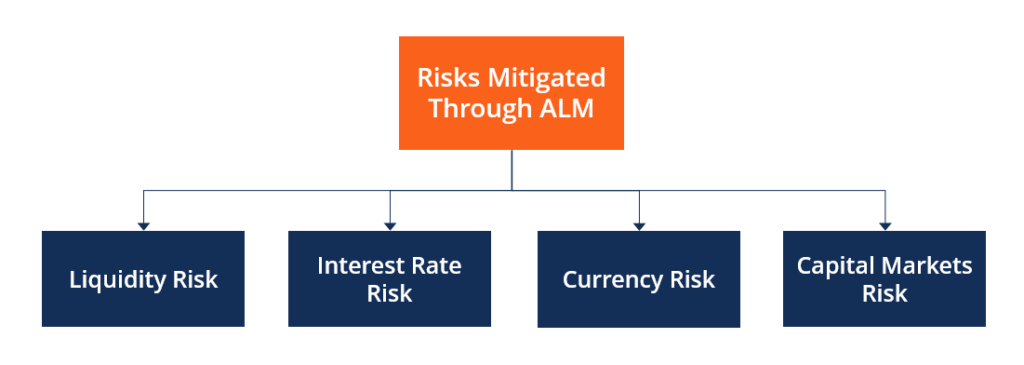
Although ALM frameworks differ greatly among organizations, they typically involve the mitigation of a wide range is risks. Some of the most common risks addressed by ALM are interest rate risk and liquidity risk.
Interest Rate Risk
Interest rate risk refers to risks associated with changes to interest rates, and how changing interest rates affect future cash flows. Financial institutions typically hold assets and liabilities that are affected by changing interest rates.
Two of the most common examples are deposits (assets) and loans (liabilities). As both are impacted by interest rates, an environment where rates are changing can result in a mismatching of assets and liabilities.
Liquidity Risk
Liquidity risk refers to risks associated with a financial institution’s ability to facilitate it’s present and future cash-flow obligations, also known as liquidity. When the financial institution is unable to meet its obligations due to a shortage of liquidity, the risk is that it will adversely affect its financial position.
To mitigate the liquidity risk, organizations may implement ALM procedures to increase liquidity to fulfill cash-flow obligations resulting from their liabilities.
Other Types of Risk
Aside from interest and liquidity risks, other types of risks are also mitigated through ALM. One example is currency risk, which are risks associated with changes to exchange rates. When assets and liabilities are held in different currencies, a change in exchange rates can result in a mismatch.
Another example is capital market risk, which are risks associated with changing equity prices. Such risks are often mitigated through futuresFutures and ForwardsFuture and forward contracts (more commonly referred to as futures and forwards) are contracts that are used by businesses and investors to hedge against risks or speculate., options, or derivatives.
Additional Resources
CFI offers the Commercial Banking & Credit Analyst (CBCA)™Program Page - CBCAGet CFI's CBCA™ certification and become a Commercial Banking & Credit Analyst. Enroll and advance your career with our certification programs and courses. certification program for those looking to take their careers to the next level. To keep learning and developing your knowledge base, please explore the additional relevant resources below:
- Audit Risk ModelAudit Risk ModelAn audit risk model is a conceptual tool applied by auditors to evaluate and manage the various risks arising from performing an audit
- Net Working CapitalNet Working CapitalNet Working Capital (NWC) is the difference between a company's current assets (net of cash) and current liabilities (net of debt) on its balance sheet.
- Risk ToleranceRisk ToleranceRisk tolerance refers to the amount of loss an investor is prepared to handle while making an investment decision. Several factors determine the level of
- Options: Calls and PutsOptions: Calls and PutsAn option is a derivative contract that gives the holder the right, but not the obligation, to buy or sell an asset by a certain date at a specified price.
-

Mastering Asset Management & Investment for a Secure Future
Anybody that wants to make real financial headway in life needs to have some understanding of asset management investment. Whether its stocks and bonds, or simply ensuring you have a decent pensi
-
Understanding Trusts: Asset Protection & Investment Management
A trust is an investment management tool where an individual entrusts assets, such as property, to others. A trust helps people protect their property and the people that they love because it hel
Business strategy
- Asset Management: Definition, Types & Importance
- Securities Explained: Types, Categories & Trading in the US
- Asset Management Companies (AMCs): A Comprehensive Guide
- Understanding Underlying Assets: Definition & Importance
- Asset Disposal: Definition, Types & Financial Statement Impact
- Contingent Liabilities: Definition, Accounting & Examples
- Strategic Financial Management: A Comprehensive Guide
- Asset Management Accounts: A Comprehensive Guide
- Asset-Liability Management (ALM): A Comprehensive Guide
-
 Financial Management: Strategies, Goals & Why It Matters
In business, financial management is the practice of handling a company’s finances in a way that allows it to be successful and compliant with regulations. That takes both a high-level plan and ...
-
Asset Allocation: A Comprehensive Guide to Portfolio Diversification
Asset allocation is how your assets are divided among various asset classes to reduce risk and potentially increase your returns. Each type of asset – stocks, bonds, and even cash – per...