
Asset Management Companies (AMCs): A Comprehensive Guide
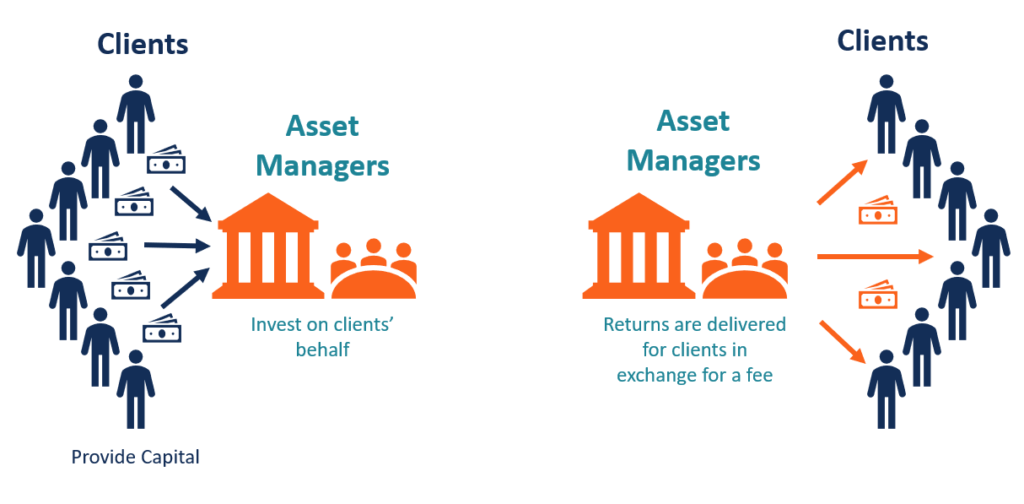
An asset management company (AMC) is a firm that invests a pooled fund of capital on behalf of its clients. The capital is used to fund different investments in various asset classesAsset ClassAn asset class is a group of similar investment vehicles. They are typically traded in the same financial markets and subject to the same rules and regulations.. Asset management companies are commonly referred to as money managers or money management firms as well.
Different Types of Asset Management Companies
Asset management companies come in many different forms and structures, such as:
- Hedge fundsHedge FundA hedge fund, an alternative investment vehicle, is a partnership where investors (accredited investors or institutional investors) pool
- Mutual funds
- Index fundsIndex FundsIndex funds are mutual funds or exchange-traded funds (ETFs) that are designed to track the performance of a market index. Currently available index funds track different market indices, including the S&P 500, Russell 2000, and FTSE 100.
- Exchange-traded funds
- Private equity fundsPrivate Equity FundsPrivate equity funds are pools of capital to be invested in companies that represent an opportunity for a high rate of return. They come with a fixed
- Other funds
In addition, they invest on behalf of various types of clients, such as:
- Retail investors
- Institutional investors
- Public sector (government organizations)
- Private sector
- High-net-worth clientsHigh Net Worth Individual (HNWI)A high net worth individual (HNWI) refers to an individual with a net worth of a minimum of $1,000,000 in highly liquid assets, such as cash and cash
Asset Management Companies Explained
Individual investors usually lack the expertise and resources to consistently produce strong investment returns over time. Therefore, many investors rely on asset management companies to invest capital on their behalf.
Asset management companies are usually a group of investment professionals with broad market expertise. With a large amount of pooled capital, they are able to utilize diversificationDiversificationDiversification is a technique of allocating portfolio resources or capital to a variety of investments.The goal of diversification is to mitigate losses and complex investment strategies to generate returns for investors.
AMCs generally charge a fee to their clients that is equal to a percentage of total assets under management (AUM). AUM is simply the total amount of capital provided by investors.
An asset management fund may charge a 2% fee on AUM. Consider as an example an asset manager who oversees a $100 million fund. The fees for one year or another time period will be $2 million ($100 million x 2.0%).
Hedge funds are notorious for charging much higher fees, sometimes upwards of 20%. However, hedge funds utilize more unorthodox and aggressive investment strategies to generate returns.
Buy-Side vs. Sell-side
Asset management companies are referred to as “buy-side” firms. It means that they help clients to buy investments. They make decisions based on which investments to purchase.
In contrast, “sell-side” firms, such as investment banks and stockbrokers, will sell investment services to buy-side companies and other investors. Sell-side companies provide market research and help to inform buy-side firms with valuable information to entice the buy-side firms to execute transactions with them.
Benefits to Asset Management Companies
There are various benefits to pooling capital together, including:
1. Economies of scale
Economies of scale are the cost advantages that a company can gain from increasing the scale of operations. With larger operations, the per-unit costs of operating are lower.
For example, asset management companies can purchase securities in larger quantities and can negotiate more favorable trading commission prices. Also, they can invest a lot of capital in a single office, which reduces overhead costsOverheadsOverheads are business costs that are related to the day-to-day running of the business. Unlike operating expenses, overheads cannot be.
2. Access to broad asset classes
Access to broad asset classes means that asset management companies can invest in asset classes that an individual investor will not be able to. For example, an AMC can invest in multi-billion-dollar infrastructure projects, such as a power plant or a bridge. The investments are so large that an individual investor will not usually be able to access them.
3. Specialized expertise
Specialized expertise refers to asset management companies hiring finance professionals with extensive experience in managing investments that most individual investors lack. For example, an AMC can hire various professionals who specialize in certain asset classes, such as real estate, fixed income, sector-specific equities, etc.
Downsides to Asset Management Companies
Asset management companies come with a few downsides as well, such as:
1. Management fees
Most asset managers charge flat fees that are collected no matter what their performance was. As a result, over time, the fees can become very expensive for investors. Because of the costs for the resources and expertise required to run an AMC, the fees are high to compensate for such costs and to provide asset managers with a profit as well.
2. Inflexible
Asset managers can become too large to a point where they are cumbersome and unresponsive to the dynamic market. Managing too large of an amount of capital creates operational problems at times.
3. Risk of underperforming
Typically, the performance of AMCs are evaluated in comparison to a benchmark. A benchmark is a standard to compare performance against, usually in the form of a broad market index. There is the risk that asset managers underperform the markets, and if including the management fees mentioned earlier, it can become very costly for investors.
Additional Resources
CFI is the official provider of the global Commercial Banking & Credit Analyst (CBCA)™Program Page - CBCAGet CFI's CBCA™ certification and become a Commercial Banking & Credit Analyst. Enroll and advance your career with our certification programs and courses. certification program, designed to help anyone become a world-class financial analyst. To keep advancing your career, the additional CFI resources below will be useful:
- Assets Under Management (AUM)Assets Under Management (AUM)Assets under management (AUM) is the total market value of the securities a financial institution owns or manages on behalf of its clients.
- Institutional InvestorInstitutional InvestorAn institutional investor is a legal entity that accumulates the funds of numerous investors (which may be private investors or other legal entities) to
- Management Expense Ratio (MER)Management Expense Ratio (MER)The management expense ratio (MER) – also referred to simply as the expense ratio – is the fee that must be paid by shareholders of a mutual fund or exchange-traded fund (ETF). The MER goes toward the total expenses used to run such funds.
- Venture Capital FundVenture Capital FundA venture capital fund is a type of investment fund that invests in early-stage startup companies that offer a high return potential but also come with a
-

Mastering Money Management: A Comprehensive Guide
Money management refers to the process of tracking and planning an individual or group’s use of capital. In personal and corporate finance, money management usually includes budgetingBudgetingBu
-

Parent Company Explained: Definition, Control & Examples
A parent company is a company that owns more than 50% of the outstanding voting shares of another company. Therefore, it controls the other company or companies and can directly influence the business
invest
- Asset Management: Definition, Types & Importance
- Asset Turnover Ratio: Definition & Calculation - Financial Analysis
- Debt-to-Asset Ratio: Definition, Calculation & Significance
- Understanding Management Discussion & Analysis (MD&A): A Comprehensive Guide
- Working Capital Management: A Comprehensive Guide
- Understanding Net-Net: A Financial Health Indicator
- Strategic Management: Definition, Objectives & Implementation
- Asset Management Accounts: A Comprehensive Guide
- Asset Management Companies (AMCs): A Comprehensive Guide
-
 Understanding Financial Gearing: Debt & Leverage Explained
Gearing is the amount of debtNet DebtNet debt = total debt - cash. Net debt is a financial liquidity metric that measures a company’s ability to pay all its debts if they were due today. Compare...
-
 Leverage in Finance: Strategies, Types & Risks
In finance, leverage is a strategy that companies use to increase assets, cash flows, and returns, though it can also magnify losses. There are two main types of leverage: financial and operating. To ...