
Understanding Underlying Assets: Definition & Importance
Underlying asset is an investment term that refers to the real financial asset or security that a financial derivative is based on. Thus, the value of the underlying asset drives the value of the financial derivative. (A derivative is simply a financial security or instrument that is derived from another security or financial asset).

One characteristic that distinguishes underlying financial assets from derivatives is where they are traded. Underlying assets are nearly always available for trading in the cash, or “spot,” markets, while financial derivatives are usually traded only on specialized exchanges, such as futures trading exchanges, privately, or in over-the-counter marketsOver-the-Counter (OTC)Over-the-counter (OTC) is the trading of securities between two counter-parties executed outside of formal exchanges and without the supervision of an exchange regulator. OTC trading is done in over-the-counter markets (a decentralized place with no physical location), through dealer networks..
Summary
- Underlying asset is an investment term that refers to the real financial asset or security that a financial derivative is based on.
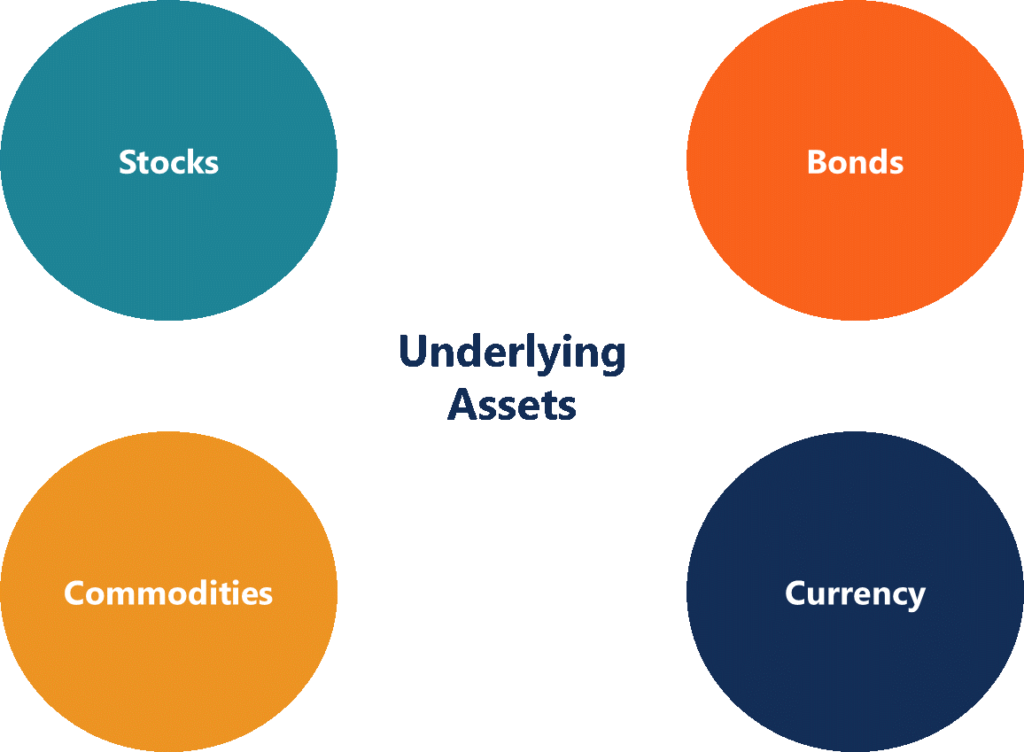
- Underlying assets include stocks, bonds, commodities, interest rates, market indexes, and currencies.
- Different classes of underlying assets and their financial derivatives are subject to different kinds of investment risk.
Types of Underlying Assets
There are different types, or classes, of underlying assets, and they come with unique characteristics that, in turn, affect the nature and structure of the derivatives associated with each type of underlying asset.
For example, different underlying asset classes are subject to different types of financial risk. Stocks and commodities are subject to market riskMarket RiskMarket risk, also known as systematic risk, refers to the uncertainty associated with any investment decision. Price volatility often arises due to and general economic risk. Bonds and other debt instruments are subject to default risk, interest rate risk, and counterparty risk. Currencies are subject to interest rate risk and political risk.
Underlying Asset – Examples
One of the most well-known and widely traded financial derivative securities are stock options. Stock options are derivatives, whose value is based on the underlying asset – namely, the actual stock. For example, a call option on a stock confers on the buyer the right to purchase the stock at a specified price (the strike price of the option) up to the point in time when the option expires.
Obviously, the value and price of an option depends upon the price of the actual stock. For a stock trading at $60 per share, a call option on the stock with a strike price of $50 will be worth a minimum of $10 per share, since the call option gives the option holder the right to purchase a $60 stock for only $50.
Stocks, bonds, commodities (such as gold, oil, or cotton), interest rates, market indexes, and currencies are underlying assets that influenced the creation of many financial derivatives. Among the most popular financial derivatives are – in addition to options – forward contracts, credit default swaps (CDS)Credit Default SwapA credit default swap (CDS) is a type of credit derivative that provides the buyer with protection against default and other risks. The buyer of a CDS makes periodic payments to the seller until the credit maturity date. In the agreement, the seller commits that, if the debt issuer defaults, the seller will pay the buyer all premiums and interest, and collateralized debt obligations (CDO).
Financial derivatives are commonly used as vehicles for risk management in investing. For example, an investor who owns a number of shares of a given stock may choose to hedge his investment in the underlying asset – the stock – with the use of derivative options on the stock.
The concept of underlying assets is important to investment speculators who may seek profits from arbitrage trading of underlying assets and derivatives – that is, making trades designed to generate a profit from temporary market discrepancies between the price of an underlying asset and the price of a derivative based on that asset.
Locks and Options
Financial derivatives are commonly classified as being either a “lock derivative” or an “option derivative.” A lock derivative, such as a forward contract, effectively locks in obligations of the respective parties that create and agree to the contract. That is, once the contract is made, the parties to it are bound to abide by its terms for the duration of the contract.
For example, if two parties create a currency forward contract, they are obligated to abide by the currency exchange rate specified in the contract, regardless of any fluctuations in the exchange rate that may occur in the cash markets while the contract is in effect.
In contrast, an option derivative, such as a stock option or commodity option, gives the option holder the right to execute a market transaction if they so desire, but they are not obligated to exercise that right – they are not “locked in” to doing a certain deal like the parties to a forward contract are.
Learn More
CFI offers the Capital Markets & Securities Analyst (CMSA)Program Page - CMSAEnroll in CFI's CMSA® program and become a certified Capital Markets &Securities Analyst. Advance your career with our certification programs and courses.™ certification program for those looking to take their careers to the next level. To keep learning and developing your knowledge base, please explore the additional relevant resources below:
- Capital MarketsCapital MarketsCapital markets are the exchange system platform that transfers capital from investors who want to employ their excess capital to businesses
- Currency ForwardCurrency ForwardA currency forward is a customized, written contract between parties that sets a fixed foreign currency exchange rate for a transaction
- Interest Rate RiskInterest Rate RiskInterest rate risk is the probability of a decline in the value of an asset resulting from unexpected fluctuations in interest rates. Interest rate risk is mostly associated with fixed-income assets (e.g., bonds) rather than with equity investments.
- Spot MarketSpot MarketA spot market is a financial market where financial instruments and commodities are traded for instantaneous delivery. Delivery refers to the
-

Understanding Guarantees: Protecting Lenders and Borrowers
A guarantee is a legal promise made by a third party (guarantor) to cover a borrower’s debt or other types of liability in case of the borrower’s defaultDebt DefaultA debt default happens
-

MiFID II Explained: A Comprehensive Guide for Investors
MiFID II is the revision of the Markets in Financial Instruments Directive (MiFID), originally published in 2004. It is the foundation of financial legislation for the European UnionEconomic UnionAn e
invest
- Understanding Financial Hardship: Causes, Impacts & Relief
- Understanding Auditors: Roles, Responsibilities & Audit Processes
- EBITDARM Explained: A Comprehensive Guide to Financial Analysis
- Eurocurrency Explained: What It Is & How It Works
- Factset: Financial Data & Analytics Solutions for Investment Professionals
- Understanding Finance: A Comprehensive Overview of Key Concepts
- Securities Explained: Types, Categories & Trading in the US
- Understanding Financial Exposure: Investment Risk & Potential Losses
- Asset Disposal: Definition, Types & Financial Statement Impact
-
 Comprehensive Financial Planning: Your Path to Financial Security
A financial plan is a document that covers an individual’s current financial situation, short-term and long-term economic goals, and an in-depth strategy to achieve the goals. A finan...
-
 Understanding Financial Systems: Institutions & Key Players
A financial system is a network of financial institutions – such as insurance companies, stock exchanges, and investment banksList of Top Investment BanksList of the top 100 investment banks in ...