
Micro-Investing Platforms: A Beginner's Guide to Small Investments
A micro-investing platform is an application that eases the process of investment by enabling users to save and invest small amounts of money periodically. Micro-investing platforms are different from conventional investment schemes in the sense that there is no minimum limit on the amount that can be saved. Also, they charge nominal brokerage and subscription fees, unlike conventional investment schemes.

Summary
- A micro-investing platform is an application that eases the process of investment by enabling users to save and invest small amounts of money periodically.
- Some of the micro-investing apps allow fractional investing, that is, buying a fraction of a share. Others require the user to link their bank account or debit card. Thereafter, the app rounds off each purchase made into the next highest integer and diverts the spare change to the user’s investment fund.
- Micro-investing platforms offer easy and profitable investment to users who lack knowledge of financial markets, as well as inculcate saving habits among people.
How Does Micro-Investing Platform Work
There are numerous apps that provide micro-investing services, but each works differently than the others. However, there are two broad ways in which they function. Some of the apps allow fractional investing, that is, buying a fraction of a share.
The stock market does not allow fractional investing, but the apps purchase an entire share and divide it into fragments for their users. With the money that they’ve saved, people can buy fractional shares in case they cannot afford an entire share.
Other apps require the user to link their bank accountSavings AccountA savings account is a typical account at a bank or a credit union that allows an individual to deposit, secure, or withdraw money when the need arises. A savings account usually pays some interest on deposits, although the rate is quite low. or debit card. Thereafter, the app rounds off each purchase made into the next highest integer and diverts the spare change to the user’s investment fund.
For example, let’s assume that Person A linked their debit card with a micro-investing app. Every morning, they buy coffee worth $2.50 from a cafe. When their card is swiped in the machine, $3 is deducted from their bank account. The remaining 50 cents are automatically deposited in their investment fund. The amount is quite small, but over a period of time, the regular deposits will add up to a considerable sum.
Benefits of Micro-Investing Platforms
Traditional investing platforms, like fixed deposit schemes or stock markets, impose certain conditions on their users, such as establishing a minimum amount for a deposit to start with or stipulating regular additions of fixed sums of money into the scheme. However, not everyone can afford to do so.
Lower-income individuals or people with irregular incomes who cannot put together $100 at a time need a convenient alternative method of saving. Micro-investing platforms allow users to build their savings without worrying about raising large amounts. It offers the following benefits to users:
1. Inculcating a saving habit
Setting aside a couple of dollars every other day or letting a few extra cents debited from one’s bank account is not a major expenditure. However, over a prolonged period, it can add up to a considerable sum. It develops a lifelong saving habit in people without making thrift a compulsion.
2. Convenience
Money can be saved at the click of a button. There is no need to fill out long forms, open Demat accounts, or follow any other lengthy process associated with conventional platforms.
3. Affordable
One does not need a strong cash balance or valuable assets to start a savings account. Daily or bi-weekly deposits of spare change are all that is required for one to build up a steady saving.
4. Ease of investment
Since the entire process of saving and investing is automated, the money that users save is automatically invested in diversified stock portfolios that offer a good rate of return. Users do not need any prior knowledge of financial markets and investment techniques.
Micro-investing is specially targeted towards technology-driven youth who wish to accumulate steady savings but lack the funds to do so. The applications gained more popularity after the Global Financial Crisis of 20082008-2009 Global Financial CrisisThe Global Financial Crisis of 2008-2009 refers to the massive financial crisis the world faced from 2008 to 2009. The financial crisis took its toll on individuals and institutions around the globe, with millions of American being deeply impacted. Financial institutions started to sink, many were absorbed by larger entities, and the US Government was forced to offer bailouts when people lost all trust in the stock market.
Calculating Returns
Investing in small amounts over several years builds up a substantial sum of money, but the returns gained from micro-investing must be weighed against its related costs.
An individual can choose between two options when investing money. The first option is to save $10 monthly on a micro-investing platform that charges a $1 monthly subscription fee. The money collected at the end of the year is then invested in a portfolio that offers a 4% return per annum.
The second option is to deposit $120 in a fixed deposit scheme for one year with a one-time charge of $6 and a rate of returnRate of ReturnThe Rate of Return (ROR) is the gain or loss of an investment over a period of time copmared to the initial cost of the investment expressed as a percentage. This guide teaches the most common formulas of 5% per annum. Calculating the amount of his savings after one year:
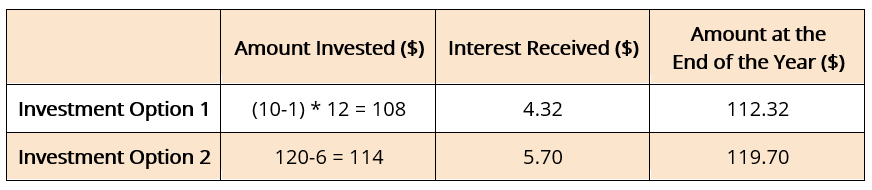
In fact, for persons who wish to build a substantial investment, micro-investing is probably not the best option. Although it does build up considerable savings in the long term, after accounting for inflationInflationInflation is an economic concept that refers to increases in the price level of goods over a set period of time. The rise in the price level signifies that the currency in a given economy loses purchasing power (i.e., less can be bought with the same amount of money). and other costs, the value of the savings in the future declines considerably.
In such a case, it would be more profitable for the person to save a large sum of money and deposit it in a traditional fixed deposit account. It need not always be the case, but whenever one is considering between two investment options, it is always better to calculate the net returns.
Related Readings
CFI offers the Commercial Banking & Credit Analyst (CBCA)™Program Page - CBCAGet CFI's CBCA™ certification and become a Commercial Banking & Credit Analyst. Enroll and advance your career with our certification programs and courses. certification program for those looking to take their careers to the next level. To keep learning and advancing your career, the following resources will be helpful:
- Personal FinancePersonal FinancePersonal finance is the process of planning and managing personal financial activities such as income generation, spending, saving, investing, and protection. The process of managing one’s personal finances can be summarized in a budget or financial plan.
- Checking Accounts vs. Savings AccountsChecking Accounts vs Savings AccountsA bank client can choose to open checking accounts vs savings accounts depending on several factors, such as purpose, ease of access, or other attributes. A checking account is a type of bank account that is used for everyday transactions. It is the most basic account that banks, credit unions, and small lenders offer.
- Return on Investment (ROI)Return on Investment (ROI)Return on Investment (ROI) is a performance measure used to evaluate the returns of an investment or compare efficiency of different investments.
- Investing: A Beginner’s GuideInvesting: A Beginner's GuideCFI's Investing for Beginners guide will teach you the basics of investing and how to get started. Learn about different strategies and techniques for trading
-
Trading Platforms: A Comprehensive Guide for Beginners
A trading platform is an online trading system that uses computer software to execute trades in a networked environment. Trading platforms can be utilized for free or at a discount, depending on the f
-

Understanding Return on Investment (ROI): A Comprehensive Guide
Before you invest your money, there is likely one big question on your mind: How much are you going to earn? This is known as the rate of return.The rate of return is expressed as a percentage of the
invest
- Understanding Investments: A Beginner's Guide to Growth & Income
- Annual Return: Definition, Calculation & Understanding
- Understanding Drawdowns: A Key Investment Risk
- Understanding Investment Horizon: A Comprehensive Guide
- Brownfield Investment: Definition, Benefits & Examples
- Greenfield Investment: Definition, Advantages & Examples
- Investment Trusts Explained: A Comprehensive Guide
- Hedging Explained: Protect Your Investments from Risk
- Understanding Investment Alpha: A Guide for Investors
-
 Portfolio Planning: A Comprehensive Guide to Investment Strategies
Portfolio planning is the process of strategizing the construction of an investment portfolio. The investment portfolio should be encompassing of the investor’s risk toleranceRisk ToleranceRisk ...
-
 Timberland Investment: A Guide to Growing Wealth with Trees
Timberland refers to an alternative form of investment that involves putting money into trees, either in managed tree plantations or natural forests. Investors bank on the predictable biological growt...