
Business Model Canvas: A Strategic Planning Tool Explained
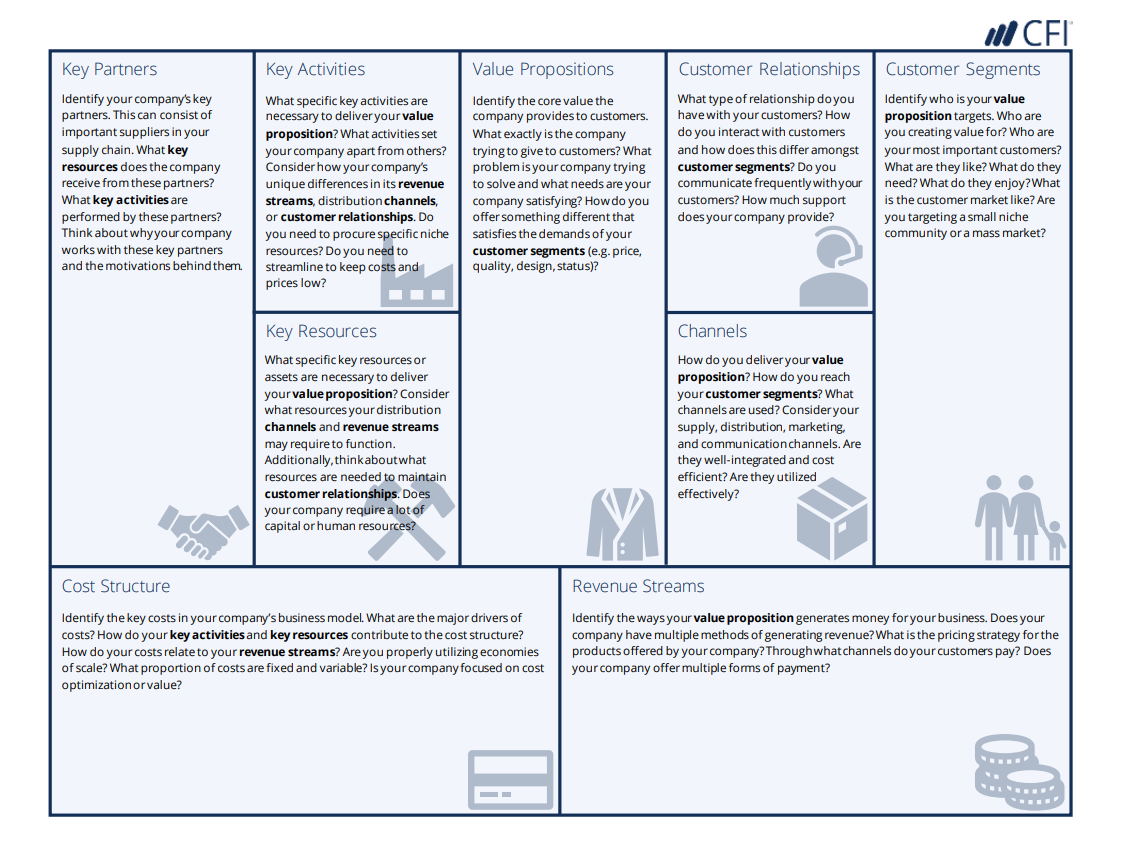
The business model canvas is a strategic planning Strategic PlanningStrategic planning is the art of formulating business strategies, implementing them, and evaluating their impact on organizational objectives. The concepttool used by managers to illustrate and develop their business model. The business model canvas template clearly identifies the key elements that make up a business. Additionally, it simplifies a business plan into a condensed form. In this way, the business model canvas template acts like an executive summaryExecutive SummaryAn executive summary is the first section of a business plan or proposal that provides a brief overview of a document and contains its main points. for the business plan.
Corporate Finance Institute®’s Corporate & Business Strategy Course has more tools that you can use to manage and improve your business!
Download the Free Template
Enter your name and email in the form below and download the free template now!
History of the Business Model Canvas
The business model canvas template was originally introduced by Alexander Osterwalder in his 2004 thesis, “The Business Model Ontology – A Proposition in a Design Science Approach”. Since then, the business model canvas template has been taught at business schools and iterated upon to fit more niche businesses.
Structure of the Business Model Canvas Template
There are nine main building blocks in the business model canvas template:
- Key Partners
- Key Activities
- Key Resources
- Value Propositions
- Customer Relationships
- Channels
- Customer Segments
- Cost Structure
- Revenue Streams
The following is a breakdown of each of these nine elements. These elements all link and work with each other to ensure the success of the business.
#1. Key Partners
Key partners are the companies or people your business works with to create a strategic relationship. A few examples of key partners are suppliers or distribution partners in the supply chainSupply ChainSupply chain is the entire system of producing and delivering a product or service, from the very beginning stage of sourcing the raw materials to the final.
Here are a few things to consider about key partners:
- What key resources does your company receive from these partners?
- What key activities are performed by these partners?
- What is your company’s motivation for working with these key partners? Is there something specific that only they can provide? Do they help lower costs?
#2. Key Activities
Key activities are specific activities or tasks that are fundamental to the operation of your business. An example of a key activity would be the procurementProcurementIn business, procurement is the process of searching for, negotiation, and purchasing good and/or services from suppliers. The procurement process of fresh produce in bulk for a restaurant.
Here are a few things to consider about key activities:
- What key activities are necessary to deliver your value proposition?
- What activities set your company apart from others?
- How do your revenue streams, distribution channels, and customer relationships differ from competitors? How do your key activities affect these?
- Do you need to procure specific niche resources?
- Do you need to streamline to keep costs and prices low?
#3. Key Resources
Key resources are the assets necessary to operate and deliver your value proposition. For example, a diamond mining company cannot operate without mining equipmentPP&E (Property, Plant and Equipment)PP&E (Property, Plant, and Equipment) is one of the core non-current assets found on the balance sheet. PP&E is impacted by Capex,. Alternatively, an automotive company cannot operate without the human capitalCapitalCapital is anything that increases one’s ability to generate value. It can be used to increase value across a wide range of categories, such as financial, social, physical, intellectual, etc. In business and economics, the two most common types of capital are financial and human. and expertise that goes into designing cars.
Here are a few things to consider about key resources:
- What specific assets are necessary to operate your business and deliver your value proposition?
- What resources do your distribution channels and revenue streams need to function?
- What resources are needed to maintain customer relationships and customer satisfactionCustomer SatisfactionCustomer satisfaction is the degree to which products or services provided by a company meet a customer’s expectations - how satisfied a customer is after?
- Does your company require significant capital or human resources?
#4. Value Propositions
Value propositionsValue PropositionValue proposition is a promise of value stated by a company that summarizes the benefit(s) of the company’s product or service and how they are delivered are arguably the most important element of the business model canvas template. The value proposition determines the fundamental offering the company is trying to give its customers. It is the primary driver of business operations. For example, Spotify’s value proposition, “Music for everyone.”, eloquently states its missionMission & ValuesCFI's mission is to help anyone become a world-class financial analyst. Learn more about Corporate Finance Institute's mission, vision, values and culture and offering. Spotify wants to be a music streaming platform that has music selections for everyone.
Here are a few things to consider about value propositions:
- What exactly is your company trying to give to customers?
- What problem is your company trying to solve and what needs are your company satisfying?
- How do you offer something different that satisfies the demandsLaw of DemandThe law of demand states that the quantity demanded of a good shows an inverse relationship with the price of a good when other factors are of your customer segments (e.g. price, quality, design, status, etc.)?
#5. Customer Relationships
Customer relationships are the different types of interactions a company has with its customers. For example, a designer suit company will provide significant help for the customer, tailoring to their needs and working directly with them to create the suit they want. Conversely, telecommunications companies often have poor reputations and customer relationships as many practice aggressive and predatory sales practices through their call centers. Compared to telecommunications companies, the designer suit company has significantly richer and more fulfilling customer relationships.
Here are a few things to consider about customer relationships:
- What type of relationship does your company have with its customers? For example, do you provide dedicated assistance or are they expected to self-serve their needs through provided support channels?
- How does the business interact with customers and how does this differ between customer segments?
- Does your company frequently communicate with customers?
- How much support is provided by your company?
#6. Channels
Channels are the different structures and methods that are used to deliver your company’s product and value proposition to its customers. Channels encompass all of a company’s supply, distribution, and marketing channels. It is important to consider all channels of a company and make sure they are functioning cohesively. For example, a company like Amazon needs to consider how its fulfillment centers and shipping services are integrated to send out timely shipments.
Here are a few things to consider about channels:
- How do you deliver your value proposition?
- How do you reach your customer segments? What channels are used?
- Are your supply, distribution, marketing, and communication channels well-integrated and cost-efficient? Are they being utilized effectively?
#7. Customer Segments
Customer Segments are the different types of customers that a company manages. A company that produces different products will need to interact with different types of customers.
An example of this would be airline companies. Airlines offer tickets for economy, business, and first-class customers. First-class passengers have access to exclusive benefits and luxury travel arrangements. Conversely, economy passengers are provided much less support, thus costing less, but also coming in significantly larger amounts.
Here are a few things to consider about customer segments:
- Who is the main focus of your value proposition? Who are you creating value for?
- Who are your most important customers? What are they like? What do they need? What do they enjoy?
- What are your different types of customersTypes of CustomersCustomers play a significant role in any business. By better understanding the different types of customers, businesses can be better equipped to develop?
- What is the customer market like? Is your company targeting a small niche community or a mass market?
#8. Cost Structure
The cost structureCost StructureCost structure refers to the types of expenses that a business incurs, and is typically composed of fixed and variable costs. Fixed costs remain unchanged refers to how a company spends money on operations. It consists of the company’s key costs and the company’s level of focus on costs. If a company is cost-driven, it focuses on minimizing costs and, thus, prices for customers. Alternatively, if a company is value-driven, it focuses on creating value for its customers, with less focus on cost.
An example of this would be a comparison between fashion retailers, Forever 21 and Gucci. Forever 21 is a fast-fashion company focused on delivering the newest styles at low costs – a cost-driven company. Alternatively, Gucci is a luxury brand focused on delivering high-quality clothes and accessories designed with the latest trends in the fashion industry – a value-driven company.
Here are a few things to consider about cost structure:
- What are the key costs in your company’s business model
- What are the major drivers of costCost DriverA cost driver is the direct cause of a cost, and its effect is on the total cost incurred. For example, if you are to determine the amount of electricity consumed in a particular period, the number of units consumed determines the total bill for electricity. In such a scenario, the units of electricity consumed?
- How do your key activities and key resources contribute to the cost structure?
- How do your costs relate to your revenue streams?
- Is your company properly utilizing economies of scaleEconomies of ScaleEconomies of scale refer to the cost advantage experienced by a firm when it increases its level of output.The advantage arises due to the?
- What proportion of costs are fixed and variableFixed and Variable CostsCost is something that can be classified in several ways depending on its nature. One of the most popular methods is classification according?
- Is your company focused on cost-optimization or value?
Check out CFI’s course on Budgeting and Forecasting Course to learn more about estimating future cash flows, revenues, and expenses!
#9. Revenue Streams
Revenue streamsRevenue StreamsRevenue Streams are the various sources from which a business earns money from the sale of goods or provision of services. The types of are a company’s source of cash flowsOperating Cash FlowOperating Cash Flow (OCF) is the amount of cash generated by the regular operating activities of a business in a specific time period.. They are the final element of the business model canvas template. Revenue streams are the different ways your company’s value proposition generates money. A company might have multiple revenue streams. For example, Apple has multiple revenue streams between its variety of products and its services, such as Apple Music.
Here are a few things to consider about revenue streams:
- Does your company have multiple methods of generating revenueRevenueRevenue is the value of all sales of goods and services recognized by a company in a period. Revenue (also referred to as Sales or Income)?
- What is the pricing strategy for the products offered by your company?
- Through what channels do your customers pay?
- Does your company offer multiple forms of payment (up-front, payment plans, financing, etc.)?
Example of a Business Model Canvas
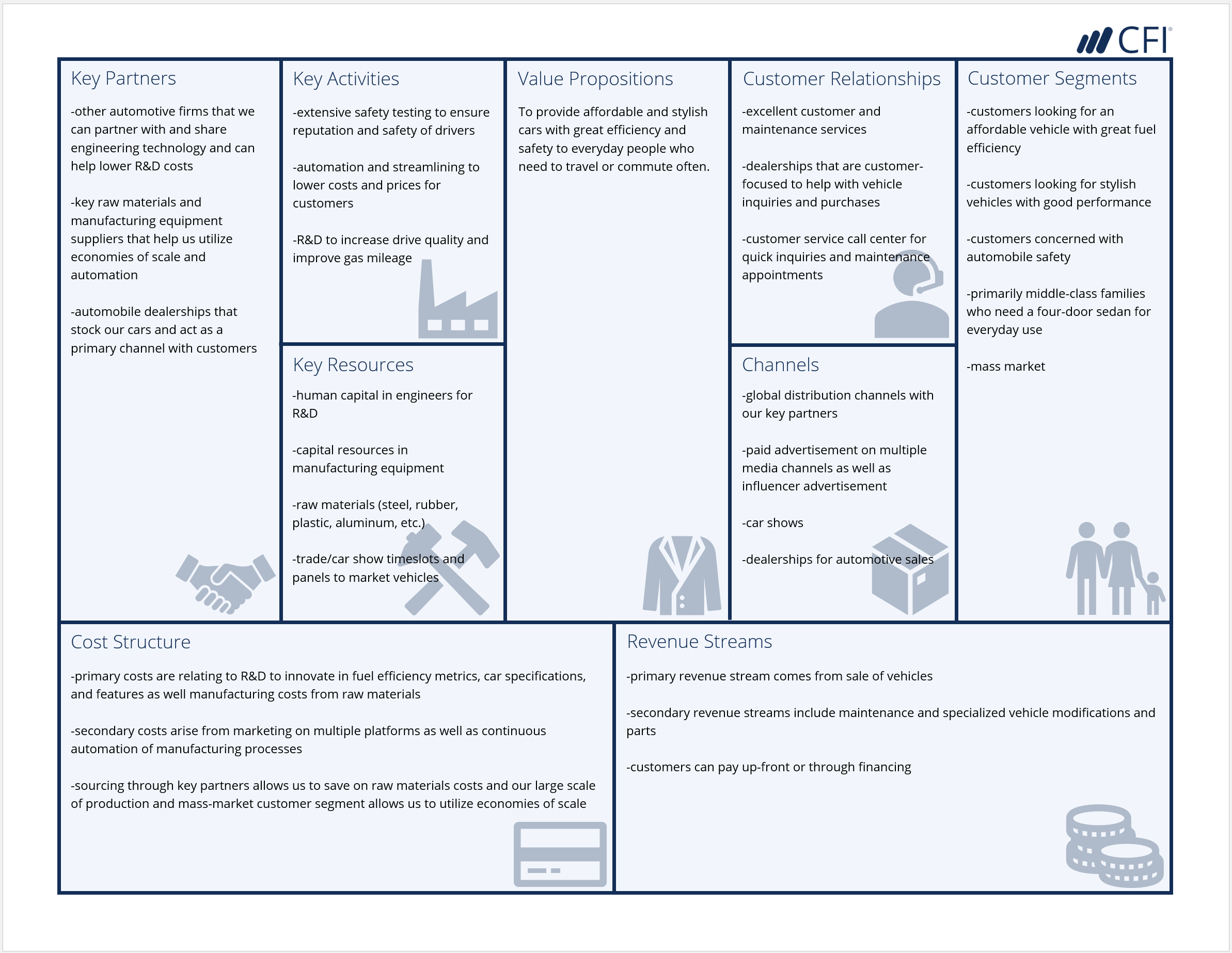
Here is a simple example built for an automotive company using our business model canvas template!
Download the Free Template
Enter your name and email in the form below and download the free template now!
Additional Resources
Proper financial management is the backbone of any business. Corporate Finance Institute has resources that will help you expand your knowledge, advance your career, and manage the financials of your company! Check out the helpful CFI resources below:
- Financial Modeling & Valuation Analyst (FMVA)® Certification ProgramBecome a Certified Financial Modeling & Valuation Analyst (FMVA)®CFI's Financial Modeling and Valuation Analyst (FMVA)® certification will help you gain the confidence you need in your finance career. Enroll today!
- Corporate & Business Strategy
- Budgeting and Forecasting
- Three Financial Statements SummaryThree Financial StatementsThe three financial statements are the income statement, the balance sheet, and the statement of cash flows. These three core statements are
-
Understanding the Business Life Cycle: Stages & Metrics
The business life cycle is the progression of a business in phases over time and is most commonly divided into five stages: launch, growth, shake-out, maturity, and decline. The cycle is shown on a gr
-
Choosing the Right Organizational Structure for Your Business
Organizational structures are essentially blueprints that reveal how companies are run and managed and how information is passed within the organization. An organizational structure is literally a cha
Business strategy
- Business Visibility: Forecasting Performance & Driving Success
- Black-Scholes Model: Understanding Stock Option Pricing
- Understanding the Heath-Jarrow-Morton (HJM) Interest Rate Model
- Heston Model: Understanding Volatility in Financial Options
- Understanding the Chart of Accounts: A Comprehensive Guide
- Business Model Canvas Examples & Templates for Strategic Planning
- Business Strategy vs. Business Model: Understanding the Difference
- Hax's Delta Model: A Strategic Framework for Business Success
- McKinsey 7S Model: Understanding Organizational Effectiveness
-
 Understanding Business Structures: A Comprehensive Guide
Business structure refers to the legal structure of an organization that is recognized in a given jurisdiction. An organization’s legal structure is a key determinant of the activities that it c...
-
 Understanding Business Entities: Types & Legal Structures
An entity is an organization created by one or more individuals to carry out the functions of a business, and that maintains a separate legal existence for tax purposesAccounting For Income TaxesIncom...