
Understanding Public Companies: A Comprehensive Guide
Public companies are entities that trade their stocks on the public exchange market. Investors can become shareholders in a public company by purchasing shares of the company’s stock. The company is considered public since any interested investor can purchase shares of the company in the public exchange to become equity owners.
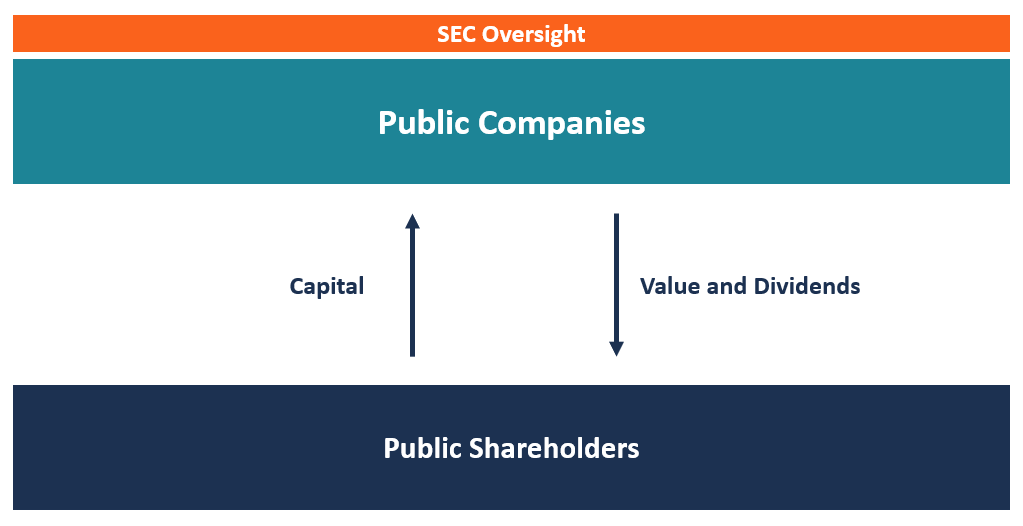
A public company is required to hold an annual general meeting (AGM) where shareholders vote to elect new members to the board of directorsBoard of DirectorsA board of directors is a panel of people elected to represent shareholders. Every public company is required to install a board of directors., debate policies, and formulate new policies, goals, and rules that will guide the operations of the company. The shareholders are entitled to a share of the profits generated by the company, and profits are distributed according to the number of shares that each shareholder owns.
A high proportion of public companies started as private companies, and they went public as a way of gaining access to a wider pool of funds to finance their projects or business operations. The process of becoming a public company involves going through an Initial Public Offering (IPO)Initial Public Offering (IPO)An Initial Public Offering (IPO) is the first sale of stocks issued by a company to the public. Prior to an IPO, a company is considered a private company, usually with a small number of investors (founders, friends, family, and business investors such as venture capitalists or angel investors). Learn what an IPO is. The IPO must be approved by the Securities and Exchange Commission (SEC) and meet all regulatory requirements. The purpose of an IPO is to create funds for the issuing company by selling stock to the public.
Advantages
1. Ability to raise funds by selling stock
One of the advantages that public companies enjoy is the ability to raise funds through the sale of the company’s stock to the public. Before becoming public, it is difficult to obtain large amounts of capital, other than through borrowing, to finance operations and new product offerings. A private entity can only get financing by reinvesting its profits, taking out a loan, or getting investments from a few wealthy individuals, who may not provide adequate capital to meet the company’s financial needs.
Public companies can raise funds in the primary and secondary marketsSecondary MarketThe secondary market is where investors buy and sell securities from other investors. Examples: New York Stock Exchange (NYSE), London Stock Exchange (LSE). by allowing the investing public to purchase shares of the company. The ability to raise large amounts of capital in public exchanges enables public companies to carry out capital-intensive activities. In return, the shareholders benefit from capital gains of stocks, as well as from dividend payments.
2. Availability of financial information
Public companies are required to file quarterly and annual financial statements and other mandatory documents with the SEC. The requirement allows shareholders, financial media, interested investors, and financial analysts to get access to additional information about the company.
The availability of financial information about the company makes it easier for analysts to calculate the valuation of the company. In contrast, private companies are not subject to legal requirements to make their financial reports public. Public companies are motivated to meet the disclosure requirements as a way of disseminating information about their financial performance and the future of the company to both current shareholders and potential investors.
Disadvantages of Public Companies
1. Increased government and regulatory scrutiny
Public companies are vulnerable to increased scrutiny from the government, regulatory agencies, and the public. The company must meet various mandatory reporting standards that are set by government entities such as the SEC and the IRS.
2. Strict adherence to global accounting standards
They must also prepare their financial reports in accordance with the Generally Accepted Accounting Principles (GAAP) or International Financial Reporting Standards (IFRS). Shareholders are also entitled to key documents on the business activities of the company.
How Companies Become Public
The main process of becoming a public company is by selling stocks to the public through an IPO. Going into an IPO process is a complicated endeavor and the issuing company is required to hire an experienced investment bank to underwrite the issue. The success of the IPO will depend largely on the competency of the investment bank, and the issuer should consider factors such as industry expertise, reputation, and distribution when hiring an underwriter.
Here are some of the important steps involved when issuing an IPO:
1. Due diligence
The investment bank, the issuing company, and other advisors are required to conduct due diligence to determine the sustainability of the company’s business model. Due diligence focuses on financial, legal, commercial, operational, and tax areas to assess potential opportunities and risks. The due diligence investigation assures investors that the issuer’s registration statement is accurate and that it is based on actual market and competitor analysis.
2. Prospectus
The prospectus is prepared by the lead bank and includes information about the business, such as financial performance and expected future performance. The prospectus may be issued in two phases. A preliminary prospectus is often used to determine the acceptability of the company’s stocks to the public. It does not disclose the number or price of shares to be issued.
The final prospectus is filed with the SEC alongside other mandatory documents required, and it provides complete information about the offering and the number of stocks or certificates to be issued to investors. The prospectus helps investors get an understanding of the business and transaction, and helps them make an informed decision.
3. SEC approval
Once the SEC is satisfied that the issuing company has met all the requirements of the IPO, the underwriter and the issuing company agree on the issue date. The two parties are also required to agree on the offer price before the effective day of the issue, which is the price at which shares of stock will be initially sold to the public. Most often, IPOs are underpriced to ensure that all the shares offered to the public are sold or oversubscribed.
Additional Resources
CFI offers the Financial Modeling & Valuation Analyst (FMVA)Become a Certified Financial Modeling & Valuation Analyst (FMVA)®CFI's Financial Modeling and Valuation Analyst (FMVA)® certification will help you gain the confidence you need in your finance career. Enroll today!™ certification program for those looking to take their careers to the next level. To keep learning and advancing your career, the following CFI resources will be helpful:
- Analysis of Financial StatementsAnalysis of Financial StatementsHow to perform Analysis of Financial Statements. This guide will teach you to perform financial statement analysis of the income statement,
- Common StockCommon StockCommon stock is a type of security that represents ownership of equity in a company. There are other terms – such as common share, ordinary share, or voting share – that are equivalent to common stock.
- IFRS vs US GAAPIFRS vs. US GAAPThe IFRS vs US GAAP refers to two accounting standards and principles adhered to by countries in the world in relation to financial reporting
- Private vs Public CompanyPrivate vs Public CompanyThe main difference between a private vs public company is that the shares of a public company are traded on a stock exchange, while a private company's shares are not.
-

Understanding Dissenters' Rights: Protecting Shareholder Value
Dissenters’ rights – part of a state’s business law – enable a company’s shareholders to get cash payments equivalent to the fair value of the shares he/she is holding in
-

Dual-Class Stock Structures: Understanding Voting Rights & Dividends
Dual-class stocks refer to a stock offering structure within a company. A dual-class structure means that a company offers two types (or classes) of stocks. The purpose of offering class A
finance
- Authorized Shares: Understanding a Company's Issuance Limit
- Cash Reserves: Definition, Benefits & Short-Term Needs
- Understanding Company Bylaws: A Comprehensive Guide
- Understanding Earnings: A Guide to Financial Profitability
- Understanding Metal Royalties and Streaming: A Mining Industry Overview
- Understanding Private Companies: Ownership, Structure, and Types
- Private vs. Public Company: Key Differences Explained
- Understanding Affiliated Companies: Definition & Key Differences
- Understanding Associate Companies: Definition & Ownership
-
 Activity Ratios: A Comprehensive Guide to Operational Efficiency
Activity ratios are financial metrics used to gauge how efficient a company’s operations are. The term can include several ratios that can apply to how efficiently a company is employing its cap...
-
 Understanding Voting Shares: Your Right to Participate in Company Decisions
Voting shares are shares of a company that entitle the shareholder to vote on key issues of the company. It is generally one vote per share. The shares represent an ownership interest in a corporation...