
Portfolio Diversification: Reduce Risk & Enhance Returns
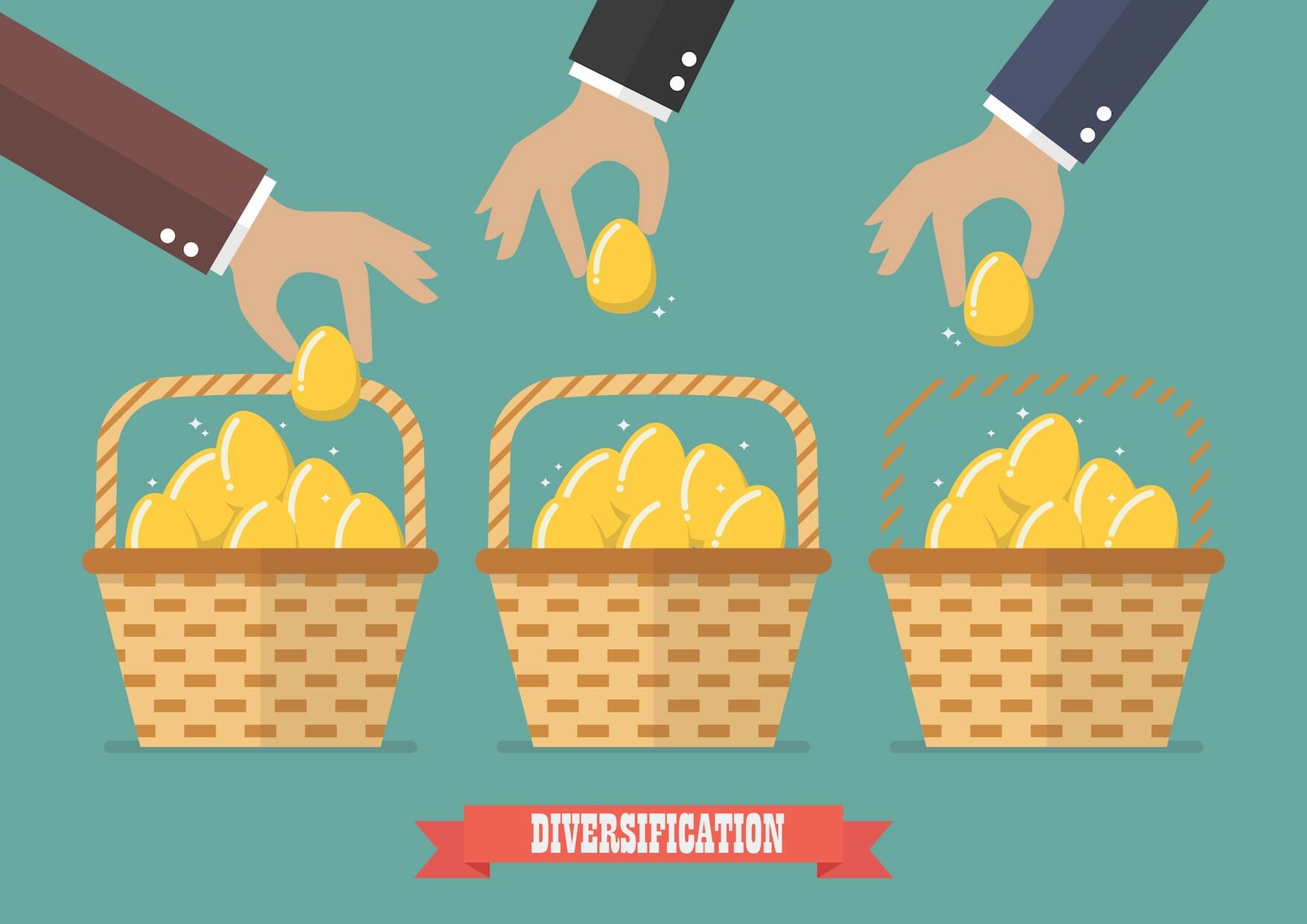
Diversification is a technique of allocating portfolio resources or capital to a mix of different investments. The ultimate goal of diversification is to reduce the volatilityVIXThe Chicago Board Options Exchange (CBOE) created the VIX (CBOE Volatility Index) to measure the 30-day expected volatility of the US stock market, sometimes called the "fear index". The VIX is based on the prices of options on the S&P 500 Index of the portfolio by offsetting losses in one asset classTypes of AssetsCommon types of assets include current, non-current, physical, intangible, operating, and non-operating. Correctly identifying and with gains in another asset class. A phrase commonly associated with diversification: “Do not put all your eggs in one basket.”
Having “eggs” in multiple baskets mitigates risk, as if one basket breaks, not all eggs are lost.
Diversification and Unsystematic Risk
Diversification is primarily used to eliminate or smooth unsystematic risk. Unsystematic riskSystemic RiskSystemic risk can be defined as the risk associated with the collapse or failure of a company, industry, financial institution or an entire economy. It is the risk of a major failure of a financial system, whereby a crisis occurs when providers of capital lose trust in the users of capital is a firm-specific risk that affects only one company or a small group of companies. Therefore, when a portfolio is well-diversified, investments with a strong performance compensate for the negative results from poorly performing investments.
However, diversification does not usually affect the inherent or systematic risk that applies to the financial markets as a whole.
One way to think about the two basic types of risk is that one refers to the specific risks of an industry or individual firm, while the other refers to risk factors in the overall economy. Unsystematic risks can usually be controlled or mitigated, but systematic risk involves fundamental economic factors that are largely outside of any one individual company’s power to control.
Learn more about Systematic and Unsystematic Risk on CFI’s CAPM pageFinanceCFI's Finance Articles are designed as self-study guides to learn important finance concepts online at your own pace. Browse hundreds of articles!
Portfolio Diversification
Portfolio diversification concerns the inclusion of different investment vehicles with a variety of features. The strategy of diversification requires balancing various investments that have only a slight positive correlation with each other – or better yet, actual negative correlation. Low correlation usually means that the prices of the investments are not likely to move in the same direction.
There is no consensus regarding the perfect amount of diversification. In theory, an investor may continue diversifying his/her portfolio virtually infinitely, as long as there are available investments in the market that are not correlated with other investments in the portfolio.
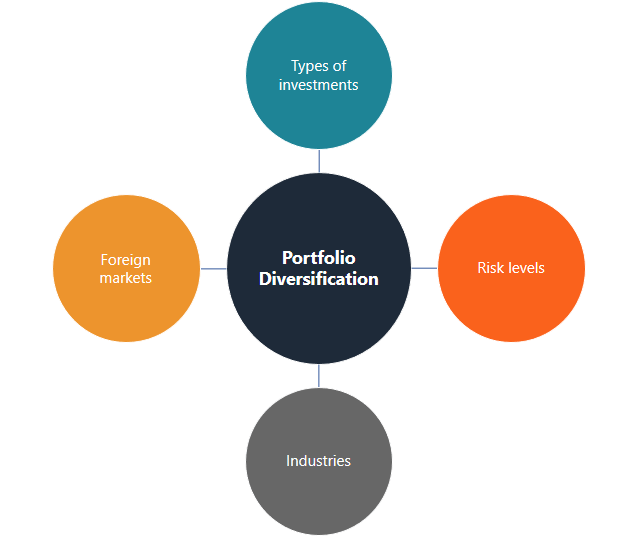
An investor should consider diversifying his/her portfolio based on the following specifications:
- Types of investments: Include different asset classes, such as cash, stocks, bonds, ETFsExchange Traded Fund (ETF)An Exchange Traded Fund (ETF) is a popular investment vehicle where portfolios can be more flexible and diversified across a broad range of all the available asset classes. Learn about various types of ETFs by reading this guide., options, etc.
- Risk levels: Investments with dissimilar levels of risk allow the smoothing of gains and losses.
- Industries: Invest in companies from distinct industries. The stocks of companies operating in different industries tend to show a lower correlation with each other.
- Foreign markets: An investor should not invest only in domestic markets. There is a high probability that the financial products traded in foreign markets are less correlated with products traded in the domestic markets.
Nowadays, index and mutual funds, as well as ETFs, provide individual investors with a simple and inexpensive instrument for creating a diversified investment portfolio.
Additional Resources
CFI offers the Financial Modeling & Valuation Analyst (FMVA)™Become a Certified Financial Modeling & Valuation Analyst (FMVA)®CFI's Financial Modeling and Valuation Analyst (FMVA)® certification will help you gain the confidence you need in your finance career. Enroll today! certification program for those looking to take their careers to the next level. To learn more about related topics, check out the following CFI resources:
- Corporate StrategyCorporate StrategyCorporate Strategy focuses on how to manage resources, risk and return across a firm, as opposed to looking at competitive advantages in business strategy
- Industry AnalysisIndustry AnalysisIndustry analysis is a market assessment tool used by businesses and analysts to understand the complexity of an industry. There are three commonly used and
- Market PositioningMarket PositioningMarket Positioning refers to the ability to influence consumer perception regarding a brand or product relative to competitors. The objective of market
- Strategic AlliancesStrategic AlliancesStrategic alliances are agreements between independent companies to cooperate in the manufacturing, development, or sale of products and services.
-
Understanding CAPM: A Comprehensive Guide to Capital Asset Pricing
The Capital Asset Pricing Model (CAPM) is a model that describes the relationship between the expected returnExpected ReturnThe expected return on an investment is the expected value of the proba
-

Understanding Credit Risk: Definition & Implications
Credit risk is the risk of loss that may occur from the failure of any party to abide by the terms and conditions of any financial contract, principally, the failure to make required payments on loans
Business strategy
- Understanding Risk Grades: An Investor's Guide
- Understanding Risk Preference: A Comprehensive Guide
- Understanding Operating Risk: A Key Component of Business Risk
- Understanding Financial Risk: A Comprehensive Guide
- Risk Shifting: Definition, Examples & Implications
- Understanding Currency Risk: A Comprehensive Guide
- Understanding Downside Risk: Protecting Your Investments
- Understanding Market Risk: A Comprehensive Guide
- Understanding Inherent Risk: A Key Concept in Risk Management
-
 Understanding Risk Acceptance: A Comprehensive Guide
Accepting risk is a concept where an individual or business identifies risk and renders it acceptable, thereby making no effort to reduce or mitigate it. The potential loss from the identified and acc...
-
 Understanding Business Risk: Threats & Mitigation
Business risk refers to a threat to the company’s ability to achieve its financial goalsEarnings GuidanceAn earnings guidance is the information provided by the management of a publicly traded c...