
Understanding Diversified Companies: Benefits & Strategies
A diversified company is a type of company that oversees several lines of business – most of them being unrelated to each other. Creating a diversified company is beneficial, as it provides several different product lines and customers, resulting in the company being shielded from any economic downswings or business fluctuations.

As there are multiple industries and exposures, shareholders can benefit from a diversification strategy and be protected from any negative exposure. However, it also limits the upside potential, as the presence of several businesses means playing safe and offsetting exposures.
Summary
- A diversified company is a type of company that oversees several lines of business – most of which are unrelated to each other.
- A company can diversify its operations by either acquiring another company or merging with a company with a different line of business.
- Related diversification involves diversifying into products or services where a company already runs an existing business or into businesses with some commonalities.
- Unrelated diversification occurs when a company merges or acquires another company without any commonalities.
Understanding Diversification
A company can diversify its operations by either acquiring another company or merging with a company with a different line of business. Typically, the merger process is very expensive, and the companies need to formulate a strong long-term strategy to ensure that the diversification is beneficial to the shareholders.
A common example of a diversified company is a conglomerateConglomerateA conglomerate is one very large corporation or company, composed of several combined companies, that is formed by either takeovers or mergers. In most cases, a conglomerate supplies a variety of goods and services that are not necessarily related to one another.. Conglomerates are fairly large companies that are made up of separate independent entities. They operate in multiple industries and are, at times, spread across different geographies. Such companies are called multinational conglomerates. The subsidiaries or independent components of the company report to the parent company of the conglomerate.
Types of Diversification
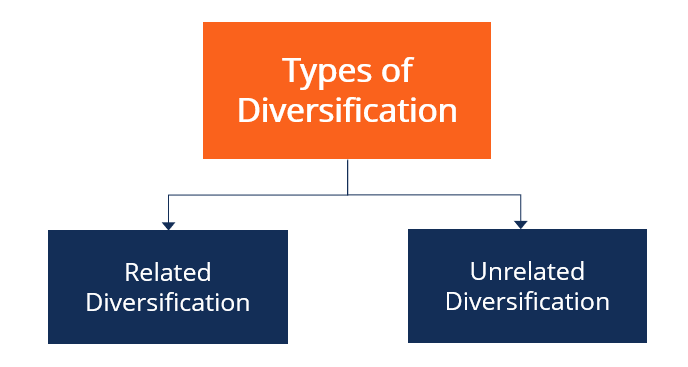
There are two main types of diversification – related and unrelated.
1. Related Diversification
Related diversification involves diversifying into products or services where a company already operates or into the businesses with some commonalities. This diversification is achieved to generate economies of scaleEconomies of ScaleEconomies of scale refer to the cost advantage experienced by a firm when it increases its level of output.The advantage arises due to the and benefit from shared resources and skills. Overall, such diversification should result in higher ROI, as revenues increase, and the companies are expected to achieve cost efficiency due to shared resources.
Examples of related diversification include horizontal and concentric diversification strategies. Horizontal diversification occurs when a company creates a new product for its existing customers. It allows the company to stick to its original customer base and try to increase its revenue per customer.
Concentric diversification occurs when a company introduces new and correlated products in a new market. An example would be a television cable company acquiring an internet company (both are related services).
2. Unrelated Diversification
Unrelated diversification occurs when a company merges or acquires another company without any commonalities. In such a situation, there is no overlap in markets, distribution channels, or production technology.
Typically, companies with extremely high cash flows go for unrelated diversification, and it is used to hedge the risk of the industry the company operates in. Conglomerates are good examples of unrelated diversification.
Strategies of a Diversified Company
A company adopts several strategic objectives as to why it plans to diversify its operations. Below, we will analyze certain strategies and objectives that diversified companies consider.
1. Attractiveness of Industries
The company needs to assess if the industries it is diversifying into are attractive in terms of market demand and revenues. Another factor to recognize is if all the industries that the company is exposed to demonstrate any overlap or complementarities or can provide adequate risk diversification from the different lines of business.
2. Strength of Business Units
A core strategy is to analyze how strong the individual business units are. It can be gauged by comparing relative market share, costs of the company, brand image and reputationBrand EquityIn marketing, brand equity refers to the value of a brand and is determined by the consumer’s perception of the brand. Brand equity can be positive or, and also through financial indicators, such as profitability.
3. Cross-Business Strategic Fit
A diversified company’s business units should be able to create value through a strategic fit. The diversified company can assess if it can create synergies within the entities by sharing or leveraging expertise from one business unit to the other (such as centralizing the HR and Finance functions to a company-level and using common suppliers for various units).
4. Fit of Company’s Resources
A company owns both financial and non-financial resources, and it is important to align the overall company on both factors. A company can classify its business units into various categories, such as cash cows (those that generate excess cash) and stars (self-supporting businesses). A business typically evolves through various stages in this category, so the company needs to examine how each unit is aligned with the resources available.
5. Allocation of Resources
Each business unit needs to be allocated certain resources based on its scale and performance. Factors that can be used to decide the allocation can include sales and profit growth, return on invested capitalROICROIC stands for Return on Invested Capital and is a profitability ratio that aims to measure the percentage return that a company earns on invested capital., and cash flow generated from the business. Most resources are channeled to units that perform the best on all the metrics.
6. New Strategic Moves
A company that is already diversified needs to constantly monitor its business units and look for further opportunities that can allow it to grow. While for some it may make sense to stick to existing business units, others may have to restructure their company or broaden diversification in case their initial strategy is not working well.
Related Readings
CFI is the official provider of the global Commercial Banking & Credit Analyst (CBCA)™Program Page - CBCAGet CFI's CBCA™ certification and become a Commercial Banking & Credit Analyst. Enroll and advance your career with our certification programs and courses. certification program, designed to help anyone become a world-class financial analyst. To keep advancing your career, the additional CFI resources below will be useful:
- Corporate StructureCorporate StructureCorporate structure refers to the organization of different departments or business units within a company. Depending on a company’s goals and the industry
- Multinational CorporationMultinational Corporation (MNC)A multinational corporation is a company that operates in its home country, as well as in other countries around the world. It maintains a
- Return on Investment (ROI)Return on Investment (ROI)Return on Investment (ROI) is a performance measure used to evaluate the returns of an investment or compare efficiency of different investments.
- SubsidiarySubsidiaryA subsidiary (sub) is a business entity or corporation that is fully owned or partially controlled by another company, termed as the parent, or holding, company. Ownership is determined by the percentage of shares held by the parent company, and that ownership stake must be at least 51%.
-

Understanding Vouchers: A Guide to Accounts Payable Documents
A voucher is an internal document within a company that is issued by the accounts payable Accounts PayableAccounts payable is a liability incurred when an organization receives goods or services from
-

Understanding Associate Companies: Definition & Ownership
An associate company, also known as an affiliate company, is a company in which a notable portion of shares is owned by a parent company. The portion usually lies between 20% and 50%. Ownership of hig
Business strategy
- Acquirer Definition: Understanding Corporate Acquisitions
- Understanding Clawbacks: Protecting Stakeholders from Failed Performance
- Portfolio Diversification: Reduce Risk & Enhance Returns
- Holding Companies: Definition, Purpose & How They Work
- Kaizen: Understanding Continuous Improvement for Business
- Outsourcing: A Comprehensive Guide to Benefits & Strategy
- What is Product Diversification?
- Ramp-Up: Definition, Benefits & How to Achieve It
- Streamlining Processes: Definition, Benefits & Techniques
-
 Goodwill in Accounting: Definition & Value
In accounting, goodwill is an intangible assetIntangible AssetsAccording to the IFRS, intangible assets are identifiable, non-monetary assets without physical substance. Like all assets, intangible as...
-
 OIBDA Explained: Understanding Operating Income Before Depreciation & Amortization
OIBDA is an abbreviation for Operating Income Before Depreciation and Amortization. It is a non-GAAP measure of the financial performance of a company during a specific period of time while excluding ...