
Disruptive Innovation: Definition, Examples & Impact
Disruptive innovation, also known as disruptive technologies, is a term that describes how a new product or firm starting initially with simple applications or offerings moves up the market relentlessly, replacing established firms, alliances, or products. Disruptive innovation alters the way existing companies do business and negatively impacts the companies that fail to adapt.

The established companies do innovate; however, the innovation is directed towards their most sophisticated and demanding market segmentsTotal Addressable Market (TAM)Total Addressable Market (TAM), also referred to as total available market, is the overall revenue opportunity that is available to a product or service if. The companies earn the highest profits by charging high prices in such segments. However, it provides opportunities for disruptive innovation aimed at the mass market.
Disruptive innovation also makes the products or services, which were historically available to wealthy or skilled consumers only, accessible to the wider population.
Summary
- Disruptive innovation is a term describing the process by which a new development significantly alters the way the existing businesses operate.
- Disruptive innovation makes a certain product or service available to the mass market, which was historically overlooked by the leading companies.
- Start-ups and smaller companies often produce disruptive innovation to disrupt the existing business models and create conditions for a new one.
Understanding Disruptive Innovation
Even a smaller company with few resources can displace a successful and established company. It may happen when the smaller company targets the market segments that have been neglected by the established companies because these segments may not be as profitable as other segments.
Thus, as the larger and established companies continue to improve products and servicesProducts and ServicesA product is a tangible item that is put on the market for acquisition, attention, or consumption while a service is an intangible item, which arises from for their profitable segments, the smaller company gains a foothold at the entry-level market or taps a new market segment that the established companies have failed to notice.
Generally, smaller companies or start-ups make an entry into the market with innovative or new technologies. They use these technologies to supply products and services specifically designed for the market segments that have been overlooked by the leading companies.
Disruption occurs when the established companies’ typical customers start using the products and services of the smaller companies in considerable volume. While established companies focus on sustained innovation, start-upsStartup Valuation MethodsSeveral startup valuation methods are available for use by financial analysts. Below, we will discuss some popular methods used for valuing startups and smaller companies focus on disruptive innovation.
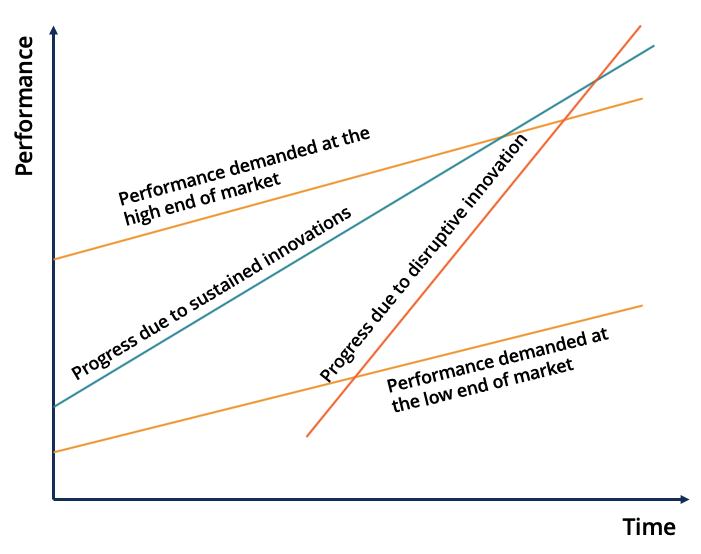
When disruptive innovation enters the typical market, the leading companies adapt to the new technology in response to the competition. However, at this point, the smaller company has already established itself in the market, and it had ample time to refine the business modelBusiness Strategy vs Business ModelSetting up and running a business involves differentiating between business strategy vs business model. To reach their goals and achieve success, owners and the product or service offered.
Therefore, reacting to the competition with the new technology will not be sufficient for the established company. It takes time and multiple iterations to develop products; hence, catching up becomes difficult.
Disruptive companies exploit technologies to provide products in different ways. For example, Netflix shifted its business model from providing customers rental DVDs to on-demand video streaming. Companies with disruptive innovation usually have initial offerings that are sub-standard to those of the leading companies.
Many customers will hesitate to switch despite discounted pricing until the product or service quality is improved. And when the product or service quality improves, a considerable number of customers begin to start using them, which ultimately drives down the market prices.
Examples of Disruptive Innovation
Airbnb disrupted the hospitality industry by combining technology and innovation in the business model. It all started when the founders decided to allow people who initially came to a conference to stay at their residence.
The number of users and rental listings gradually increased, and eventually, it reached the mainstream. It targeted high-value customers with premium-level services such as Luxe and Airbnb Plus concepts. It allows travelers to stay at a place where the locals live.
The platform facilitates transactions between travelers and property owners. It allows user-generated content on individual homes, rooms, and destination locations. Compared to traditional hotels, Airbnb has a competitive advantageCompetitive AdvantageA competitive advantage is an attribute that enables a company to outperform its competitors. It allows a company to achieve superior margins of low cost and accommodation options.
It provides travelers a cheaper alternative to traditional hotels and various unique listings to choose from. Travelers can choose from several options, such as villas, boats, and tents, while the stay experience in traditional hotels remains almost the same.
Another example of major disruptive innovation is Netflix. Initially, it offered a DVD rental service by mail and later shifted to an online movie streaming service that is subscription-based. During the 1990s, the video rental industry was dominated by Blockbuster. However, in the 2000s, Netflix entered the market and targeted the segments ignored by Blockbuster, and thus Blockbuster began to lose substantial revenue.
Even when Netflix changed its business model to an online streaming service, Blockbuster was earning billions. With its accessible and more flexible online service, Netflix began to attract non-customers as well. In response to the competition, Blockbuster launched its equivalent services. However, at this point, Netflix had already established itself in the market.
Additional Resources
CFI offers the Capital Markets & Securities Analyst (CMSA)®Program Page - CMSAEnroll in CFI's CMSA® program and become a certified Capital Markets &Securities Analyst. Advance your career with our certification programs and courses. certification program for those looking to take their careers to the next level. To keep learning and advancing your career, the following resources will be helpful:
- Customer Profitability AnalysisCustomer Profitability AnalysisCustomer Profitability Analysis is a tool from managerial accounting that shifts the focus from product line profitability to individual
- Disruptive TechnologyDisruptive TechnologyDisruptive technology is the technology that affects the normal operation of a market or an industry. Disruptive technology displaces a
- Knowledge CapitalKnowledge CapitalKnowledge capital, also known as intellectual capital, is a term used to describe the intangible part of a business’s value. A business also
- Intersegment SalesIntersegment SalesIntersegmental sales refer to revenue generated by means of an exchange between segments that belong to the same business.
-

Understanding Market Risk: A Comprehensive Guide
The term market risk, also known as systematic risk, refers to the uncertainty associated with any investment decision. Price volatility often arises due to unanticipated fluctuations in factors that
-

Understanding Market Sentiment: A Guide for Investors
The term market sentiment, also known as investor sentiment, refers to the general outlook or attitude of investors toward a particular security or the overall financial market. The optimism or pessim
Business strategy
- Eurodollars: Understanding Foreign Currency Time Deposits
- Understanding Markets: Definition, Types & Examples
- AIM Explained: Investing in High-Growth Companies on the London Stock Exchange
- Understanding Auction Markets: How Prices Are Determined
- Understanding Keiretsu: Japan's Network of Interconnected Companies
- Market Neutral Investing: Strategy, Benefits & How It Works
- Market Orientation: Definition & Benefits for Business Success
- Market Segmentation & Targeting: A Comprehensive Guide
- Understanding Financial Investment Companies: Roles & How They Work
-
 Understanding Market Makers: How They Fuel Liquidity
Market maker refers to a firm or an individual that engages in two-sided markets of a given security. It means that it provides bids and asks in tandem with the market size of each security. A market ...
-
 Understanding Market Manipulation: Definition, Tactics & SEC Role
Market manipulation refers to artificial inflation or deflation of the price of a security. Also known as price manipulation or stock manipulation, it involves the literal manipulation of a financial ...