
Harvest Strategy: Maximizing Profitability for Declining Products
A harvest strategy is a calculated decision to minimize all types of spending on a specific product to maximize profitability, despite a potential decline in market shareMarket ShareMarket share refers to the portion or percentage of a market earned by a company or an organization. In other words, a company’s market share. A harvesting strategy can be developed for product or business lines and serves as an “exit” plan should a product become outdated.

Harvesting strategies are usually used and put into action at the end of a product or business life cycleBusiness Life CycleThe business life cycle is the progression of a business in phases over time, and is most commonly divided into five stages. At this point, it is decided that additional investment into the product or business line will not increase revenue.
Summary
- A harvest strategy is a calculated decision to minimize all types of spending on a specific product to maximize profitability, despite a potential decline in market share.
- The strategy can be developed for product or business lines and serves as an “exit” plan. It is usually used and put into action at the end of a product or business life cycle.
- There are four common stages that every business or product line is expected to follow – the start-up or introduction stage, the growth stage, the maturity stage, and the renewal or declination stage.
The Product or Business Life Cycle
To fully comprehend the use and applicability of a harvest strategy, it is beneficial to understand the business/product life cycle. There are four common stages that every business or product line is expected to follow. They include the start-up or introduction stage, the growth stage, the maturity stage, and the renewal or decline stage.
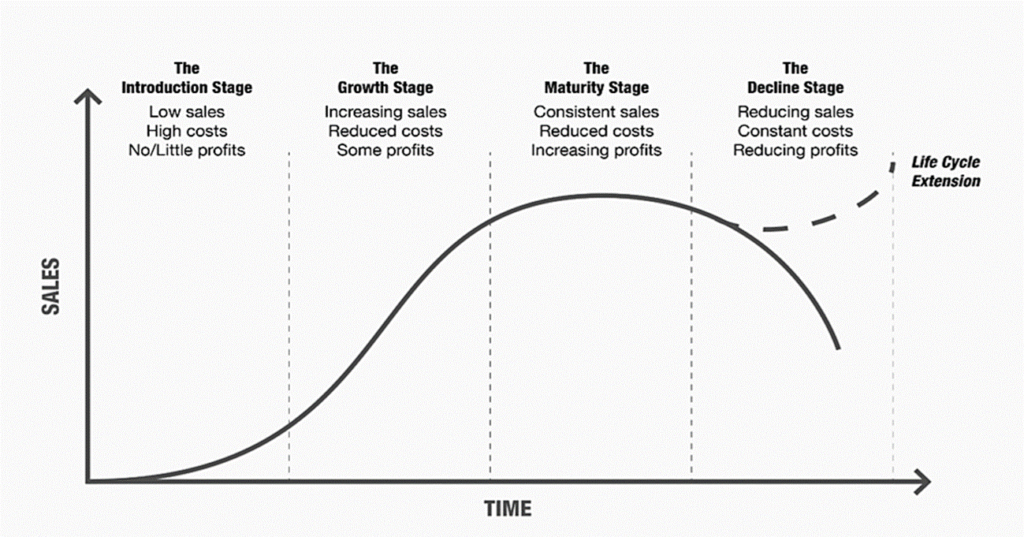
- The start-up stage is the very beginning of the cycle. The business model is still being developed, and significant amounts of investment is needed to market the release of the new product or business line. The start-up stage focuses on increasing customer awareness and generating initial sales.
- The growth stage of a product or business line is the stage at which demand starts to increase, thereby offsetting an increase in overall production and product access and availability. At the growth stage, the existing consumer base begins to mature, while traction for new customers continues to increase.
- The maturity stage of a business is the stage at which a business’ marketing and production costs begin to decrease, and the business is generating its highest profits. At the maturity stage, revenue is constant, and operations are efficient.
- The renewal or decline stage is the stage where a product or business line starts to lose market share as a result of increased competition and/or stagnant revenues. It is also known as the cash-cow stage of the business or product, where more investment is not necessary, as further investments may not result in increased sales.
A business faces three considerations for employing a harvest strategy – a reduction or complete cut in capital expenditureCapital ExpendituresCapital expenditures refer to funds that are used by a company for the purchase, improvement, or maintenance of long-term assets to improve and spending, a reduction or complete cut in marketing expenditure, or a reduction or complete cut in operating expenditure. The strategy can also include a plan on new avenues of investment where resources can be channeled to.
Reasons to Employ a Harvesting Strategy
A business may decide to employ a harvesting strategy for reasons including (but not limited to):
- Arrival of a product or business line at the cash-cow or declination stage. Here, marketing the product is no longer necessary, and resources can be allocated to other avenues that may be generating increased revenues.
- Development of new products and other interests. The new product development may require additional resources and investment to encourage increased income generation.
- Discontinuation of a product or business line. As a result of a business’ decision to discontinue a product, further marketing and reinvestment are no longer necessary.
Examples of Harvest Strategies
Below are a few real-world examples of harvesting strategies:
1. Equity investments
Also referred to as an exit strategy, a harvest strategy is a plan for investors to maximize their profits. A common exit strategy in equity investments is listing a company on the stock market – i.e., launching an initial public offering (IPO).
2. Telecommunications sector
A common harvesting strategy for business in the telecommunications sector is the redirection of resources and funds into the development of new technology and brands with notable growth opportunities, instead of allocating resources to technology or products that are becoming obsolete as technology advances.
Additional Resources
CFI offers the Commercial Banking & Credit Analyst (CBCA)™Program Page - CBCAGet CFI's CBCA™ certification and become a Commercial Banking & Credit Analyst. Enroll and advance your career with our certification programs and courses. certification program for those looking to take their careers to the next level. To keep learning and advancing your career, the following resources will be helpful:
- Exit StrategyExit StrategyAn exit strategy is a plan for a partner or owner to transition out of ownership of a company. It is accomplished through a merger and
- Initial Public Offering (IPO)Initial Public Offering (IPO)An Initial Public Offering (IPO) is the first sale of stocks issued by a company to the public. Prior to an IPO, a company is considered a private company, usually with a small number of investors (founders, friends, family, and business investors such as venture capitalists or angel investors). Learn what an IPO is
- Market PlanningMarket PlanningMarket planning is the process of organizing and defining the marketing aims of a company and gathering strategies and tactics to achieve them. A solid
- Product Life CycleProduct Life CycleThe Product Life Cycle (PLC) defines the stages that a product moves through in the marketplace as it enters, becomes established, and exits the marketplace
-

Strategic Analysis: A Comprehensive Guide for Business Success
Strategic analysis refers to the process of conducting research on a company and its operating environment to formulate a strategy. The definition of strategic analysis may differ from an academi
-

Strategic Planning: A Comprehensive Guide to Long-Term Success
Strategic planning is the art of creating specific business strategies, implementing them, and evaluating the results of executing the plan, in regard to a company’s overall long-term goals or d
Business strategy
- Business Banking: Services, Accounts & Loans Explained
- Assemble-to-Order (ATO): Definition, Benefits & Implementation
- Bootstrapping: How to Build a Business with Minimal Funding
- Business Plan: Definition, Importance & Funding Options
- Business Strategy vs. Business Model: Understanding the Difference
- Understanding Business Structures: A Comprehensive Guide
- Corporate Strategy: A Comprehensive Overview | [Your Company Name]
- Understanding Business Entities: Types & Legal Structures
- Harvest Strategy: Maximizing Profitability for Declining Products
-
 Risk Management: A Comprehensive Guide for Business Success
Risk management encompasses the identification, analysis, and response to risk factors that form part of the life of a businessBusiness Life CycleThe business life cycle is the progression of a busine...
-
 Scalability: Definition, Strategy & Business Growth
Scalability can fall into both financial and business strategyCorporate StrategyCorporate Strategy focuses on how to manage resources, risk and return across a firm, as opposed to looking at competiti...