
Risk Management: A Comprehensive Guide for Business Success
Risk management encompasses the identification, analysis, and response to risk factors that form part of the life of a businessBusiness Life CycleThe business life cycle is the progression of a business in phases over time, and is most commonly divided into five stages. Effective risk management means attempting to control, as much as possible, future outcomes by acting proactively rather than reactively. Therefore, effective risk management offers the potential to reduce both the possibility of a risk occurring and its potential impact.
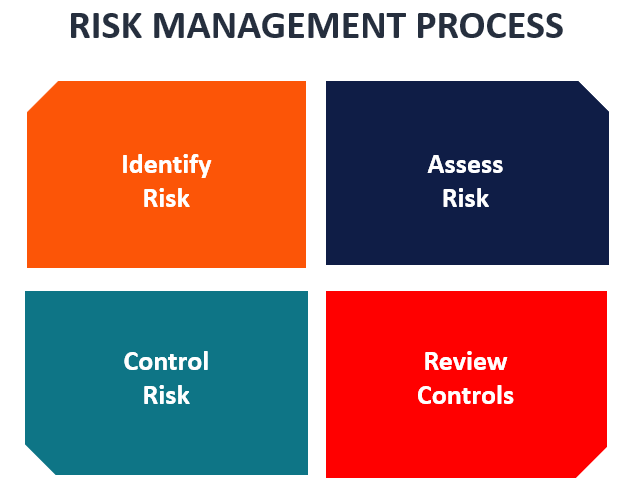
Risk Management Structures
Risk management structures are tailored to do more than just point out existing risks. A good risk management structure should also calculate the uncertainties and predict their influence on a business. Consequently, the result is a choice between accepting risks or rejecting them. Acceptance or rejection of risks is dependent on the tolerance levels that a business has already defined for itself.
If a business sets up risk management as a disciplined and continuous process for the purpose of identifying and resolving risks, then the risk management structures can be used to support other risk mitigation systems. They include planning, organization, cost control, and budgetingBudgetingBudgeting is the tactical implementation of a business plan. To achieve the goals in a business’s strategic plan, we need some type of budget that finances the business plan and sets measures and indicators of performance.. In such a case, the business will not usually experience many surprises, because the focus is on proactive risk management.
Response to Risks
Response to risks usually takes one of the following forms:
- Avoidance: A business strives to eliminate a particular risk by getting rid of its cause.
- Mitigation: Decreasing the projected financial valueTypes of Financial ModelsThe most common types of financial models include: 3 statement model, DCF model, M&A model, LBO model, budget model. Discover the top 10 types associated with a risk by lowering the possibility of the occurrence of the risk.
- Acceptance: In some cases, a business may be forced to accept a risk. This option is possible if a business entity develops contingencies to mitigate the impact of the risk, should it occur.
When creating contingencies, a business needs to engage in a problem-solving approach. The result is a well-detailed plan that can be executed as soon as the need arises. Such a plan will enable a business organizationTypes of OrganizationsThis article on the different types of organizations explores the various categories that organizational structures can fall into. Organizational structures to handle barriers or blockage to its success because it can deal with risks as soon as they arise.
Importance of Risk Management
Risk management is an important process because it empowers a business with the necessary tools so that it can adequately identify and deal with potential risks. Once a risk has been identified, it is then easy to mitigate it. In addition, risk management provides a business with a basis upon which it can undertake sound decision-making.
For a business, assessment and management of risks is the best way to prepare for eventualities that may come in the way of progress and growth. When a business evaluates its plan for handling potential threats and then develops structures to address them, it improves its odds of becoming a successful entity.
In addition, progressive risk management ensures risks of a high priority are dealt with as aggressively as possible. Moreover, the management will have the necessary information that they can use to make informed decisions and ensure that the business remains profitable.
Risk Analysis Process
Risk analysis is a qualitative problem-solving approach that uses various tools of assessment to work out and rank risks for the purpose of assessing and resolving them. Here is the risk analysis process:
1. Identify existing risks
Risk identification mainly involves brainstorming. A business gathers its employees together so that they can review all the various sources of risk. The next step is to arrange all the identified risks in order of priority. Because it is not possible to mitigate all existing risks, prioritization ensures that those risks that can affect a business significantly are dealt with more urgently.
2. Assess the risks
In many cases, problem resolution involves identifying the problem and then finding an appropriate solution. However, prior to figuring out how best to handle risks, a business should locate the cause of the risks by asking the question, “What caused such a risk and how could it influence the business?”
3. Develop an appropriate response
Once a business entity is set on assessing likely remedies to mitigate identified risks and prevent their recurrence, it needs to ask the following questions: What measures can be taken to prevent the identified risk from recurring? In addition, what is the best thing to do if it does recur?
4. Develop preventive mechanisms for identified risks
Here, the ideas that were found to be useful in mitigating risks are developed into a number of tasks and then into contingency plans that can be deployed in the future. If risks occur, the plans can be put to action.
Summary
Our business ventures encounter many risks that can affect their survival and growth. As a result, it is important to understand the basic principles of risk management and how they can be used to help mitigate the effects of risks on business entities.
More Resources
CFI offers the Financial Modeling & Valuation Analyst (FMVA)™Become a Certified Financial Modeling & Valuation Analyst (FMVA)®CFI's Financial Modeling and Valuation Analyst (FMVA)® certification will help you gain the confidence you need in your finance career. Enroll today! certification program for those looking to take their careers to the next level. To keep learning and advancing your career, the following CFI resources will be helpful:
- Idiosyncratic RiskIdiosyncratic RiskIdiosyncratic risk, also sometimes referred to as unsystematic risk, is the inherent risk involved in investing in a specific asset – such as a stock – the
- Loss AversionLoss AversionLoss aversion is a tendency in behavioral finance where investors are so fearful of losses that they focus on trying to avoid a loss more so than on making gains. The more one experiences losses, the more likely they are to become prone to loss aversion.
- RAID LogRAID LogA RAID Log is a project management tool that is aimed at centralizing and simplifying the collection, monitoring, and tracking of project data
- Risk AverseRisk Averse DefinitionSomeone who is risk averse has the characteristic or trait of preferring avoiding loss over making a gain. This characteristic is usually attached to investors or market participants who prefer investments with lower returns and relatively known risks over investments with potentially higher returns but also with higher uncertainty and more risk.
-
Understanding Financial Risk: A Comprehensive Guide
In finance, risk is the probability that actual results will differ from expected results. In the Capital Asset Pricing Model (CAPM)Capital Asset Pricing Model (CAPM)The Capital Asset Pricing Model (C
-

Risk Shifting: Definition, Examples & Implications
Risk shifting is a risk strategy that involves transferring the responsibility for risk or liability to another party. The risk can be transferred in full or partially, and it ensures that the third p
Business strategy
- Understanding Business Risk: Threats & Mitigation
- Bootstrapping: How to Build a Business with Minimal Funding
- Business Plan: Definition, Importance & Funding Options
- Understanding Business Structures: A Comprehensive Guide
- Portfolio Diversification: Reduce Risk & Enhance Returns
- Enterprise Risk Management (ERM): A Comprehensive Guide
- Understanding Business Entities: Types & Legal Structures
- Quality Management: Definition, Importance & Implementation
- Strategic Management: Definition, Objectives & Implementation
-
 Mastering Money Management: A Comprehensive Guide
Money management refers to the process of tracking and planning an individual or group’s use of capital. In personal and corporate finance, money management usually includes budgetingBudgetingBu...
-
 Understanding Operating Risk: A Key Component of Business Risk
Operating risk is the risk related to a company’s cost structure. More specifically, it is the risk the company faces due to the level of fixed costs in its operations. Together with sales ...