
Portfolio Companies: Definition & How Private Equity Uses Them
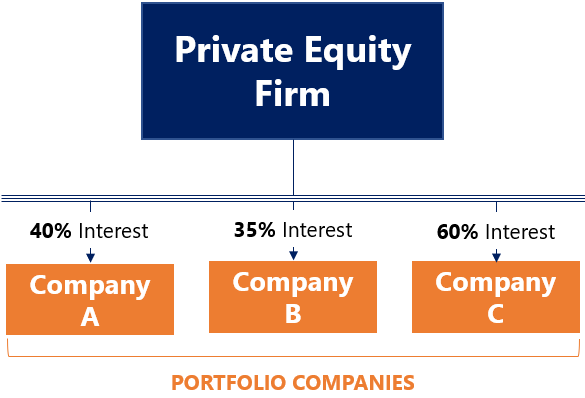
A portfolio company is a company (public or private) that a venture capital firm, buyout firm, or holding company owns equity. In other words, companies that private equity firms hold an interest in are considered portfolio companies. Investing in a portfolio company aims to increase its value and earn a return on investment through a sale.
Summary
- Companies that private equity firms hold an interest in are considered portfolio companies.
- A financial sponsor and investors are required to create a private equity fund that invests in companies.
- Common approaches to investing in a portfolio company include leveraged buyout, venture capital, and growth capital.
The Private Equity Structure
The private equity structure can be summarized in the simple graphic below:
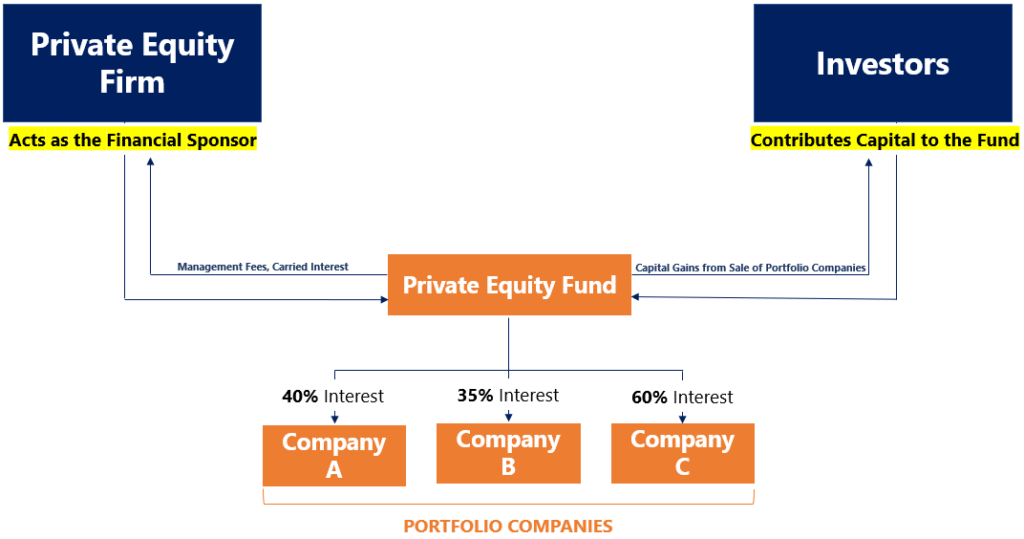
Creating a private equity fund, which invests in companies, requires two different parties: (1) a financial sponsor, and (2) investors.
1. Financial Sponsor
The financial sponsor is generally called the general partner. The financial sponsor manages the private equity fund and receives management fees and carried interest as compensation. Management fees are fees tied to the capital raised, while carried interest is a share of the fund’s profits.
2. Investors
The investors provide the capital required for the fund to invest in companies. Investors include high net worth individualsHigh Net Worth Individual (HNWI)A high net worth individual (HNWI) refers to an individual with a net worth of a minimum of $1,000,000 in highly liquid assets, such as cash and cash, family offices, endowments, insurance companies, pension funds, foundations, funds-of-funds, sovereign wealth funds, etc. Investors generate a return from their investment through the private equity fund selling portfolio companies at a higher price than the initial investment cost.
Approaches to Investing in Portfolio Companies
There are numerous methods of investing in a portfolio company. Below, we outline three common methods.
1. Leveraged Buyout (LBO)
A leveraged buyout (LBO)Leveraged Buyout (LBO)A leveraged buyout (LBO) is a transaction where a business is acquired using debt as the main source of consideration. is extremely common in private equity transactions. An LBO involves using primarily debt (hence “leveraged” buyout) and a small equity injection to finance the company’s buyout. The debt is typically raised through using the portfolio company’s assets as security.
2. Venture Capital
Venture capital refers to the provision of capital by private equity funds to start-up companies that require early-stage funding in exchange for an equity stake.
3. Growth Capital
Growth capital refers to providing capital to established businesses to help expand business operations. The capital can be used to help a business develop a new product, restructure operations, finance an acquisition, or expand into new markets.
Common Types of Exits for Portfolio Companies
Investors in private equity funds generate a return through portfolio companies’ exit in the private equity fund. Private equity firms typically acquire companies for a specific period (usually five to seven years), with the end goal of exiting the investment through a sale above the initial investment price. Common exit strategies include the following:
1. Initial Public Offering (IPO)
An initial public offering of a portfolio company generally provides one of the highest valuations, compared to other exits, provided that public market conditions are stable and that there is strong demand. A key disadvantage with an IPO exit is the high transaction costsTransaction CostsTransaction costs are costs incurred that don’t accrue to any participant of the transaction. They are sunk costs resulting from economic trade in a market. In economics, the theory of transaction costs is based on the assumption that people are influenced by competitive self-interest. and potential restrictions placed on existing investors, such as a lock-up period requirement.
2. Strategic Sale
A strategic sale, also called a trade sale, is the sale of a portfolio company to a strategic buyer that can realize material synergies or achieve a strategic fit through the acquisition. Strategic buyers often pay a premium for the portfolio company due to the preceding sentence’s reasons.
3. Secondary Buyout
A secondary buyout is the sale of a portfolio company to another private equity firm. There may be many reasons to engage in a secondary buyout, such as the desire to get rid of the portfolio company or the portfolio company’s management wanting to find another private equity firm to operate with.
Examples
Prominent private equity firms in Canada include ONEX Partners and Novacap Investments, to name a few. The portfolio companies of ONEX Partners and Novacap Investments can be found here and here, respectively.
Additional Resources
CFI offers the Commercial Banking & Credit Analyst (CBCA)™Program Page - CBCAGet CFI's CBCA™ certification and become a Commercial Banking & Credit Analyst. Enroll and advance your career with our certification programs and courses. certification program for those looking to take their careers to the next level. To keep learning and advancing your career, the following resources will be helpful:
- Management Buyout (MBO)Management Buyout (MBO)A management buyout (MBO) is a corporate finance transaction where the management team of an operating company acquires the business by borrowing money to
- Exit StrategiesExit StrategiesExit strategies are plans executed by business owners, investors, traders, or venture capitalists to exit their position in an asset at a certain point
- IPO ProcessIPO ProcessThe IPO Process is where a private company issues new and/or existing securities to the public for the first time. The 5 steps discussed in detail
- Venture CapitalVenture CapitalVenture capital is a form of financing that provides funds to early stage, emerging companies with high growth potential, in exchange for equity or an ownership stake. Venture capitalists take the risk of investing in startup companies, with the hope that they will earn significant returns when the companies become a success.
-
Understanding Equity: A Comprehensive Guide for Investors
In finance and accounting, equity is the value attributable to the owners of a business. The book value of equity is calculated as the difference between assetsTypes of AssetsCommon types of assets in
-
Equity Crowdfunding: A Comprehensive Guide for Startups & Investors
Equity crowdfunding (also known as crowd-investing or investment crowdfunding) is a method of raising capital used by startupsStartup Valuation Metrics (for internet companies)Startup Valuation Metric
Business strategy
- Understanding Stockholders' Equity: Factors & Impact
- Understanding Liquid Equity: A Guide to Company Stock
- Equity Valuation: A Comprehensive Guide for Investors
- Debt/Equity Swap: Understanding Financial Restructuring
- Equity Financing: A Comprehensive Guide for Business Growth
- Equity Multiplier: Definition, Calculation & Financial Significance
- Equity Ratio: Understanding Financial Leverage & Risk
- Return on Common Equity (ROCE): Definition & Importance
- Holding Companies: Definition, Purpose & How They Work
-
 Backstop: Understanding Financial Safety Nets and Contingency Funding
A backstop is a financial arrangement that creates a secondary source of funds in case the primary source is not enough to meet current needs. It can also be thought of as an insurance policy that cov...
-
 Understanding Clawbacks: Protecting Stakeholders from Failed Performance
What happens when a person promises to perform and then fails to deliver on their promises? Or what happens when it is found that a performance reportDue Diligence ReportExample due diligence report o...