
Pull Marketing Strategy: Definition, Benefits & Examples
A pull marketing strategy, also called a pull promotional strategy, refers to a strategy in which a firm aims to increase the demand for its productsProduct CostsProduct costs are costs that are incurred to create a product that is intended for sale to customers. Product costs include direct material and draw (“pull”) consumers to the product. Pull marketing strategies revolve around getting consumersBuyer TypesBuyer types is a set of categories that describe spending habits of consumers. Consumer behavior reveals how to appeal to people with different habits to want a particular product. A pull marketing strategy can be used by itself or in conjunction with a push marketing strategy.
In a pull marketing strategy, the goal is to make a consumer actively seek a product and get retailers to stock the product in response to direct consumer demand.

Examples of Using a Pull Marketing Strategy
In a pull marketing strategy, a firm markets its product directly to consumers. The consumers then seek out the products to purchase. There are several pull marketing methods available today, including:
- Social media networks
- Word of mouth
- Media coverage
- Sales promotions and discounts
- Advertising
- Email marketing
Explore further topics on Corporate StrategyCorporate StrategyCorporate Strategy focuses on how to manage resources, risk and return across a firm, as opposed to looking at competitive advantages in business strategy, with CFI’s Strategy Course.
Illustration of a Pull Marketing Strategy
A pull marketing strategy is illustrated as follows:
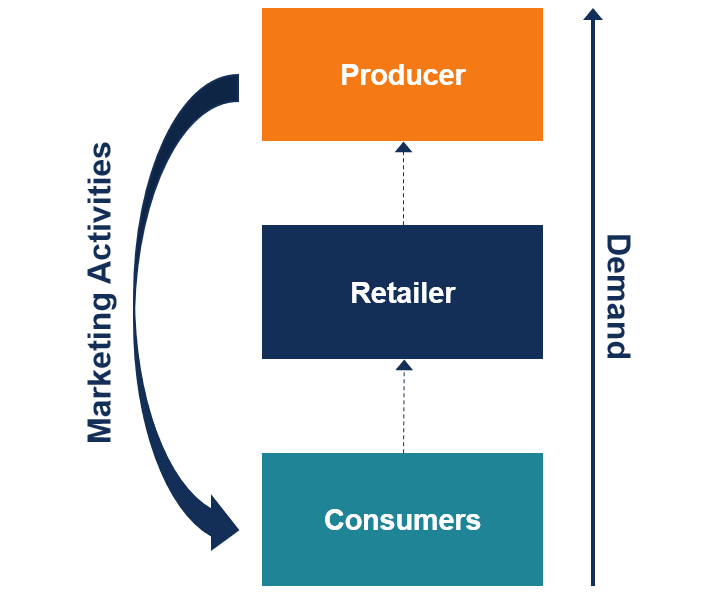
As illustrated above, a pull marketing strategy involves a business using marketing activities5 P's of MarketingThe 5 P's of Marketing – Product, Price, Promotion, Place, and People – are key marketing elements used to position a business strategically. The 5 P's of to pull consumers to its products.
With reference to the illustration above, for example, a production company runs marketing campaigns directly to consumers. Due to the marketing campaigns, consumers seek out a particular product and go to retailers looking to purchase the product. Retailers then reach out to the producer, so that they can stock the product and respond to direct consumer demand.
A pull marketing strategy can be contrasted with a push marketing strategy, where marketing activities are employed along the supply chainSupply ChainSupply chain is the entire system of producing and delivering a product or service, from the very beginning stage of sourcing the raw materials to the final.
Example of a Pull Marketing Strategy
Colin recently launched a new product – the Fanner 3000. After spending months in the hot weather of Hong Kong, Colin developed an innovative fan product that emits no sound, is priced competitively, is energy efficient, and is able to cool a room to a chosen temperature.
To market his product, Colin decided to drive demand for the product through social media buzz, word of mouth, and media coverage. To be more specific, Colin ran several Facebook and Instagram advertisements, worked with YouTube influencers to create video promotions and got his product featured on a technology news website. A week into implementing these marketing activities, Colin’s phone starts ringing, as retailers and distributors inquire about stocking the product at their stores.
Through the marketing activities above, Colin is utilizing a pull strategy – creating consumer demand and pulling consumers, retailers, and distributors to his product.
Advantages
There are several advantages to a pull marketing strategy:
- Able to establish direct contact with consumers and build consumer loyalty
- Stronger bargaining power with retailers and distributors
- Focuses on creating brand equity and product value
- Consumers are actively seeking out the product, which removes much of the pressure of conducting outbound marketing
- Can be used to test a product’s acceptance in the market and obtain consumer feedback on the product
Disadvantages
Potential disadvantages to using a pull strategy include the following:
- Usually works effectively only when there is high brand loyalty
- Lead time is long, as consumers are comparing alternatives before making a purchase
- Requires creating a high demand for a product, which can be difficult in a highly competitive marketplace landscape
- Requires strong marketing efforts to convince consumers to actively seek out the product (they may, instead, just decide to settle for whatever similar product a retailer has in stock, rather than insisting on getting your product)
Additional Resources
CFI is the official provider of the Financial Modeling and Valuation Analyst (FMVA)™Become a Certified Financial Modeling & Valuation Analyst (FMVA)®CFI's Financial Modeling and Valuation Analyst (FMVA)® certification will help you gain the confidence you need in your finance career. Enroll today! certification program, designed to transform anyone into a world-class financial analyst. To keep learning and developing your knowledge of financial analysis, we highly recommend the additional CFI resources below:
- AIDA ModelAIDA ModelThe AIDA model, which stands for Attention, Interest, Desire, and Action model, is an advertising effect model that identifies the stages that an individual
- Knocking on DoorKnocking on DoorsKnocking on Doors is a lead generation strategy used by banking advisors to secure prospects for business.
- Market PlanningMarket PlanningMarket planning is the process of organizing and defining the marketing aims of a company and gathering strategies and tactics to achieve them. A solid
- Walmart Marketing MixWalmart Marketing MixWalmart is a powerhouse of a business, and one of its key strengths is its marketing mix. Surviving in the retail market requires more than just luck
-
Retail Assortment Strategies: A Comprehensive Guide
Assortment strategies refer to the plans that retailers (in-store and e-commerceIntroduction to E-commerceE-commerce refers to commercial transactions of goods or services conducted over the internet.
-

Bait and Switch: Understanding This Deceptive Sales Tactic
Bait and switch is a fraudulent activity whereby a company advertises goods at an incredibly low price with the aim of substituting for them with inferior or pricier alternatives at the time of purcha
Business strategy
- Trading Strategies: A Comprehensive Guide to Profitable Investing
- Affiliate Marketing: A Comprehensive Guide for Beginners
- Assemble-to-Order (ATO): Definition, Benefits & Implementation
- Business Strategy vs. Business Model: Understanding the Difference
- Guerrilla Marketing: Definition, Tactics & Examples | [Your Brand/Site Name]
- Comprehensive Marketing Plan: Definition, Elements & Strategy
- What is Product Differentiation?
- Pull Marketing Strategy: Definition, Benefits & Examples
- Push Marketing Strategy: Definition & Tactics | [Your Brand/Company]
-
 Strategic Planning: A Comprehensive Guide to Long-Term Success
Strategic planning is the art of creating specific business strategies, implementing them, and evaluating the results of executing the plan, in regard to a company’s overall long-term goals or d...
-
 Product Marketing: A Beginner's Guide to Launching and Growing Products
If you run a search for product marketing on Google N-Gram to scan its mentions in literature, you’ll quickly realize the term wasn’t in use until the 1920s. It goes without saying that, althoug...