
Understanding Profit Models: A Comprehensive Guide
A profit model refers to a company’s plan that aims to make the business profitable and viable. It lays out what the company plans to manufacture or provide, how sales will be generated, and all the expensesFixed and Variable CostsCost is something that can be classified in several ways depending on its nature. One of the most popular methods is classification according that the business will incur in a bid to make the model viable. Without a concrete profit model, the business will be operating blindly and will be much less likely to become profitable.
The starting point of designing a profit model is to understand the value propositionValue PropositionValue proposition is a promise of value stated by a company that summarizes the benefit(s) of the company’s product or service and how they are delivered of the business. The value proposition is a statement detailing all the products and services that the company offers to the market and what makes them of value to potential customers.
The driving force when a customer is making a purchase is the value that they will obtain from using that product rather than any other product offered in the market. A clear value proposition also helps the company’s services stand out from competitors who sell identical or similar products.
Types of Profit Models
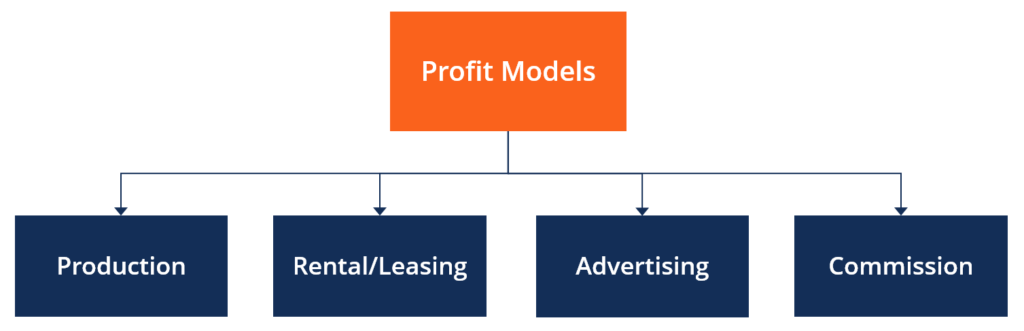
There are various types of profit models, depending on the activities the company performs and how it charges for such activities. The different profit models include:
1. Production model
The production model involves the creation of a product or serviceProducts and ServicesA product is a tangible item that is put on the market for acquisition, attention, or consumption while a service is an intangible item, which arises from for sale to consumers. The company purchases raw materials for use in the production process, then adds value to the product in order to obtain a finished product.
The product is then sold directly to the consumer or to a wholesaler or retailer who then resells the product to consumers. An example is a soap manufacturer that sells its finished products directly to customers or wholesalers who resell the product to consumers.
2. Rental/Leasing model
The rental/leasing model involves such things as renting or leasing of motor vehicles, buildings, machinery and equipment, land, office furniture, and computers. For example, a landlord and tenant enter into an agreement where the tenant agrees to pay a certain fee for the temporary use of the housing asset owned by the landlord.
After the expiry of the leaseLeaseA lease is an implied or written agreement specifying the conditions under which a lessor accepts to let out a property to be used by a lessee. The or rental period, the property reverts back to the landlord.
3. Advertising model
The advertising model involves providing an advertising space that businesses can use to promote their service and product offerings. An advertising model is mainly used by media companies that provide free information to the public and rely on advertisements to generate revenue. They sell advertising space in newspapers, magazines, television, websites, and mobile applications.
4. Commission model
The commission model generates revenues by charging a fee when it offers a service to another party. An example is a brokerage or an auctioneer that acts as an intermediaryFinancial IntermediaryA financial intermediary refers to an institution that acts as a middleman between two parties in order to facilitate a financial transaction. The institutions that are commonly referred to as financial intermediaries include commercial banks, investment banks, mutual funds, and pension funds. between two parties. The intermediary then charges a commission depending on the value of the transaction.
Components of a Profit Model
There are several components of a profit model that are key to making a business profitable. They include:
1. Production and operating component
The production and operating component forms the backbone of the profit model. The production component is the process that a product undergoes before it can become available for customers to buy. The production department must operate at maximum efficiency to produce high-quality products that give value to customers. It must also operate at the lowest possible cost, since a high production cost would make the products too expensive for potential customers to buy.
The operating component comprises both personnel and production equipment. The personnel operating the production equipment must be efficient in their work, with little to no idle time. The personnel should be well-trained to handle production machinery and they should receive frequent training to enhance their skills.
When hiring new employees, the company should look for employees who are well-skilled and experienced, rather than novice employees who may take a long time to learn the required skills. For the operating equipment, the management should ensure that they are operating at optimal levels and working properly. They should be serviced periodically and upgraded whenever newer models are available in the market.
2. Sales and marketing component
The sales and marketing component involves getting the word out about the company’s products, with the goal of creating interest among consumers. The personnel in charge of sales and marketing achieves objectives using word of mouth, billboards, television and radio ads, internet ads campaign, etc.
The sales and marketing department should remain open to adopting new ideas and technologies that make it easy to reach out to consumers about the company’s products, their benefits, and how they are different from competitor’s products. The concerned personnel should also work to retain current customers by providing discounts, special offers, and free samples of new products.
3. Delivery of goods and services
The last component of a profit model is the delivery of goods and services to the customer. Once the sales and marketing department has made potential customers aware of the company’s products, and the customers purchase the items, the seller should ensure that the buyer receives their goods or services in a timely manner. Failure to deliver the goods will be wasting all the efforts spent in developing and marketing the product.
After delivery, the company should provide a communication channel that customers can use to submit complaints, make recommendations, and ask questions about its products and services.
Related Readings
CFI is the official provider of the Financial Modeling and Valuation Analyst (FMVA)™Become a Certified Financial Modeling & Valuation Analyst (FMVA)®CFI's Financial Modeling and Valuation Analyst (FMVA)® certification will help you gain the confidence you need in your finance career. Enroll today! certification program, designed to transform anyone into a world-class financial analyst.
To keep learning and developing your knowledge of financial analysis, we highly recommend the additional CFI resources below:
- Business Model Canvas TemplateBusiness Model Canvas TemplateThe business model canvas template is a strategic planning tool used by managers to illustrate, summarize, and develop their business model.
- Corporate StrategyCorporate StrategyCorporate Strategy focuses on how to manage resources, risk and return across a firm, as opposed to looking at competitive advantages in business strategy
- Non-Profit Business PlanNon-Profit Business PlanA non-profit business plan is simply a roadmap of the non-profit organization that outlines its goals and objectives, how it can achieve its stated purpose
- Profitability RatiosProfitability RatiosProfitability ratios are financial metrics used by analysts and investors to measure and evaluate the ability of a company to generate income (profit) relative to revenue, balance sheet assets, operating costs, and shareholders' equity during a specific period of time. They show how well a company utilizes its assets to produce profit
-

Understanding Normal Profit: A Key Concept in Economics
Normal profit is an economic term that refers to a situation where the total revenues of a company are equal to the total costs in a perfectly competitive market. It means that the company makes suffi
-
Operating Margin: Definition, Calculation & Importance
Operating margin is equal to operating incomeOperating IncomeOperating income is the amount of revenue left after deducting the operational direct and indirect costs from sales revenue. divided by rev
Business strategy
- Model Audit: Ensuring Accuracy and Reliability in Financial Models
- Profit vs. Cash Flow: Understanding the Key Difference
- Backtesting: A Comprehensive Guide to Strategy Validation
- Marginal Profit: Definition, Calculation & Maximization
- Understanding Profit: A Key Financial Metric
- Profit Margin Explained: Types & How to Calculate
- Business Strategy vs. Business Model: Understanding the Difference
- What is Product Differentiation?
- Understanding Profit Models: A Comprehensive Guide
-
 Audit Risk Model: Definition, Purpose & Application
An audit risk model is a conceptual tool applied by auditors to evaluate and manage the various risks arising from performing an audit engagement. The tool helps the auditor decide on the types of evi...
-
 Gross Profit Explained: Definition, Calculation & Importance
The Gross Profit (GP) of a business is the accounting result obtained after deducting the cost of goods sold and sales returns/allowances from total sales revenueSales RevenueSales revenue is the...