
SPACs Explained: A Comprehensive Guide to Special Purpose Acquisition Companies
A special purpose acquisition company (SPAC) is a corporation formed for the sole purpose of raising investment capital through an initial public offering (IPO)Initial Public Offering (IPO)An Initial Public Offering (IPO) is the first sale of stocks issued by a company to the public. Prior to an IPO, a company is considered a private company, usually with a small number of investors (founders, friends, family, and business investors such as venture capitalists or angel investors). Learn what an IPO is. Such a business structure allows investors to contribute money towards a fund, which is then used to acquire one or more unspecified businesses to be identified after the IPO. Therefore, this sort of shell firm structure is often called a “blank-check company” in popular media.
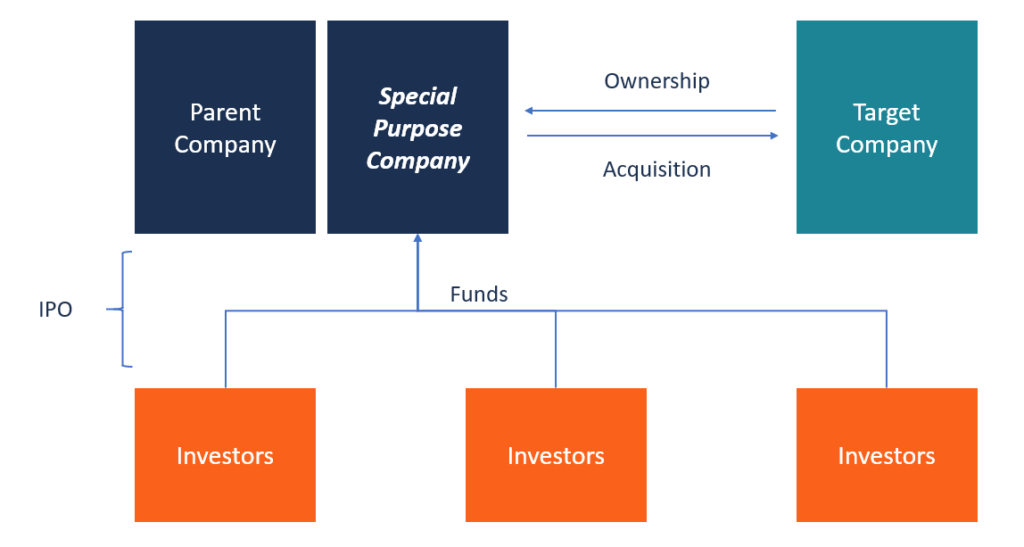
When the SPAC raises the required funds through an IPO, the money is held in a trust until a predetermined period elapses or the desired acquisition is made. In the event that the planned acquisition is not made or legal formalities are still pending, the SPAC is required to return the funds to the investors, after deducting bank and broker fees.
How Does a Special Purpose Acquisition Company Work?
Founders
A special purpose acquisition company is formed by experienced business executives who are confident that their reputation and experience will help them identify a profitable company to acquire. Since the SPAC is only a shell company, the founders become the selling point when sourcing funds from investors.
The founders provide the starting capital for the company and they stand to benefit from a sizeable stake in the acquired company. The founders often hold an interest in a specific industry when starting a special purpose acquisition company.
Issuing the IPO
When issuing the IPO, the management team of the SPAC contracts an investment bankList of Top Investment BanksList of the top 100 investment banks in the world sorted alphabetically. Top investment banks on the list are Goldman Sachs, Morgan Stanley, BAML, JP Morgan, Blackstone, Rothschild, Scotiabank, RBC, UBS, Wells Fargo, Deutsche Bank, Citi, Macquarie, HSBC, ICBC, Credit Suisse, Bank of America Merril Lynch to handle the IPO. The investment bank and the management team of the company agree on a fee to be charged for the service, usually about 10% of the IPO proceeds. The securities sold during an IPO are offered at a unit price, which represents one or more shares of common stock.
The prospectusProspectusA prospectus is a legal disclosure document that companies are required to file with the Securities and Exchange Commission (SEC). The document provides information about the company, its management team, recent financial performance, and other related information that investors would like to know. of the SPAC mainly focuses on the sponsors, and less on company history and revenues since the SPAC lacks performance history or revenue reports. All proceeds from the IPO are held in a trust account until a private company is identified as an acquisition target.
Acquiring a Target Company
After the SPAC has raised the required capital through an IPO, the management team has 18 to 24 months to identify a target and complete the acquisition. The period may vary depending on the company and industry. The fair market valueFair ValueFair value refers to the actual value of an asset - a product, stock, or security - that is agreed upon by both the seller and the buyer. Fair value is applicable to a product that is sold or traded in the market where it belongs or under normal conditions - and not to one that is being liquidated. of the target company must be 80% or more of the SPAC’s trust assets.
Once acquired, the founders will profit from their stake in the new company, usually 20% of the common stock, while the investors receive an equity interest according to their capital contribution.
In the event that the predetermined period lapses before an acquisition is completed, the SPAC is dissolved, and the IPO proceeds held in the trust account are returned to the investors. When running the SPAC, the management team is not allowed to collect salaries until the deal is completed.
SPAC Capital Structure
Public Units
A SPAC floats an IPO to raise the required capital to complete an acquisition of a private company. The capital is sourced from retail and institutional investors, and 100% of the money raised in the IPO is held in a trust account. In return for the capital, investors get to own units, with each unit comprising a share of common stock and a warrant to purchase more stock at a later date.
The purchase price per unit of the securities is usually $10.00. After the IPO, the units become separable into shares of common stock and warrants, which can be traded in the public market. The purpose of the warrant is to provide investors with additional compensation for investing in the SPAC.
Founder Shares
The founders of the SPAC will purchase founder sharesFounders StockFounders stock refers to the equity that is given to the early founders of an organization. This type of stock differs in a few important ways from common stock sold in the secondary market. Key differences are (1) that founders stock can only be issued at face value, and (2) it comes with a vesting schedule. at the onset of the SPAC registration, and pay nominal consideration for the number of shares that results in a 20% ownership stake in the outstanding shares after the completion of the IPO. The shares are intended to compensate the management team, who are not allowed to receive any salary or commission from the company until an acquisition transaction is completed.
Warrants
The units sold to the public comprise a fraction of a warrant, which allows the investors to purchase a whole share of common stock. Depending on the bank issuing the IPO and the size of the SPAC, one warrant may be excisable for a fraction of a share (either half, one-third or two-thirds) or a full share of stock.
For example, if a price per unit in the IPO is $10, the warrant may be exercisable at $11.50 per share. The warrants become exercisable either 30 days after the De-SPAC transaction or twelve months after the SPAC IPO.
The public warrants are cash-settled, meaning that the investor must pay the full cost of the warrant in cash to receive a full share of stock. Founder warrants, on the other hand, may be net settled, meaning that they are not required to deliver cash to receive a full share of stock. Instead, they are issued shares of stock with a fair market value equal to the difference between the stock trading price and the warrant strike price.
More Resources
CFI offers the Financial Modeling & Valuation Analyst (FMVA)™Become a Certified Financial Modeling & Valuation Analyst (FMVA)®CFI's Financial Modeling and Valuation Analyst (FMVA)® certification will help you gain the confidence you need in your finance career. Enroll today! certification program for those looking to take their careers to the next level. To keep learning and advancing your career, the following CFI resources will be helpful:
- Capital StructureCapital StructureCapital structure refers to the amount of debt and/or equity employed by a firm to fund its operations and finance its assets. A firm's capital structure
- M&A ProcessMergers Acquisitions M&A ProcessThis guide takes you through all the steps in the M&A process. Learn how mergers and acquisitions and deals are completed. In this guide, we'll outline the acquisition process from start to finish, the various types of acquirers (strategic vs. financial buys), the importance of synergies, and transaction costs
- Special Purpose Vehicle (SPV)Special Purpose Vehicle (SPV)A Special Purpose Vehicle/Entity (SPV/SPE) is a separate entity created for a specific and narrow objective, and that is held off-balance sheet. SPV is a
- Structured Investment Vehicle (SIV)Structured Investment Vehicle (SIV)A structured investment vehicle (SIV) is a non-bank financial entity set up to purchase investments designed to profit from the difference in interest rates - known as the credit spread - between short-term and long-term debt.
-
![Corporate Actions: Definition, Types & Impact | [Your Company Name]](https://www.etffin.com/article/uploadfiles/202110/2021100815410257_S.jpeg)
Corporate Actions: Definition, Types & Impact | [Your Company Name]
A corporate action is a move – enacted by a publicly-traded company – that encourages or furthers processes that have a direct impact on whatever assets the company issues. In other words,
-

Understanding Cross-Holding: Risks & Implications
Cross holding, also referred to as cross shareholding, describes a situation where one publicly-traded company holds a significant number of shares of another publicly-traded company. The shares owned
Business strategy
- Special Purpose Acquisition Companies (SPACs): A Comprehensive Overview
- Understanding Acquisition Cost: Definitions & Applications
- Understanding the IPO Process: A Comprehensive Guide
- Special Dividends: Understanding One-Time Distributions
- Understanding Hot IPOs: A Guide to Initial Public Offerings
- Special Purpose Vehicles (SPVs): Definition, Types & Assets
- Tuck-in Acquisitions: Definition, Strategy & Benefits
- Understanding IPOs: A Comprehensive Guide for Investors
- What is a Special Purpose Acquisition Company (SPAC)?
-
 Understanding Associate Companies: Definition & Ownership
An associate company, also known as an affiliate company, is a company in which a notable portion of shares is owned by a parent company. The portion usually lies between 20% and 50%. Ownership of hig...
-
 Competitive Advantage: Definition & Key Metrics for Business Success
A competitive advantage is an attribute that enables a company to outperform its competitors. This allows a company to achieve superior marginsOperating MarginOperating margin is equal to operating in...