
Tuck-in Acquisitions: Definition, Strategy & Benefits
A tuck-in acquisition involves the acquisition of a smaller company and integrating it into the acquirer’s platform. The acquirerAsset AcquisitionAn asset acquisition is the purchase of a company by buying its assets instead of its stock. It also involves an assumption of certain liabilities. is usually a large company that possesses the large infrastructure that the smaller company lacks. The smaller company usually has a strong owner but lacks the infrastructure, administrative resources, and/or access to capital required to facilitate growth. This makes it a potential candidate for absorption into a larger company’s platform.
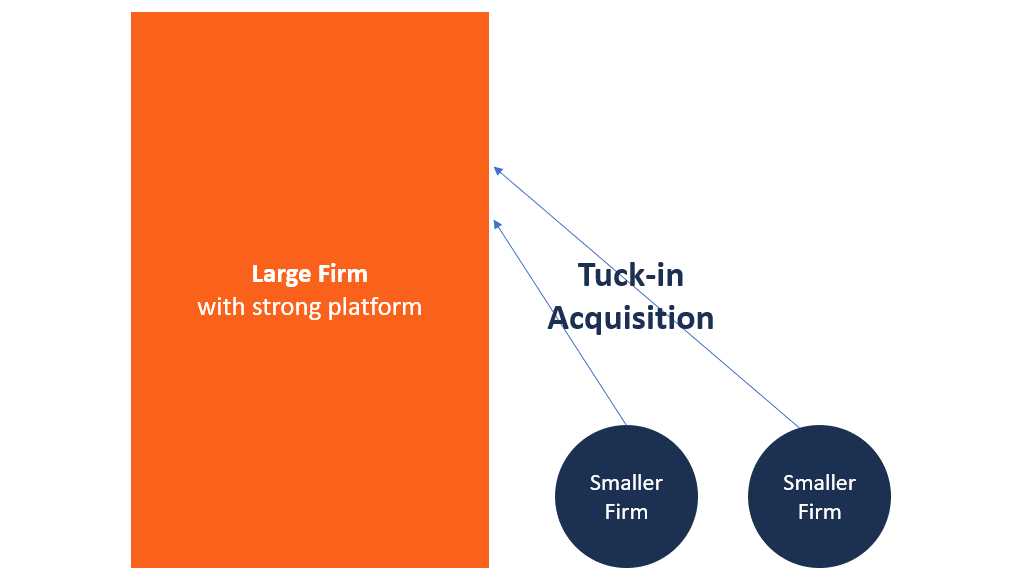
The acquirer pursues the acquisition of smaller companies with the goal of increasing its revenuesSales RevenueSales revenue is the income received by a company from its sales of goods or the provision of services. In accounting, the terms "sales" and, market share, and resources. Some examples of resources that the acquirer may be interested in include intellectual propertyIntangible AssetsAccording to the IFRS, intangible assets are identifiable, non-monetary assets without physical substance. Like all assets, intangible assets, proprietary technology, and complementary product lines.
Tuck-in Acquisitions vs. Bolt-on Acquisitions
Both tuck-in acquisitions and bolt-on acquisitions occur when a larger company absorbs a smaller company through a merger and acquisition process,Mergers Acquisitions M&A ProcessThis guide takes you through all the steps in the M&A process. Learn how mergers and acquisitions and deals are completed. In this guide, we'll outline the acquisition process from start to finish, the various types of acquirers (strategic vs. financial buys), the importance of synergies, and transaction costs with the goal of increasing its market share and revenues or expanding its product offerings. However, the two types of acquisitions differ in the way the acquired assets are treated.
Tuck-in acquisition
This type of acquisition occurs when a large company acquires a smaller company in the same or related industry. For the acquirer to consider a small company for acquisition, it must have something unique that it is bringing to the table. Among the things acquiring companies commonly look for are new products, patents, expert manpower, technology, and market share.
After the acquisition, the smaller company does not retain its original structure. It is often absorbed into an existing department of the larger company. The acquirer already has the technology structure, distribution systems, and inventory, and mainly pursues the target company with the goal of reinforcing its existing infrastructure.
Bolt-on acquisition
With this type of acquisition, a large company acquires another smaller company in the same or related industry, but the smaller company remains intact and continues to function as a division of the large entity. This is especially common with small companies that have built a substantial brand in the industry.
The smaller company benefits by exploiting the acquirer’s infrastructure and economies of scale. On the other hand, the acquirer benefits from expanding its market shareTotal Addressable Market (TAM)Total Addressable Market (TAM), also referred to as total available market, is the overall revenue opportunity that is available to a product or service if, product offerings, and customer reach.

Advantages of Tuck-in Acquisitions
The following are some of the benefits that the acquiring company gets after completing a tuck-in acquisition:
#1 New resources
A large company may consider completing a tuck-in acquisition as a way of obtaining new resources. Such a company would target smaller companies with strong management and the desired resources. Acquiring new resources will help the acquirer increase its annual revenues.
Also, raising capital for future acquisitions will become easier, due to a broader pool of resources that can be used as collateral for bank loans. Acquiring resources that the company does not own will help the acquirer diversify its operations to other product and service lines, and that will produce additional revenues.
#2 Market dominance
Large companies also use tuck-in acquisitions as a means for increasing their market dominance. The practice is common in high-competition industries where several large companies compete for a share of the existing customers. When a large company acquires and absorbs one of its smaller competitors in the marketplace, it can increase its market presence, reduce the competitor’s market share, and diversify its product offering.
#3 Increased return on investments
When investors purchase the stock of the acquiring company, they entertain expectations of earning a high return on investmentReturn on Investment (ROI)Return on Investment (ROI) is a performance measure used to evaluate the returns of an investment or compare efficiency of different investments. in the long run. However, in a market with intense competition, the company may experience slow or stagnant growth, as each competitor tries to increase its market share. A large company can use tuck-in acquisitions to increase its market share and overall returns, which helps to achieve the shareholders’ expectations.
Disadvantages of Tuck-in Acquisitions
Despite their advantages, tuck-in acquisitions also come with a number of drawbacks:
#1 Costly to implement
Completing an acquisition is a costly affair, and the costs may exceed earlier projections on some occasions. The acquisition cost may comprise asset acquisition costs, attorney fees, loan fees, regulatory fees, commissions, etc.
#2 Poorly matched partner
The acquisition may also end up as a failed acquisition if the two companies are incompatible or when the two companies rush into completing the transactions without conducting due diligence.
Practical Example of Tuck-in Acquisition
Assume that Company ABC is a large company that offers digital payment solutions to customers in the United States, Canada, and Europe. On the other hand, Company XYZ is a small peer-to-peer digital payment processing company with operations in the United States. The company owns a proprietary technology that is unique in the industry.
Company ABC makes a proposition to acquire Company XYZ, and both companies agree to integrate their systems. XYZ’s systems are absorbed into ABC’s infrastructure, and the company rebrands to adopt ABC’s name. The acquisition allows ABC to increase its market dominance, thanks largely to acquiring the proprietary technology used by Company XYZ.
More Resources
CFI is the official provider of the global Financial Modeling & Valuation Analyst (FMVA)™Become a Certified Financial Modeling & Valuation Analyst (FMVA)®CFI's Financial Modeling and Valuation Analyst (FMVA)® certification will help you gain the confidence you need in your finance career. Enroll today! certification program, designed to help anyone become a world-class financial analyst. To keep learning and advancing your career, the additional CFI resources below will be useful:
- Financial SynergyFinancial SynergyFinancial Synergy occurs when the joining of two companies improves financial activities to a level greater than when the companies were operating as separate entities. Usually, M&A transactions result in a larger company, which has a higher bargaining power to get a lower cost of capital.
- Horizontal MergerHorizontal MergerA horizontal merger occurs when companies operating in the same or similar industry combine together. The purpose of a horizontal merger is to more
- M&A Considerations and ImplicationsM&A Considerations and ImplicationsWhen conducting M&A a company must acknowledge & review all factors and complexities that go into mergers and acquisitions. This guide outlines important
- Types of MergersTypes of MergersA merger refers to an agreement in which two companies join together to form one company. In other words, a merger is the combination of two companies into a single legal entity. In this article, we look at different types of mergers that companies can undergo. Types of Mergers There are five different types of
-

Understanding Vouchers: A Guide to Accounts Payable Documents
A voucher is an internal document within a company that is issued by the accounts payable Accounts PayableAccounts payable is a liability incurred when an organization receives goods or services from
-

Understanding Associate Companies: Definition & Ownership
An associate company, also known as an affiliate company, is a company in which a notable portion of shares is owned by a parent company. The portion usually lies between 20% and 50%. Ownership of hig
Business strategy
- Acquirer Definition: Understanding Corporate Acquisitions
- Understanding Acquisition Cost: Definitions & Applications
- Understanding Clawbacks: Protecting Stakeholders from Failed Performance
- Holding Companies: Definition, Purpose & How They Work
- Kaizen: Understanding Continuous Improvement for Business
- Outsourcing: A Comprehensive Guide to Benefits & Strategy
- Ramp-Up: Definition, Benefits & How to Achieve It
- SPACs Explained: A Comprehensive Guide to Special Purpose Acquisition Companies
- Streamlining Processes: Definition, Benefits & Techniques
-
 Goodwill in Accounting: Definition & Value
In accounting, goodwill is an intangible assetIntangible AssetsAccording to the IFRS, intangible assets are identifiable, non-monetary assets without physical substance. Like all assets, intangible as...
-
 OIBDA Explained: Understanding Operating Income Before Depreciation & Amortization
OIBDA is an abbreviation for Operating Income Before Depreciation and Amortization. It is a non-GAAP measure of the financial performance of a company during a specific period of time while excluding ...