
Special Purpose Vehicles (SPVs): Definition, Types & Assets
A Special Purpose Vehicle (SPV) is a separate legal entity created by an organization. The SPV is a distinct company with its own assetsTypes of AssetsCommon types of assets include current, non-current, physical, intangible, operating, and non-operating. Correctly identifying and and liabilitiesLiabilityA liability is a financial obligation of a company that results in the company’s future sacrifices of economic benefits to other entities or businesses. A liability can be an alternative to equity as a source of a company’s financing., as well as its own legal status. Usually, they are created for a specific objective, often to isolate financial risk. As it is a separate legal entity, if the parent company goes bankruptBankruptcyBankruptcy is the legal status of a human or a non-human entity (a firm or a government agency) that is unable to repay its outstanding debts, the special purpose vehicle can carry on.
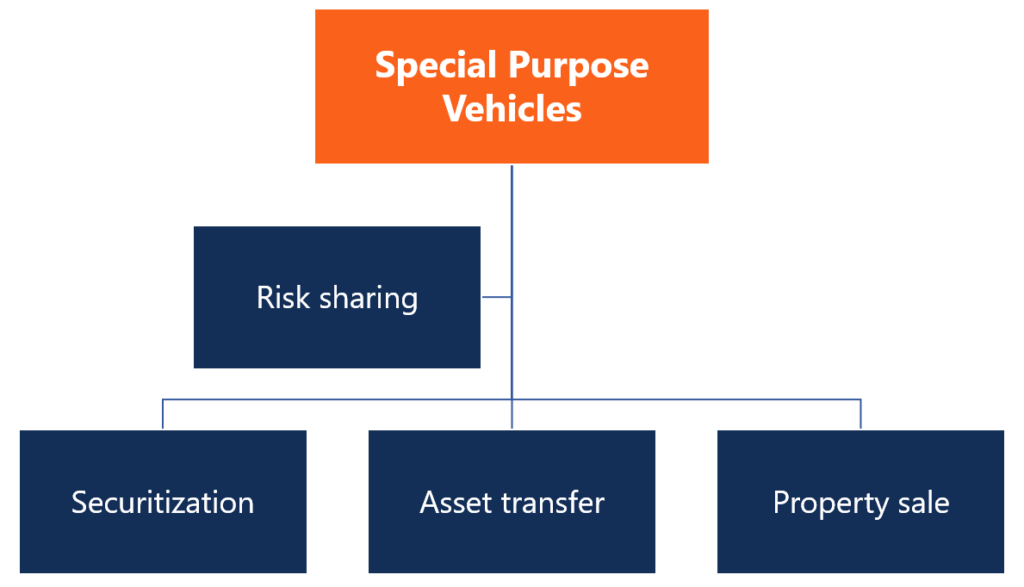
A special purpose vehicle can be a “bankruptcy-remote entity” because the operations of the entity are restricted to the purchase and financing of specific assets or projects.
The typical legal forms of special purpose vehicles are partnerships, limited partnerships, or joint venturesJoint Venture (JV)A joint venture (JV) is a commercial enterprise in which two or more organizations combine their resources to gain a tactical and strategic edge in the market. Companies often enter into a joint venture to pursue specific projects. The JV may be a new project or new core business. Moreover, in some cases, it is required that the SPV should not be owned by the company on whose behalf the entity is created.
Learn more in CFI’s Financial Analyst Training ProgramBecome a Certified Financial Modeling & Valuation Analyst (FMVA)®CFI's Financial Modeling and Valuation Analyst (FMVA)® certification will help you gain the confidence you need in your finance career. Enroll today!.
Uses of Special Purpose Vehicles
The following are the most common reasons for creating SPVs:
1. Risk sharing
A corporation’s project may entail significant risks. Creating an SPV enables the corporation to legally isolate the risks of the project and then share this risk with other investors.
2. Securitization
Securitization of loans is a common reason to create an SPV. For example, when issuing mortgage-backed securitiesMortgage-Backed Security (MBS)A Mortgage-backed Security (MBS) is a debt security that is collateralized by a mortgage or a collection of mortgages. An MBS is an asset-backed security that is traded on the secondary market, and that enables investors to profit from the mortgage business from a pool of mortgages, a bank can separate the loans from its other obligations by creating an SPV. The SPV allows investors in the mortgage-backed securities to receive payments for these loans before other creditors of the bank.
3. Asset transfer
Certain types of assets can be hard to transfer. Thus, a company may create an SPV to own these assets. When they want to transfer the assets, they can simply sell the SPV as part of a merger and acquisition (M&A) processMergers Acquisitions M&A ProcessThis guide takes you through all the steps in the M&A process. Learn how mergers and acquisitions and deals are completed. In this guide, we'll outline the acquisition process from start to finish, the various types of acquirers (strategic vs. financial buys), the importance of synergies, and transaction costs.
4. Property sale
If the taxes on propertyReal EstateReal estate is real property that consists of land and improvements, which include buildings, fixtures, roads, structures, and utility systems. Property rights give a title of ownership to the land, improvements, and natural resources such as minerals, plants, animals, water, etc. sales are higher than the capital gain realized from the sale, a company may create an SPV that will own the properties for sale. It can then sell the SPV instead of the properties and pay tax on the capital gain from the sale instead of having to pay the property sales tax.
Benefits and Risks of Special Purpose Vehicles
Benefits:
- Isolated financial risk
- Direct ownership of a specific asset
- Tax savings, if the vehicle is created in a tax haven such as the Cayman IslandsTop Banks in the Cayman IslandsThere are 111 banks in the Cayman Islands, the majority of which are branches (66) and subsidiaries (31) of international banks.
- Easy to create and set up the vehicle
Risks:
- Lower access to capital at the vehicle level (since it doesn’t have the same credit as the sponsor)
- Mark to Market accounting rules could be triggered if an asset is sold, significantly impacting the sponsor’s balance sheetBalance SheetThe balance sheet is one of the three fundamental financial statements. The financial statements are key to both financial modeling and accounting.
- Regulatory changes could cause serious problems for companies using these vehicles
- The optics surrounding SPVs are sometimes negative
Learn more from Wharton about special purpose vehicles and why companies use them.
Additional Resources
CFI is the official provider of the Financial Modeling and Valuation Analyst (FMVA)®Become a Certified Financial Modeling & Valuation Analyst (FMVA)®CFI's Financial Modeling and Valuation Analyst (FMVA)® certification will help you gain the confidence you need in your finance career. Enroll today! certification program, designed to transform anyone into a world-class financial analyst. To keep learning and advancing your finance career, we highly recommend the additional CFI resources below:
- Fixed Income SecuritiesFixed Income SecuritiesFixed income securities are a type of debt instrument that provides returns in the form of regular, or fixed, interest payments and repayments of the
- Investing: A Beginner’s GuideInvesting: A Beginner's GuideCFI's Investing for Beginners guide will teach you the basics of investing and how to get started. Learn about different strategies and techniques for trading
- Project Finance – A PrimerProject Finance - A PrimerProject finance primer. Project finance is the financial analysis of the complete life-cycle of a project. Typically, a cost-benefit analysis is used to
- Structured Investment Vehicle (SIV)Structured Investment Vehicle (SIV)A structured investment vehicle (SIV) is a non-bank financial entity set up to purchase investments designed to profit from the difference in interest rates - known as the credit spread - between short-term and long-term debt.
-
Forward Integration: Definition, Benefits & Examples
Forward integration is a form of vertical integrationVertical IntegrationA vertical integration is when a firm extends its operations within its supply chain. It means that a vertically integrated com
-

Funding Request: A Comprehensive Guide for Business Plans
The funding request section of a business planBusiness PlanA business plan is a document that outlines how and why a new business is being created. A well-researched and comprehensive business plan is
Business strategy
- Special Purpose Acquisition Companies (SPACs): A Comprehensive Overview
- Special Dividends: Understanding One-Time Distributions
- Holding Companies: Definition, Purpose & How They Work
- Kaizen: Understanding Continuous Improvement for Business
- Outsourcing: A Comprehensive Guide to Benefits & Strategy
- Ramp-Up: Definition, Benefits & How to Achieve It
- SPACs Explained: A Comprehensive Guide to Special Purpose Acquisition Companies
- Streamlining Processes: Definition, Benefits & Techniques
- What is a Special Purpose Acquisition Company (SPAC)?
-
 Understanding Empire Building: Strategies for Business Growth
In general, empire building is the process that an individual or entity undertakes to broaden the scope of its influence and power. In the business world, empire building entails the comprehensive ste...
-
 Exit Strategy: A Comprehensive Guide for Business Owners
An exit strategy is a plan for a partner or owner to transition out of ownership of a company. It is accomplished through a merger and acquisition (M&A) with another company, through an initial pu...