
Supply Chain Management: Definition, Process & Key Components
A supply chain is an entire system of producing and delivering a product or service, from the very beginning stage of sourcing the raw materials to the final delivery of the product or service to end-users. The supply chain lays out all aspects of the production process, including the activities involved at each stage, information that is being communicated, natural resources that are transformed into useful materials, human resources, and other components that go into the finished product or service.
Why Should A Company Understand Its Supply Chain?
Mapping out a supply chain is one of the critical steps in performing an external analysisExternal AnalysisExternal analysis means examining the industry environment of the company, including factors such as competitive structure, competitive position, dynamics in a strategic planning processStrategic AnalysisStrategic analysis refers to the process of conducting research on a company and its operating environment to formulate a strategy. The definition. The importance of clearly laying out the supply chain is that it helps a company define its own market and decide where it wants to be in the future. In developing corporate-level strategiesCorporate StrategyCorporate Strategy focuses on how to manage resources, risk and return across a firm, as opposed to looking at competitive advantages in business strategy, a company often needs to make decisions on whether to operate a single line of business or enter into other related or unrelated industries.
Each stage of a supply chain is essentially a different industry, for example, raw material extraction and manufacturing. The supply chain enables a company to understand others that are involved in each of the stages, and thereby provides some insights on the attractiveness or competitiveness in industries the company might want to enter in the future.
Supply Chain Examples
Let’s look at two different examples of a supply chain.
Generic Supply Chain
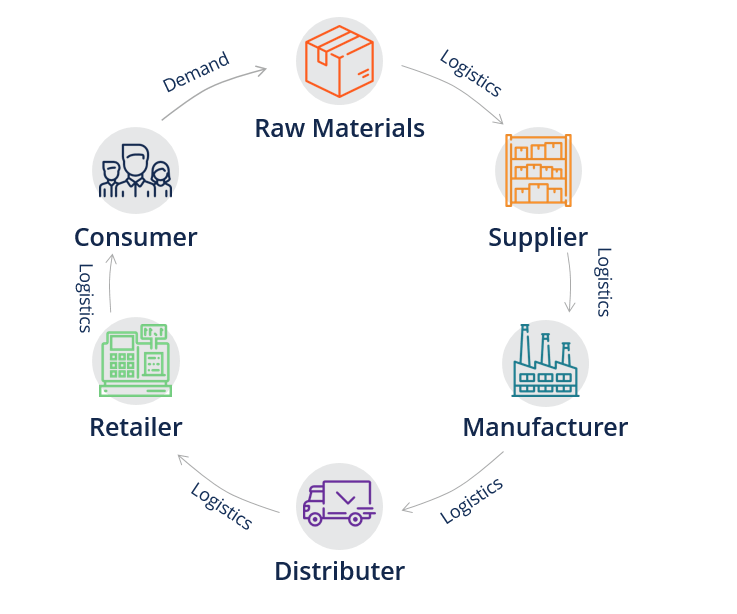
The generic supply chain begins with the sourcing and extraction of raw materials. The raw materials are then taken by a logistics provider to a supplier, which acts as the wholesaler. The materials are taken to a manufacturer, or probably to various manufacturers that refine and process them into a finished product.
Afterward, it goes to a distributor that wholesales the finished product, which is next delivered to a retailer. The retailer sells the product in a store to consumers. Once the consumer buys it, this completes the cycle, but it’s the demand that then goes back and drives the production of more raw materials, and the cycle continues.
Supply Chain for an e-Commerce Company
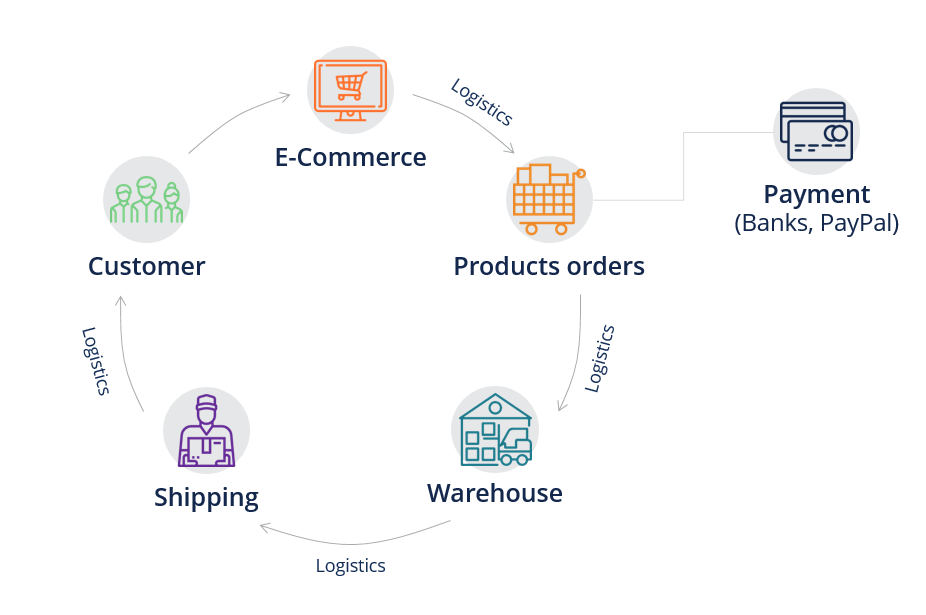
In this example, the e-commerce company operates a website, and that website sells various products. When a customer places an order for a product, the product order is being processed by technology such as a checkout cart, an order system, or a third-party product such as Shopify. The payment processors then come in and deal with payment transactions for the order, which actually opens up a new supply chain.
The payment processors use their own systems but, in most cases, third parties such as PayPalPayPal HoldingsPayPal Holdings, Inc. is one of the largest online payments companies that allow parties to make payments through online funds transfers. The online payment system offers electronic alternatives to traditional payment methods such as money order and checks. PayPal provides a platform for online vendors, auction sites, and Stripe are employed, and they involve banks and other providers. When a product order is placed, the warehouse receives the order and ensures the product is ready for delivery. The warehousing company can be either in-house or a third-party logistics provider.
The order then goes from the warehouse to the shipping company. Once again, the shipping may be in-house or a third-party shipping company. After shipping, the package arrives at the customer’s door and the customer receives it.
More Related Resources
Thank you for visiting our resource on supply chains. To learn more about external analysis and how to perform strategic analysis, enroll in our Corporate & Business Strategy course today!
Additional relevant CFI resources include:
- Bargaining Power of BuyersBargaining Power of BuyersThe bargaining power of buyers, one of the forces in Porter’s Five Force Industry Analysis framework, refers to the pressure that customers/consumers can
- Bargaining Power of SuppliersBargaining Power of SuppliersThe Bargaining Power of Suppliers, one of the forces in Porter’s Five Forces Industry Analysis Framework, is the mirror image of the bargaining power
- External AnalysisExternal AnalysisExternal analysis means examining the industry environment of the company, including factors such as competitive structure, competitive position, dynamics
- All Strategy ResourcesStrategyCorporate and business strategy guides. Read all CFI articles and resources on business and corporate strategy, important concepts for financial analysts to incorporate in their financial modeling and analysis. First mover advantage, Porter's 5 Forces, SWOT, competitive advantage, bargaining power of suppliers
-

DeFi Explained: A Beginner's Guide to Decentralized Finance
The Beginner’s Guide to Decentralized FinanceIf you’re diving deep into the world of cryptocurrency, you have probably heard the term “DeFi” used to describe a variety of new protocols and assets. Fi
-
0x: A Comprehensive Guide to Decentralized Ethereum Trading
What Is 0x? 0x is a decentralized exchange for trading ERC 20 tokens. (See also: What Is ERC 20 And What Does It Mean For Ethereum?). It is among the most high-profile examples of decentra
Business strategy
- Understanding Long-Run Supply: Definition & Market Dynamics
- Understanding Short-Run Supply: Fixed Assets & Production
- Visible Supply: Definition, Importance & Examples
- Disintermediation: Definition, Benefits & Examples
- External Analysis: Understanding Your Industry & Market
- Supply Chain Management: Definition, Process & Key Components
- Bitcoin Halving Explained: Understanding Supply & Value
- Understanding Bitcoin Price: Factors Influencing Value
- Binance Smart Chain (BSC): A Comprehensive Overview
-
DB(k) Plans: A Hybrid Retirement Solution for Employers & Employees
The DB(k) plan is a type of retirement plan that is available for employers. This type of retirement plan combines features from the 401(k) plan with features from a defined benefit pension plan...
-
 Understanding Regulation Z: Your Rights as a Borrower
Regulation Z is a consumer-protection regulation that compels lenders to disclose the cost of credit in a clear way for consumers. Whether you’re applying for a mortgage or dealing...