
Understanding Short-Run Supply: Fixed Assets & Production
The short-run is the time period in which at least one input is fixed – generally property, plant, and equipment (PP&E)PP&E (Property, Plant and Equipment)PP&E (Property, Plant, and Equipment) is one of the core non-current assets found on the balance sheet. PP&E is impacted by Capex,. An increase in demand can only be met by increasing the usage of variable factors of production. Therefore, short-run supply is the supply given the firm’s investment in fixed assets.
Summary
- Short-run supply is defined as the current supply given a firm’s capital expenditure on fixed assets – such as property, plant, and equipment.
- The break-even price is equal to the minimum average total cost.
- The short-run market equilibrium is the point where the quantity supplied equals the quantity demanded, where the number of producers is held fixed.
What are Short Run Costs?
At any point in time, a firm sees a short-run cost curve that corresponds to its investment in fixed assetsFixed AssetsFixed assets refer to long-term tangible assets that are used in the operations of a business. They provide long-term financial benefits – such as property, plant, and equipment. If the firm wishes to change its output, it will move along the curve.
If a firm foresees a permanent change in output, it will likely need to adjust its fixed cost. In order to produce efficiently, the firm should adjust its fixed costs to a level that minimizes the average total cost of production.
The Short-Run Production Decision
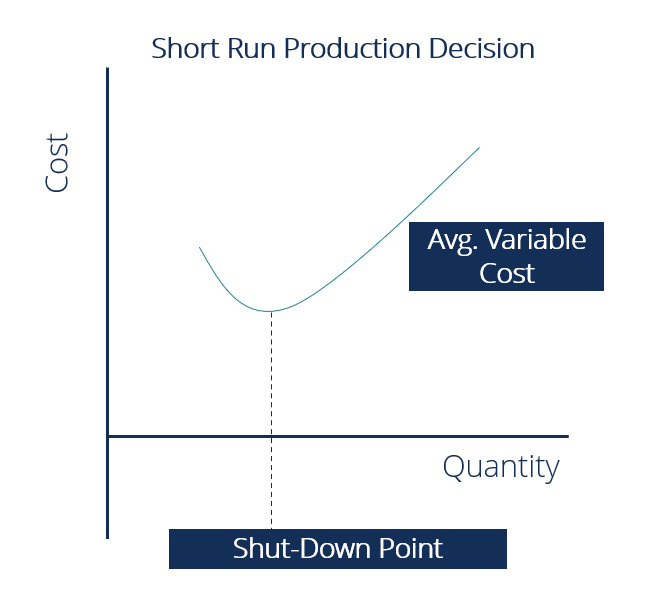
Since fixed costs are considered to be sunk in the short run, they are irrelevant in the short-run production decision process. It is because, in the short run, fixed cost is paid regardless of the amount produced. A firm will only shut down production if the market price is lower than the minimum average variable cost of the product.
Therefore, the shut-down price is equal to the minimum average variable cost. When the market price is less than the minimum average variable cost, the price received by the firm is less than the variable cost. Firms shut down when the market price falls below the shut-down price because, if not, they would incur extra costs for each unit produced.
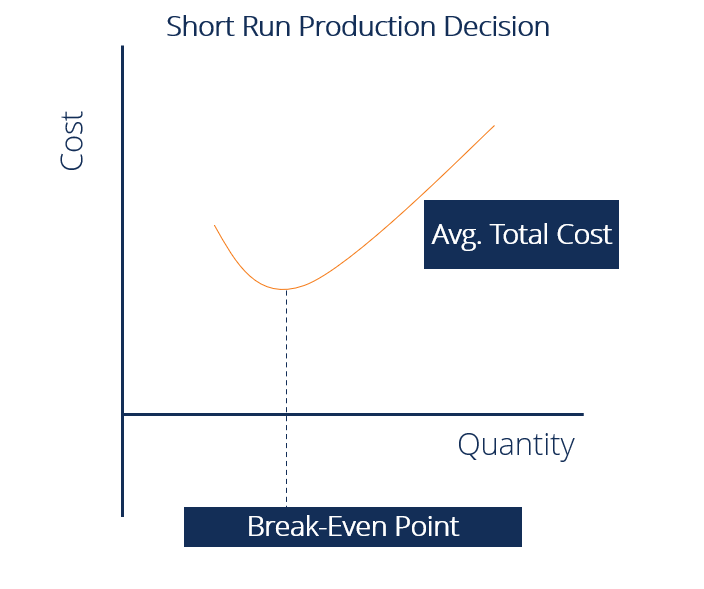
The break-even price is when the market price is equal to the minimum average total cost of production. If the market price is less than the minimum average total cost, the firm will still produce; however, it will be making an economic loss. Whereas if the minimum average total cost is less than the market price, the firm will make an economic profitEconomic ProfitEconomic profit (or loss) refers to the difference between the total revenues, less costs, and the opportunity cost associated with the.
Short-Run Supply Curve
The short-run individual supply curve is the individual’s marginal cost at all points greater than the minimum average variable cost. It holds true because a firm will not produce if the market price is lesser than the shut-down price.
Ultimately, the short-run individual supply curve demonstrates how the producer’s profit-maximizing output is strictly dependent on the market price and holds the fixed cost as sunk.
Short-Run Industry Supply Curve
A short-run industry supply curve illustrates how quantity supplied in the market is dependent on the market price, assuming that the number of producers in the market is fixed. The short-run market equilibrium is the point where the quantity supplied equals the quantity demanded, where the number of producers is held fixed. This is also known as the allocative efficient point.
Calculating the Short-Run Industry Supply Curve
The short-run industry supply curve is calculated by taking an individual producer’s supply curve, setting it equal to quantity, and then multiplying it by the number of producers in the market
For example, consider a producer with the following supply curve:
P = 2Q + 1
Assuming that there are 10 producers in the market and there is a market demand curve of:
P = -1Q + 10
First, set the individual producer supply curve equal to quantity supplied:
Q = (P – 1)/2 -> Q = P/2 – .5
Then, multiply the quantity supplied formula by the number of producers in the market:
Q = 5P – 5
To identify the short-run market equilibrium, substitute the market supply formula into the market demand formula to calculate the equilibrium price:
P = -1 (5P – 5) + 10
P = 2.5
Finally, add the equilibrium price into either the market demand or market supply formula to calculate the market quantity demanded:
2.5 = -1Q + 10
Q = 7.5
Related Readings
CFI is the official provider of the global Commercial Banking & Credit Analyst (CBCA)™Program Page - CBCAGet CFI's CBCA™ certification and become a Commercial Banking & Credit Analyst. Enroll and advance your career with our certification programs and courses. certification program, designed to help anyone become a world-class financial analyst. To keep advancing your career, the additional resources below will be useful:
- DemandDemandDemand is a principle that refers to a consumer’s willingness to pay for a good or service. Under the assumption that all else is equal, an
- Equilibrium QuantityEquilibrium QuantityEquilibrium quantity refers to the quantity of a good supplied in the marketplace when the quantity supplied by sellers exactly matches the
- Indifference CurveIndifference CurveAn indifference curve is a contour line where utility remains constant across all points on the line. In economics, an indifference curve is
- Fixed and Variable CostsFixed and Variable CostsCost is something that can be classified in several ways depending on its nature. One of the most popular methods is classification according
-

Understanding Secular Markets: Long-Term Trends & Investment Strategies
A secular market is predominantly driven and impacted by elements or forces that are likely to be present in the foreseeable future. The forces can impact the price or value of a financial assetFinanc
-
Sensex Explained: Understanding India's Key Stock Market Index
Sensex, also known as the S&P BSE Sensex Index, is the benchmark index that tracks India’s Bombay Stock Exchange (BSE). The Sensex is composed of the 30 largest and most-traded stocks within
finance
- Eurodollars: Understanding Foreign Currency Time Deposits
- Understanding Markets: Definition, Types & Examples
- Understanding Auction Markets: How Prices Are Determined
- Doji Candlestick Pattern: Meaning & Trading Signals
- Understanding Frothy Markets: Risks & Opportunities
- Understanding Inefficient Markets: Causes & Implications
- Understanding Market Cycles: Trends & Economic Environments
- Understanding Market Depth: A Guide for Traders
- Understanding Market Exposure: Risk & Portfolio Allocation
-
 Understanding Quote-Driven Markets: A Guide for Investors
A quote-driven market is a type of secondary market trading structure where investors trade with dealers. Nearly all bonds, currenciesCurrencyCurrency refers to money, that which is used as a medium o...
-
 Understanding Stock Rallies: Definition & What Causes Them
A rally refers to a period of continuous increase in the prices of stocks, indexes or bondsBondsBonds are fixed-income securities that are issued by corporations and governments to raise capital. The ...