
Understanding Long-Run Supply: Definition & Market Dynamics
The long-run supply is the supply of goods available when all inputs are variable. It means that in the long run, all property, plant, and equipment expenditure is variable. Furthermore, in the long run, the number of producers in the market is not fixed. Therefore, new firms will enter the market if there are economic profits, and some firms will leave the market if they are experiencing an economic loss.
In the long run, there are zero economic profits, meaning that firms will only earn an ordinary profit. It implies that the long-run supply curve will always be more elastic than the short-run supply curve because, in the long run, all firms make zero economic profitEconomic ProfitEconomic profit (or loss) refers to the difference between the total revenues, less costs, and the opportunity cost associated with the.
Summary
- The long-run supply is the supply of goods available when all inputs are variable.
- The long-run supply curve is always more elastic than the short-run supply curve.
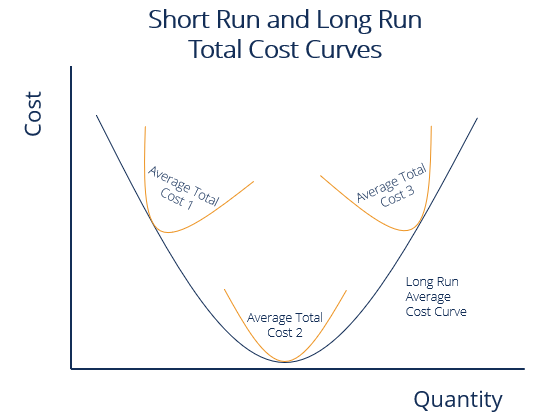
- The long-run average cost curve envelopes the short-run average cost curves in a u-shaped curve.
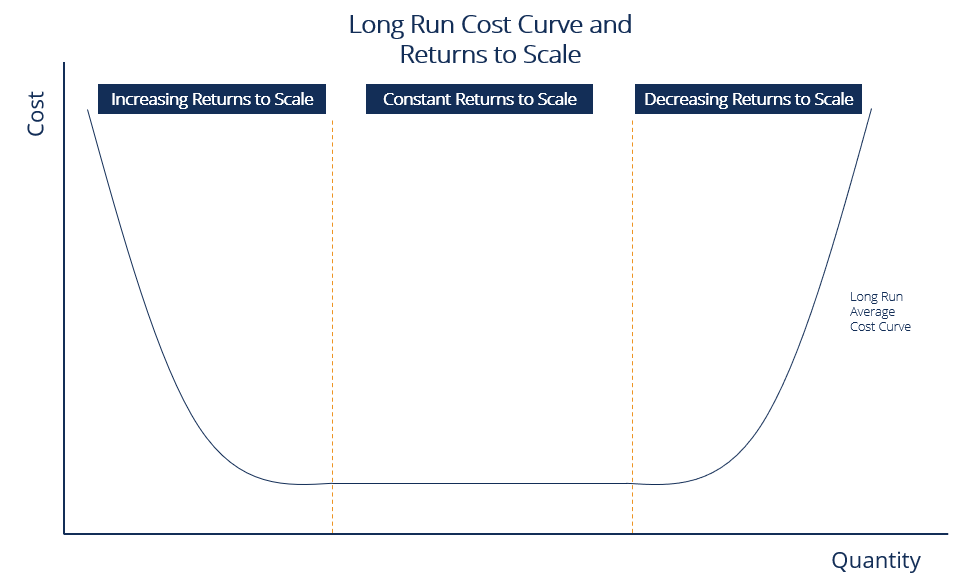
- Returns to scale can be determined by assessing if the long-run average cost curve is downwards sloping, constant, or upwards sloping at the quantity output.
Relationship Between Short-Run and Long-Run Average Total Cost Curves
Short-run and long-run average total cost curves differ because, in the short run, fixed assetsFixed AssetsFixed assets refer to long-term tangible assets that are used in the operations of a business. They provide long-term financial benefits are held fixed, whereas, in the long run, all costs are variable. It implies that each point on the long-run average total cost curve would minimize the average total cost for reach level of output.
The graphical relationship between the short-run average total cost curves and the long-run average total cost curves demonstrates how the average total cost is minimized for each level of output in the long run. Such a condition holds true at the point of tangency between the short-run average cost curve and the long-run average cost curve.
Returns to Scale
Scale is a major factor in a firm’s long-run average total cost of production, and firms that operate scale find that their long-run average total costs vary substantially by the amount of output produced. There are three major types of scale to be considered:
- Economies of Scale
- Constant Returns to Scale
- Diseconomies of Scale
Economies of Scale
Firms experience economies of scale, otherwise known as increasing returns to scale, when the firm’s long-run average total cost becomes smaller as output is increasing. Firms employ economies of scale to create larger profit marginsProfit MarginIn accounting and finance, profit margin is a measure of a company's earnings relative to its revenue. The three main profit margin metrics on the output produced. They experience economies of scale (increasing returns to scale) when the long-run average cost curve is downwards sloping.
Economies of scale generally occur because of:
1. Specialization
A larger scale of operations allows individual workers to specialize in a few specific tasks and become highly skilled at them. It will allow firms to produce output more efficiently.
2. Large initial setup cost
If an industry requires large initial capital expenditure to operate, firms that can afford the capital expenditure will experience increasing returns to scale.
3. Network externalities
The network effect is the impact of an additional user of a good or service on the value of that good or serviceProducts and ServicesA product is a tangible item that is put on the market for acquisition, attention, or consumption while a service is an intangible item, which arises from to others. For example, if a social media platform only lists a hundred users, likely, it will not be very valuable for a social media user. Whereas if a social media platform counts one billion users, the social media service is more valuable to its users.
Constant Returns to Scale
Firms experience constant returns to scale when its long-run average total cost increases proportionally to the increase in output. Therefore, scale does not impact the long-run average cost of the firm. Firms experience constant returns to scale when the long-run average cost curve is flat. The area of constant returns to scale is around the center of the curve.
Diseconomies of Scale
Firms experience diseconomies of scale, otherwise known as decreasing returns to scale, when long-run average total cost increases at a greater rate than output. Firms that experience diseconomies of scale create smaller profit margins on the output produced.
Diseconomies of scale occur in large firms when there are problems of coordination or communication. It is because as firms grow, communicationCommunicationBeing able to communicate effectively is one of the most important life skills to learn. Communication is defined as transferring information to produce greater understanding. It can be done vocally (through verbal exchanges), through written media (books, websites, and magazines), visually (using graphs, charts, and maps) or non-verbally across the firm becomes more expensive and costly. Diseconomies of scale (decreasing returns to scale) can be observed graphically when the long-run average cost curve is sloping upwards.
More Resources
CFI is the official provider of the Commercial Banking & Credit Analyst (CBCA)™Program Page - CBCAGet CFI's CBCA™ certification and become a Commercial Banking & Credit Analyst. Enroll and advance your career with our certification programs and courses. certification program, designed to transform anyone into a world-class financial analyst.
In order to help you become a world-class financial analyst and advance your career to your fullest potential, these additional resources will be very helpful:
- Capital ExpendituresCapital ExpendituresCapital expenditures refer to funds that are used by a company for the purchase, improvement, or maintenance of long-term assets to improve
- Diseconomies of ScaleDiseconomies of ScaleDiseconomies of scale occur when an additional production unit of output increases marginal costs, which results in reduced profitability
- Short-Run SupplyShort-Run SupplyThe short-run is the time period in which at least one input is fixed – generally property, plant, and equipment (PPE). An increase in demand
- Supply and DemandSupply and DemandThe laws of supply and demand are microeconomic concepts that state that in efficient markets, the quantity supplied of a good and quantity
-

Understanding Acquisition Cost: Definitions & Applications
Acquisition cost is the cost of purchasing an asset. It is generally used in three different contexts in business, which include the following:Mergers and acquisitionsFixed assetsCustomer acquisition&
-

Cost Principle Explained: Importance for Small Businesses | GAAP
The cost principle states that any asset should b
finance
- Pool Heating Costs: A Comprehensive Guide to Average Expenses & Savings
- Room Addition Costs: A Comprehensive Cost Breakdown
- Bitcoin Mining Costs: A Comprehensive Breakdown (2024)
- Understanding the Cost of Preferred Stock: A Key Capital Metric
- Levelized Cost of Energy (LCOE): Definition & Calculation
- Minimum Efficient Scale (MES): Definition & Importance
- Cost Recovery Method: Understanding Revenue Recognition
- Variable Cost Ratio: Definition, Calculation & Importance
- Average Vacation Cost: A Comprehensive Breakdown for 2024
-
 Attic Insulation Costs: Average Prices & Savings
Insulating an attic is cheapest when done at the same time as other house insulation. When most homes are built, attics are insulated along with the rest of the house. But in some cases attic...
-
 Air Force Pay Scale: Salaries, Ranks & Benefits (2024)
Air Force pilots hold officer rank and receive salary depending on rank and time in service. The Defense Finance and Accounting Service publishes the pay scale for the Air Force. The pay scal...