
Understanding the Threat of New Entrants: A Porter's Five Forces Analysis
The Threat of New Entrants, one of the forces in Porter’s Five Forces industry analysis frameworkIndustry AnalysisIndustry analysis is a market assessment tool used by businesses and analysts to understand the complexity of an industry. There are three commonly used and, refers to the threat that new competitors pose to current players within an industry. It is one of the forces that shape the competitive landscape of an industry and that helps determine the attractiveness of an industry. The framework was developed by Michael Porter at Harvard University.
The other forces are competitive rivalry, bargaining power of buyers, the threat of substitutes, and the bargaining power of suppliers.
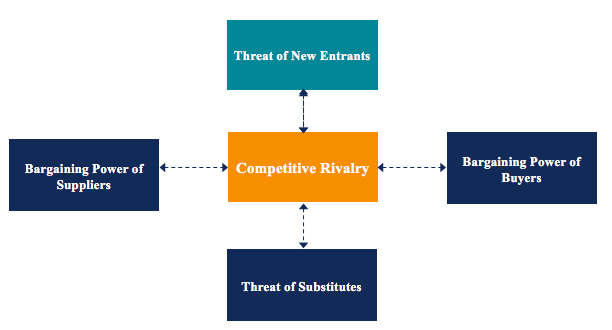
The Threat of New Entrants Explained
The Threat of New Entrants exerts a significant influence on the ability of current companies to generate a profitGross ProfitGross profit is the direct profit left over after deducting the cost of goods sold, or cost of sales, from sales revenue. It's used to calculate the gross profit margin.. When new competitors enter into an industry offering the same products or services, a company’s competitive position will be at risk. Therefore, the threat of new entrants refers to the ability of new companies to enter into an industry.
Barriers to New Entry
The Threat of New Entrants depends on the barriers to entryBarriers to EntryBarriers to entry are the obstacles or hindrances that make it difficult for new companies to enter a given market. These may include. The barriers refer to the existence of high costs or obstacles that can deter new competitors from entering the industry.
Barriers to entry include:
- Brand loyalty: Customers in the industry show a strong preference for the products and/or services of existing companies.
- Cost advantages: Existing companies can easily produce and offer their products and/or services at a lower cost/price than that of new entrants.
- Government regulationsFiscal PolicyFiscal Policy refers to the budgetary policy of the government, which involves the government controlling its level of spending and tax rates
- Capital requirement: A high fixed cost to enter into an industry, e.g., telecommunications.
- Access to suppliers and distribution channels: Existing companies own exclusive rights to suppliers and distribution channels.
- Retaliation: Existing companies may collude and deter new entrants.
High Threat of New Entrants When:
- Low brand loyalty in the current industry
- Current brand names are not well-known
- Low initial capital investment required
- Access to suppliers and distribution channels is easy to obtain
- Weak government regulations
- No threat of retaliation
- Proprietary technology is not required
Low Threat of New Entrants When:
- High brand loyalty in the current industry
- Brand names are well-known
- High initial capital investment required
- Little to no access to suppliers and distribution channels
- Strong government regulations
- Threat of retaliation from existing competitors
- Proprietary technology is required to be successful
Barriers to Entry and the Threat of New Entrants:
A low threat of new entrants makes an industry attractive – there are high barriers to entry. Therefore, existing companies are able to enjoy increased profit potential.

A high threat of new entrants makes an industry less attractive – there are low barriers to entry. Therefore, new competitors are able to easily enter into the industry, compete with existing firms, and take market share. There is a reduced profit potential as more competitors are in the industry.

Example Analysis
Let us consider whether JetBlue, a company in the airline industry, faces a high or low threat of new entrants.
New entrants to the airline industry pose a very low threat to JetBlue. First, the barriers to entry are remarkably high, as several airplanes are required to compete in the airline industry. Operating costs are massive and there are major government regulations for companies in the industry. Therefore, it is safe to say that the threat of new entrants in the airline industry is low as barriers to entry are high.
However, the threat of new entrants alone does not determine the overall attractiveness of an industry. The remaining forces (bargaining power of buyers, rivalry among existing competitors, bargaining power of suppliers, and the threat of substitutes) must be taken into consideration when determining overall industry attractiveness.
Related Reading
Thank you for reading this guide to performing industry analysis. CFI is the official provider of the Financial Modeling & Valuation Analyst (FMVA)™ certificationBecome a Certified Financial Modeling & Valuation Analyst (FMVA)®CFI's Financial Modeling and Valuation Analyst (FMVA)® certification will help you gain the confidence you need in your finance career. Enroll today!. To prepare for the FMVA curriculum, these additional CFI resources will be helpful:
- Market EconomyMarket EconomyMarket economy is defined as a system where the production of goods and services are set according to the changing desires and abilities of
- Law of SupplyLaw of SupplyThe law of supply is a basic principle in economics that asserts that, assuming all else being constant, an increase in the price of goods
- MonopolyMonopolyA monopoly is a market with a single seller (called the monopolist) but with many buyers. In a perfectly competitive market, which comprises
- Inelastic DemandInelastic DemandInelastic demand is when the buyer’s demand does not change as much as the price changes. When price increases by 20% and demand decreases by
-

FINRA: Protecting Investors and Regulating the U.S. Securities Industry
The Financial Industry Regulatory Authority (or FINRA) is a non-governmental organization that acts as a self-regulatory organization for securities firms that operate in the United States. The goal o
-

NYBOT: Understanding the New York Board of Trade - Commodity Futures Exchange
Founded and established in 1870, the New York Board of Trade (NYBOT) is a physical commodity futures exchange. The NYBOT is located in New York City and trades futures and/or optionsOptions: Calls and
Business strategy
- Understanding Industry Trends: Impact & Significance
- Jumbo Loans in New Jersey: Definition & Requirements
- Herfindahl-Hirschman Index (HHI): Understanding Market Concentration
- Understanding Industry Knowledge: Benefits & Importance
- 5C Analysis: A Comprehensive Framework for Business Strategy
- Porter's Five Forces: A Comprehensive Guide to Competitive Analysis
- Industry Analysis: A Comprehensive Guide for Business Insights
- Understanding the Industry Life Cycle: Stages & Dynamics
- Understanding Industry Maturity: A Comprehensive Guide
-
 Amazon Credit Builder Card: A Guide to Improving Your Credit Score
Whatever your history, whether it's checkered or nonexistent, building credit can be rough. Millennials are practically by definition neck-deep in debt, which has psychic costs as well as financia...
-
 Unlock True Freedom: New Book Reveals the Path to Liberation
Freedom. It’s the highest aim in life. But for years, I was unfree in a free world. Unwanted responsibilities kept me caged.In my latest book, I share how I finally became free. The book is called&nbs...