
Herfindahl-Hirschman Index (HHI): Understanding Market Concentration
The Herfindahl-Hirschman Index is an index that measures the market concentration of an industry. A highly concentrated industry is one where only a few players in the industry hold a large percentage of the market share, leading to a near-monopolisticMonopolistic CompetitionMonopolistic competition is a type of market structure where many companies are present in an industry, and they produce similar but situation. A low degree of concentration means that the industry is closer to a perfect competition scenario, where many firms of more or less equal size share the market.
The Herfindahl-Hirschman Index is used to monitor the potential impact of mergers and acquisitionsMergers Acquisitions M&A ProcessThis guide takes you through all the steps in the M&A process. Learn how mergers and acquisitions and deals are completed. In this guide, we'll outline the acquisition process from start to finish, the various types of acquirers (strategic vs. financial buys), the importance of synergies, and transaction costs on an industry. It is a quantitative measure that regulators can cite to veto an M&A transaction. Conversely, companies can include the index in their M&A proposals to indicate that the merger would not lead to a monopolistic market. The lower the HHI is, the more power consumers hold in that industry. Thus, prices are usually lower, and company margins compressed.
How is the Herfindahl-Hirschman Index (HHI) Calculated?
To calculate the Herfindahl-Hirschman Index, we take the percentage market share of each firm in an industry, square that number, and then add all the squares together. The formula to calculate Herfindahl-Hirschman Index is as follows:
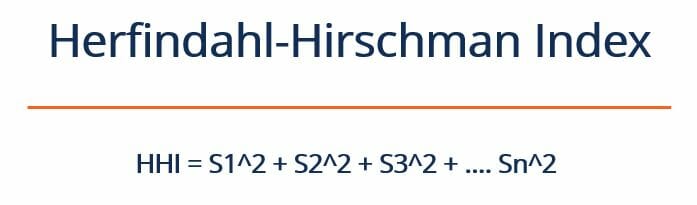
Where:
S1, S2, etc… – refers to the percentage market share that various companies hold in the given industry
Herfindahl-Hirschman Index Scale
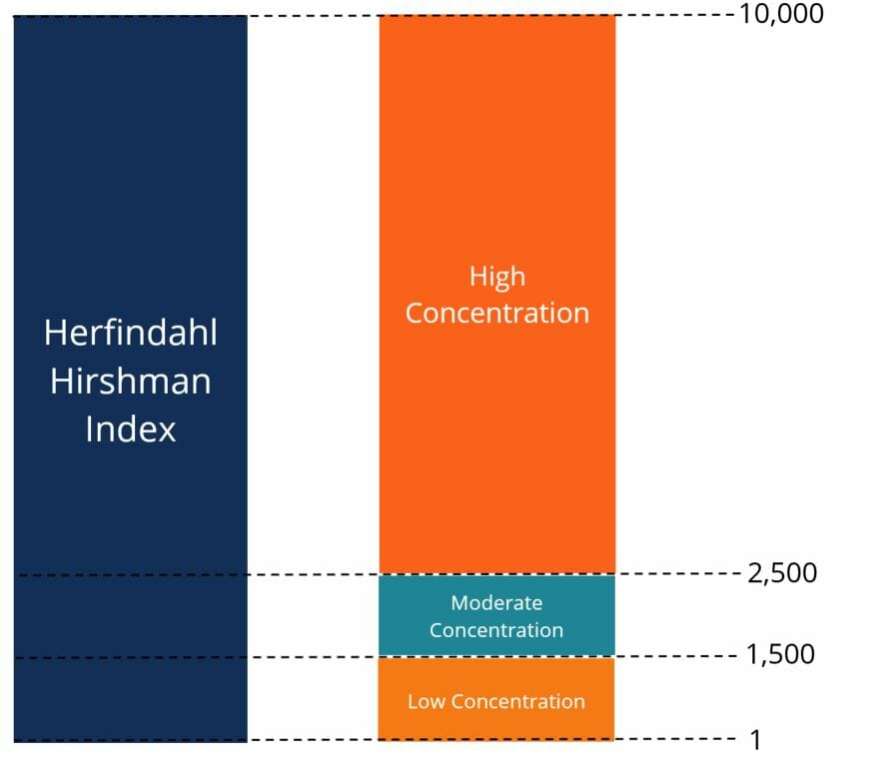
The Herfindahl-Hirschman Index ranges from 1 (least concentrated) to 10,000 (most concentrated). The 10,000 figure comes from a theoretical scenario where there is only one company operating in the industry, with 100% of the market share. According to the U.S. Department of Justice, an HHI of less than 1,500 represents an industry with low market concentration. An HHI ranging between 1,500 and 2,500 represents moderate concentration. HHI values of more than 2,500 represent a highly concentrated industry. The graphic below illustrates this classification:
The U.S. Department of Justice also maintains a general rule of thumb that if an M&A transaction is projected to raise an industry’s HHI by more than 200 points, there could be legitimate concerns that the transaction might breach certain antitrust laws. Thus, such transactions are subject to greater scrutiny. The deal makers would need to offer evidence that the merger would not make the industry excessively shift towards a monopolistic scenario.
Herfindahl-Hirschman Index Example
Consider an American industry comprised of eight firms, with market shares of 35%, 20%, 6%, 4%, 3%, 10%, 13%, and 9%, respectively. The government wants to assess the degree of concentration of the industry.
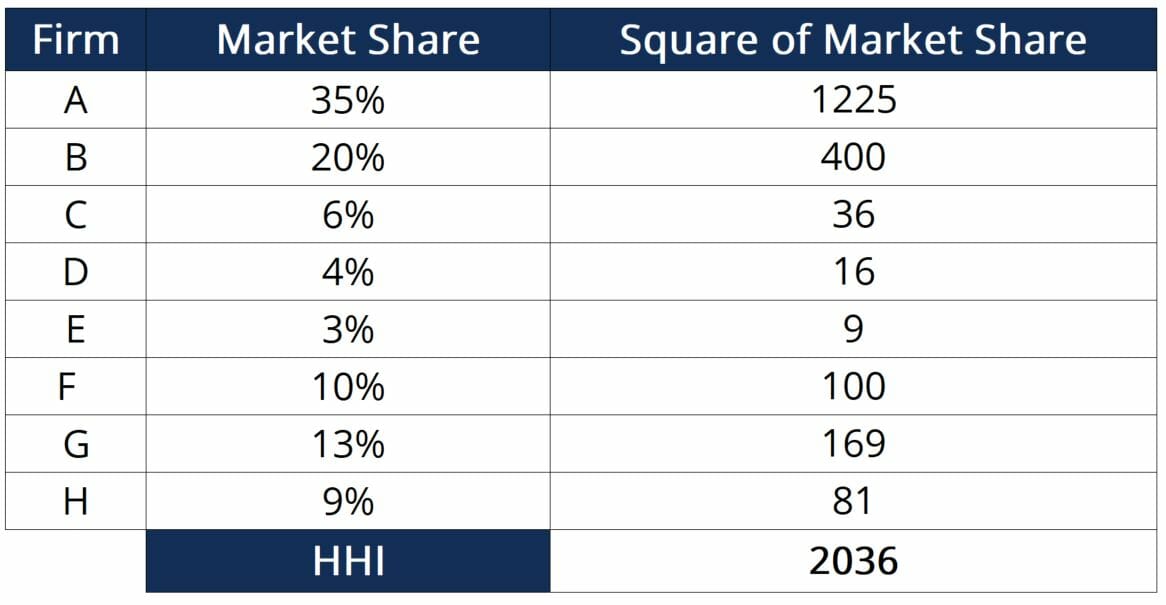
In the table above, we see that the HHI of the industry in question is 2,036, which classifies it as a moderately concentrated industry. Further M&As led by Firm A could potentially raise the HHI by more than 200 points and even push the index to over 2,500.
It is also important to note that in the calculation of the squares, the whole number version of the percentages is used. For example, Firm A’s contribution to HHI is 1,225, which is the square of 35, not the square of 0.35.
Additional Resources
Thank you for reading CFI’s explanation of the Herfindahl-Hirschman Index. CFI offers the Financial Modeling & Valuation Analyst (FMVA)™Become a Certified Financial Modeling & Valuation Analyst (FMVA)®CFI's Financial Modeling and Valuation Analyst (FMVA)® certification will help you gain the confidence you need in your finance career. Enroll today! certification program for those looking to take their careers to the next level. To learn more about related topics, check out the following CFI resources:
- Mergers and Acquisitions M&A course
- Relative Strength Index (RSI)Relative Strength Index (RSI)The Relative Strength Index (RSI) is one of the most popular and widely used momentum oscillators. It was originally developed by the famed mechanical engineer turned technical analyst, J. Welles Wilder. The RSI measures both the speed and rate of change in price
- Types of MergersTypes of MergersA merger refers to an agreement in which two companies join together to form one company. In other words, a merger is the combination of two companies into a single legal entity. In this article, we look at different types of mergers that companies can undergo. Types of Mergers There are five different types of
- Big Mac IndexBig Mac IndexThe Big Mac Index is a tool devised by economists in the 1980s to examine whether the currencies of various countries offer roughly equal levels of basic affordability. The Big Mac Index is based on the theory of Purchasing Power Parity (PPP).
-

Hang Seng Index (HSI): A Comprehensive Guide to Hong Kong's Stock Market
The Hang Seng Index (HSI) is a stock market index in Hong Kong. It records and monitors the daily changes in stock prices of the 50 largest Hong Kong stock market companies. As the companies represent
-
Herrick Payoff Index: Understanding Derivative Market Trends
The Herrick Payoff Index is a forward-looking technical analysis tool used to identify trends in derivative markets. Using price, volume, and open interest, the index provides an overview of money flo
finance
- Advance-Decline Line: Understanding Market Sentiment & Trends
- Arms Index (TRIN): Understanding Short-Term Market Sentiment
- DAX Index: Your Guide to Germany's Top 30 Companies
- EAFE Index: Understanding Developed Market Performance
- KBW Bank Index: Tracking US Banking Sector Performance
- NASDAQ-100 Index: Definition, Components & Historical Data
- Nikkei Index: Understanding Japan's Top Stock Market Indicator
- Price-Weighted Index Explained: How It Works & Examples
- Understanding the S&P 500: Top Holdings & Long-Term Performance
-
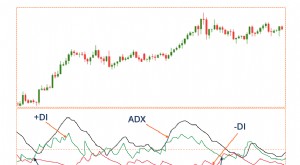 DMI: Understanding the Directional Movement Index for Trading
The Directional Movement Index (DMI) is an indicator that helps in determining the direction the asset price is moving and the strength of the price movement. It does so by comparing the current price...
-
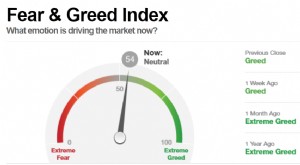 Fear & Greed Index: Understanding Investor Sentiment | CNN Business
The Fear and Greed Index, developed by CNNMoney, is used to gauge whether investors are too bullish or bearish on the stock market. The index ranges from 0 (extreme fear) to 100 (extreme greed). ...