
Vertical Mergers: Definition, Examples & Impact on Business
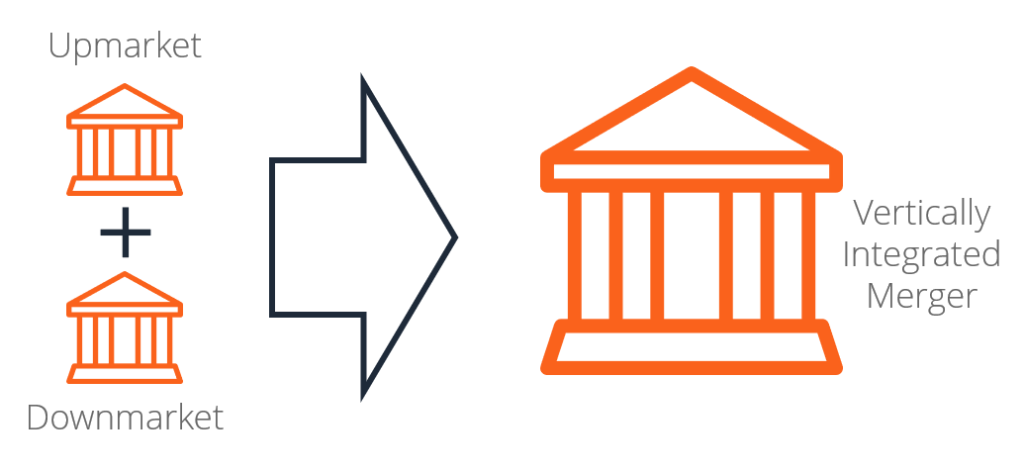
A vertical merger is a union between two companies in the same industry but at different stagesBusiness Life CycleThe business life cycle is the progression of a business in phases over time, and is most commonly divided into five stages of the production process. In other words, a vertical merger is the combination and integration of two or more companies that are involved in different stages of the supply chain in the production of goodsInventoryInventory is a current asset account found on the balance sheet, consisting of all raw materials, work-in-progress, and finished goods that a or services.
Reasons for a Vertical Merger
In a merger, two companies agree to integrate their operations together on a co-equal basis. A vertical merger integration creates value in that the businesses merging together should be worth more than they would be under independent ownershipStockholders EquityStockholders Equity (also known as Shareholders Equity) is an account on a company's balance sheet that consists of share capital plus. Therefore, the rationale behind this type of merger is to increase synergiesM&A SynergiesM&A Synergies occur when the value of a merged company is higher than the sum of the two individual companies. 10 ways to estimate operational synergies in M&A deals are: 1) analyze headcount, 2) look at ways to consolidate vendors, 3) evaluate any head office or rent savings 4) estimate the value saved by sharing and be more efficient operating as one entity. The following are the common reasons for a vertical merger:
- Reduce operating costs
- Realize higher profits
- Ensure tighter quality control
- Better flow and control of information along the supply chain
- Synergies: operating synergy, financial synergy, managerial synergy, etc.
Potential Synergies Created in a Vertical Merger
Below are the potential synergies created through a vertical merger:
1. Operating synergy
A vertical merger facilitates better coordination and administration along the supply chain. For example, the uncertainty of inputs and demand for a product can be minimized and costs of communication can be saved.
2. Financial synergy
A vertical merger integration helps in eliminating financial constraints by deploying surplus free cash flow to help the merging company grow, enlarging the debt capacity, reducing its cost of capital, and achieving better creditworthiness.
3. Managerial synergy
A vertical merger increases managerial effectiveness by replacing the poor performing management team with the more effective one.
Main Challenges in Merger Success
Although there are many benefits and reasons to undergo a merger, there are also several challenges in the process. Note that synergies may not always be realized. The three main reasons why mergers fail include:
1. Disparate corporate cultures
Mergers may fail due to the inability to combine two distinct corporate cultures.
2. Additional costs of control
When two companies merge, bureaucratic costs increase. The additional costs may outweigh the benefit gained from the merger.
3. Loss of key personnel
It is common for key personnel to leave the merged company due to their unwillingness to accept the merger or due to poor communication between the companies.
Backward and Forward Integration
A vertical merger integration can integrate backward or forward:
Backward integration involves merging with upstream companies (such as suppliers and producers).
Forward integration involves merging with downstream companies (such as distributors or retailers).
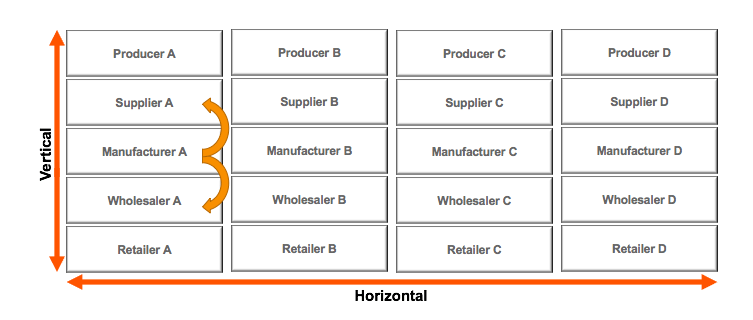
Consider the diagram above with producers, suppliers, manufacturers, wholesalers, and retailers.
- If Manufacturer A merges with Supplier A, it would be considered a backward merger – Manufacturer A is integrating with an upstream company. Backward integration would weaken supplier power.
- If Manufacturer A merges with Wholesaler A, it would be considered a forward merger – Manufacturer A is integrating with a downstream company. Forward integration would weaken buyer power.
Example of a Vertical Merger
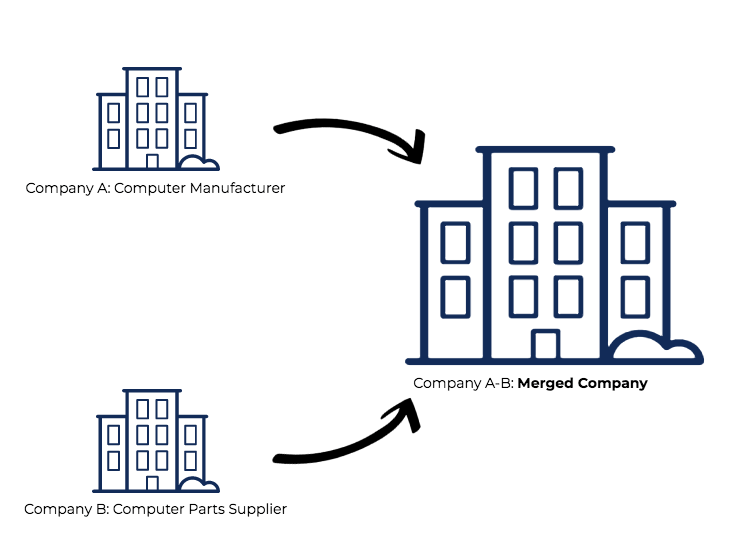
Company A is a computer manufacturer. Company B is the main supplier of parts to Company A. Therefore, the two companies are operating at different stages of the production process. Company A decides to merge with Company B to improve operational efficiency. Through this merger, A-B Company can now buy supplies at cost and, thus, increase the profit margin of its products.
Example of a Successful Vertical Merger
In 2006, Walt Disney announced that it would buy Pixar in a deal worth over $7 billion and make Pixar its subsidiary. This was a vertical merger because Disney would benefit from owning the world’s most innovative animation studio, while Pixar would benefit from Disney’s strong financials and extensive distribution network. Since then, the Disney-Pixar merger has been considered one of the most successful mergers in recent history.
Related Resources
CFI is the global provider of the Financial Modeling & Valuation Analyst (FMVA)Become a Certified Financial Modeling & Valuation Analyst (FMVA)®CFI's Financial Modeling and Valuation Analyst (FMVA)® certification will help you gain the confidence you need in your finance career. Enroll today! designation, a program that strives to turn anyone into a world-class financial analyst. To continue developing your finance career, these additional CFI resources will be helpful:
- Horizontal MergerHorizontal MergerA horizontal merger occurs when companies operating in the same or similar industry combine together. The purpose of a horizontal merger is to more
- Conglomerate MergerConglomerate MergerA Conglomerate Merger is a union between companies that operate in different industries and are involved in distinct, unrelated business activities. Conglomerate mergers are divided into pure conglomerate mergers and mixed conglomerate mergers.
- M&A ProcessMergers Acquisitions M&A ProcessThis guide takes you through all the steps in the M&A process. Learn how mergers and acquisitions and deals are completed. In this guide, we'll outline the acquisition process from start to finish, the various types of acquirers (strategic vs. financial buys), the importance of synergies, and transaction costs
- Financial Modeling GuideFree Financial Modeling GuideThis financial modeling guide covers Excel tips and best practices on assumptions, drivers, forecasting, linking the three statements, DCF analysis, more
-

Bootstrapping: How to Build a Business with Minimal Funding
Bootstrapping is the process of building a business from scratch without attracting investment or with minimal external capital. It is a way to finance small businessesSmall and Medium-sized Enterpris
-
Brownfield Investment: Definition, Benefits & Examples
In economics, a brownfield investment (BI) is a type of foreign direct investment (FDI)Foreign Direct Investment (FDI)Foreign direct investment (FDI) is an investment from a party in one country into
Business strategy
- PC Banking: A Comprehensive Guide to Online Banking Security & Features
- IRA CDs: Secure Retirement Savings with FDIC Insurance
- Understanding the DU: Your Mortgage Approval Explained
- Decentralized Finance (DeFi): A Comprehensive Overview
- Understanding Vertical Line Charts: A Beginner's Guide
- Understanding Vertical Spreads: A Beginner's Guide
- Vertical Analysis: A Comprehensive Guide to Financial Statement Analysis
- Horizontal Mergers: Definition, Benefits & Examples | [Your Company Name]
- Vertical Integration: Definition, Types & Benefits | [Your Company Name]
-
 Affiliate Marketing: A Comprehensive Guide for Beginners
AffiliateAffiliatesBecome a CFI Affiliate and earn 20% commission by referring your audience to the worlds leading finance training and courses. marketing occurs when an individual or company markets ...
-
 Assemble-to-Order (ATO): Definition, Benefits & Implementation
Assemble-to-order is a manufacturing strategy under which the manufacturer stocks up on sub-assembly parts and inventories and assembles the parts into the final product when a customer places an orde...