
Vertical Analysis: A Comprehensive Guide to Financial Statement Analysis
Vertical analysis is an accounting tool that enables proportional analysis of documents, such as financial statements. While performing a vertical analysis, every line item on a financial statement is entered as a percentage of another item. For example, on an income statementIncome StatementThe Income Statement is one of a company's core financial statements that shows their profit and loss over a period of time. The profit or, every line item is stated in terms of the percentage of gross sales.

Similarly, in a balance sheet, every entry is made not in terms of absolute currency but as a percentage of the total assets. Performing a vertical analysis of a company’s cash flow statement represents every cash outflow or inflow relative to its total cash inflows.
When is Vertical Analysis Used?
Vertical analysis is most commonly used within a financial statement for a single reporting period, e.g., quarterly. It is done so that accountants can ascertain the relative proportions of the balances of each account.
Vertical analysis is exceptionally useful while charting a regression analysisRegression AnalysisRegression analysis is a set of statistical methods used to estimate relationships between a dependent variable and one or more independent variables. or a ratio trend analysis. It enables the accountant to see relative changes in company accounts over a given period of time. The analysis is especially convenient to do so on a comparative basis.
Advantages of Vertical Analysis
- Vertical analysis simplifies the correlation between single items on a balance sheetBalance SheetThe balance sheet is one of the three fundamental financial statements. The financial statements are key to both financial modeling and accounting. and the bottom line, as they are expressed in a percentage. A company’s management can use the percentages to set goals and threshold limits. For example, management may consider shutting down a particular unit if profit per unit falls below a particular threshold percentage.
- It is a relatively more potent tool than horizontal analysis, which shows the corresponding changes in the finances of a particular unit/ account/department over a certain period of time.
- It is also useful in comparing a company’s financial statement to the average trends in the industry. It would be ineffective to use actual dollar amounts while analyzing entire industries. Common-size percentages solve such a problem and facilitate industry comparison.
- It is also highly effective while comparing two or more companies operating in the same industry but with different sizes. It is often tricky to compare the balance sheet of a $1 billion company to one that is valued at $500,000. Vertical analysis enables accountantsAccounting Salary GuideIn this accounting salary guide, we give you the midpoint compensation figures for those employed both in public and private accounting. Accountants are responsible for examining financial statements to ensure accuracy and compliance with existing laws and regulations, handling tax-related tasks such as calculating the to create common-size measures, which enable them to compare and contrast amounts of different magnitudes in a very efficient manner.
Practical Examples
1. Comparative Balance Sheet with Vertical Analysis
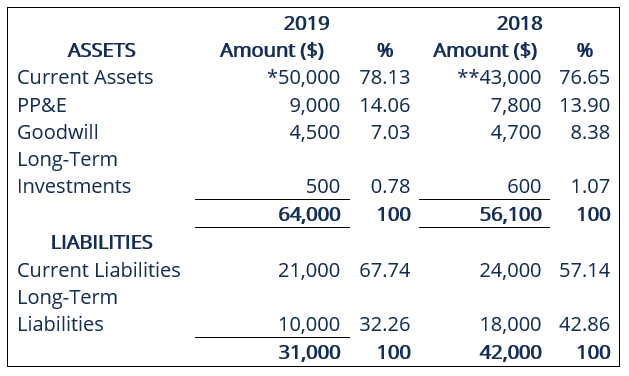
*2019: ($50,000 / $64,000) × 100 = 78.13%
**2018: ($43,000 / $56,100) × 100 = 76.65%
2. Comparative Income Statement with Vertical Analysis
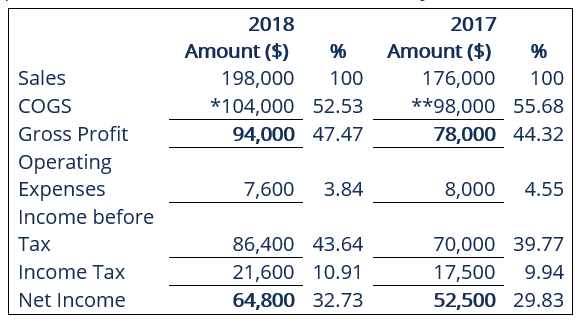
*2018: ($104,000 / $198,000) × 100 = 52.53%
**2017: ($98,000 / $176,000) × 100 = 55.68%
Related Readings
CFI offers the Commercial Banking & Credit Analyst (CBCA)™Program Page - CBCAGet CFI's CBCA™ certification and become a Commercial Banking & Credit Analyst. Enroll and advance your career with our certification programs and courses. certification program for those looking to take their careers to the next level. To keep learning and advancing your career, the following resources will be helpful:
- Analysis of Financial StatementsAnalysis of Financial StatementsHow to perform Analysis of Financial Statements. This guide will teach you to perform financial statement analysis of the income statement,
- Projecting Balance Sheet Line ItemsProjecting Balance Sheet Line ItemsProjecting balance sheet line items involves analyzing working capital, PP&E, debt share capital and net income. This guide breaks down how to calculate
- Top-Down BudgetingTop-Down BudgetingTop-down budgeting refers to a budgeting method where senior management prepares a high-level budget for the company. The company’s senior management prepares the budget based on its objectives and then passes it on to department managers for implementation.
- Vertical EquityVertical EquityVertical equity is a method of taxation wherein the personal income tax liability of an individual increases as their income increases. It is based on the
-

Financial Inclusion: Definition, Benefits & Impact
Financial inclusion refers to the provision of equally available and affordable access to financial services for everyone, regardless of their level of income. It applies to providing services to both
-

Financial Literacy: Understanding Key Concepts & Skills
Financial literacy is the cognitive understanding of financial components and skills such as budgeting, investing, borrowing, taxation, and personal financial management. The absence of such skil
Accounting
- Understanding Financial Hardship: Causes, Impacts & Relief
- Understanding Auditors: Roles, Responsibilities & Audit Processes
- Common Size Analysis: A Comprehensive Guide for Financial Statement Analysis
- Horizontal Analysis: Understanding Financial Trends & Growth
- Ratio Analysis: A Comprehensive Guide to Financial Statement Insights
- Financial Analysis: A Comprehensive Guide for Professionals
- Accounting Explained: Understanding Financial Records & Reporting
- Understanding Financial Audits: A Comprehensive Guide
- Understanding Finance: A Comprehensive Overview
-
 Financial Engineering: Principles, Applications & Career Paths
Financial engineering encompasses a broad, multidisciplinary field of study and practice that, essentially, applies an engineering approach and methodology to the world of finance. It integrates and u...
-
 Understanding Your Financial Health: A Comprehensive Guide
Financial health is a basic measure of the soundness of an individual’s finances – essentially, it’s about what kind of financial shape you’re in overall. You may also view it ...