
Annualized Total Return (CAGR): Definition & Calculation
An annualized total return is the return earned on an investment each year. It is computed as a geometric average of the returns of each year earned over a period. It is also known as the Compounded Annual Growth Rate (CAGR)CAGRCAGR stands for the Compound Annual Growth Rate. It is a measure of an investment’s annual growth rate over time, with compounding taken into account..

The annualized rate of return allows investors to compare investments with different time lengths. While it gives investors a performance preview of the investments, the annualized total return does not suggest anything about the price fluctuations or unpredictability of the investments.
Formula for Annualized Total Return
1. If an investor is given the annual rate of returns for each year over the investment period, the annualized total return is calculated using the following formula:

Where:
- R1 is the year 1 annual return
- R2 is the year 2 annual return, and so on
- n is the number of years
For example, an investor previously purchased 150 shares for $20 each and decided to hold onto these shares for two years. The stock rises 15% in the current year and increases by 12% the year after. What will be the annualized total return of the investment held for two years?
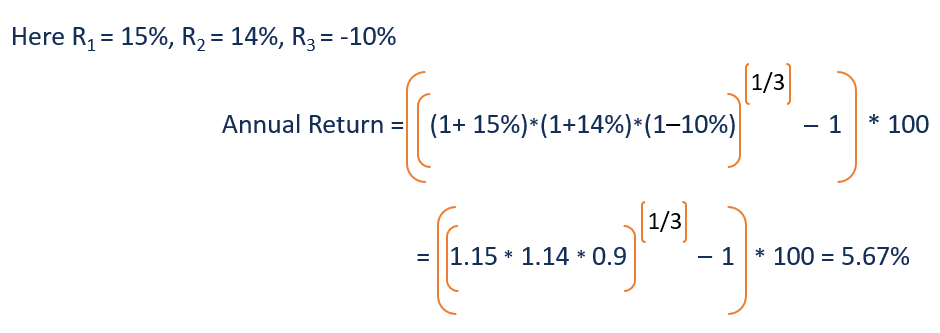
The investor earns a return of 13.5% each year for the two years the stocks were held.
2. If the cumulative return is known, the annualized total return can be computed for a given period, and the investment period does not need to be in years. An investment can be held for a given number of days and, in that case, the annualized total return can be calculated using the formula:
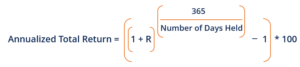
Where:
- R is the cumulative return
For example, assume an investor held an investment for 650 days, which earned a cumulative return of 15.75%. What will be the annualized total return on the investment?
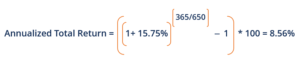
Here, an investment providing an aggregate return of 15.75% earns an annualized total return of 8.56%.
3. If an investor is given the initial and final dollar values of the investment, the annualized total return can be computed using the following formula:
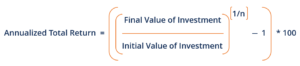
For example, assume that an investor previously purchased 100 shares for $12 each and decided to hold onto the shares for two years. The investor receives $1.50 per share in cash dividends each year. After two years, the investor decides to sell all the shares at $15. What is the rate of return during the two years that the investor owned the shares?
Initial value of investment = $12 * 100 = $1,200
Cash received as dividends over two-year period = $1.50 * 100 * 2 = $300
Value from selling the shares = $15 * 100 = $1,500
Hence, the final value of investment = $300 + $1,500 = $1,800
Annualized Total Return:
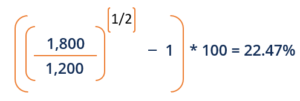
Therefore, the investor earns an annualized return of 22.47% on the investment.
Practical Applications
- Companies use the annualized total return to forecast their financial performance assuming the present conditions will prevail.
- Annualization helps taxpayers to convert the tax periods of less than a year to an annual period, which helps the taxpayers to plan effectively.
- Short-term borrowing loan rates and investments are annualized for comparison purposes.
Absolute Return vs. Annualized Total Return
An absolute return or total return shows how the investment performed with no regard for the period of investment. It tells an investor the amount of funds earned by the investment and measures the percentage gain or loss with respect to the initial investment value.
For example, if an investor invested $20,000 and receives $25,000 at the end of three years, the investment provided a total return of (25,000 – 20,000) / 20,000 = 0.25 (i.e., 25%). However, it does not consider the period of three years that the investor dedicated to the security.
While calculating an absolute return is simple, it cannot be used to compare investments with different time periods. On the contrary, an annualized total return expresses the return on investmentReturn on Investment (ROI)Return on Investment (ROI) is a performance measure used to evaluate the returns of an investment or compare efficiency of different investments. in terms of one year. Hence, investments with different time frames can be easily compared.
For example, between two investments with annualized total returns of 8.5% and 9.8%, respectively, it would be reasonable to choose the latter. The annualized total return considers the effect of compounding and either projects or decreases the time period of absolute return to one year.
Key Takeaways
- The annualized total return is the return that an investment earns each year for a given period.
- It is useful when comparing investments with different lengths of time.
- The annualized total return can be used to forecast the performance of an asset or a company. However, due to market volatility and other conditions, the predictions cannot be guaranteed.
More Resources
CFI is the official provider of the Commercial Banking & Credit Analyst (CBCA)™Program Page - CBCAGet CFI's CBCA™ certification and become a Commercial Banking & Credit Analyst. Enroll and advance your career with our certification programs and courses. certification program, designed to transform anyone into a world-class financial analyst.
To keep learning and developing your knowledge of financial analysis, we highly recommend the additional resources below:
- Continuously Compounded ReturnContinuously Compounded ReturnContinuously compounded return is what happens when the interest earned on an investment is calculated and reinvested back into the account for an infinite number of periods. The interest is calculated on the principal amount and the interest accumulated over the given periods
- CAGR CalculatorCAGR CalculatorThis CAGR calculator will help you determine the Compound Annual Growth rate of an investment. CAGR is a great measure of growth, as it isolated the effect of compounding on growth, which is sometimes concealed on other metrics for growth. CAGR stands for compound annual growth rate.
- Rate of ReturnRate of ReturnThe Rate of Return (ROR) is the gain or loss of an investment over a period of time copmared to the initial cost of the investment expressed as a percentage. This guide teaches the most common formulas
- Investing: A Beginner’s GuideInvesting: A Beginner's GuideCFI's Investing for Beginners guide will teach you the basics of investing and how to get started. Learn about different strategies and techniques for trading
-
![Total Sales Revenue: Definition & Importance | [Your Company Name]](https://www.etffin.com/article/uploadfiles/202110/2021100811445605_S.jpg)
Total Sales Revenue: Definition & Importance | [Your Company Name]
Total sales revenue, also known as gross sales, is the combined value of goods and services a business delivers to its customers during a specific reporting period. What Is Tota
-

Alternative Investments: A Comprehensive Guide to Tangible & Financial Assets
An alternative investment is an investment in assets different from cash, stocks, and bonds. Alternative investments can be investments in tangible assetsTangible AssetsTangible assets are assets with
finance
- Understanding Alpha: A Guide to Investment Performance
- Understanding Return on Investment (ROI): A Comprehensive Guide
- Return on Total Capital (ROTC): Definition & Calculation
- Total Return Swap (TRS): Definition, Mechanics & Uses
- Annual Return: Definition, Calculation & Understanding
- Annualized Rate of Return: Definition & Calculation
- Understanding Return on Investment (ROI): A Comprehensive Guide
- Understanding Total Return Indices: A Comprehensive Guide
- Compound Annual Growth Rate (CAGR): Definition & Calculation
-
 Total Return Index Explained: A Comprehensive Guide
What Is a Total Return Index? A total return index is a type of equity index that tracks both the capital gains as well as any cash distributions, such as dividends or interest, attributed to t...
-
 Understanding Money and Time-Weighted Returns: A Comprehensive Guide
Money and time-weighted returns are rates of return typically used to assess the performance of a managed investment portfolio. Today, the time-weighted rate of return is the industry standard since i...