
Annual Return: Definition, Calculation & Understanding
The annual return is the return on an investment generated over a year and calculated as a percentage of the initial amount of investment. If the return is positive (negative), it is considered a gain (loss) on the initial investment. The rate of returnRate of ReturnThe Rate of Return (ROR) is the gain or loss of an investment over a period of time copmared to the initial cost of the investment expressed as a percentage. This guide teaches the most common formulas will vary depending on the level of risk involved.
Summary
- The annual return is a measure of how much the investment has grown or shrunk in one year.
- The annualized return is the geometric average of annual returns of each year over the investment period.
- The annualized return is useful when you want to see the performance of an investment over time or to compare two investments with different time periods.
Annual Return Formula
The return earned over any 12-month period for an investment is given by the following formula:

All the interest and dividendsDividendA dividend is a share of profits and retained earnings that a company pays out to its shareholders. When a company generates a profit and accumulates retained earnings, those earnings can be either reinvested in the business or paid out to shareholders as a dividend. received during the 12-month period should be included in the final value of the investment.
Annual Return Example
Assume that you purchased 200 shares at a price of $10 each. You receive $1 in cash dividends after one year, and the share now trades at $9.50. How can you evaluate the performance of the investment that you made a year ago?
It is reasonable to say that the investment can be deemed profitable if the return is positive. Let’s calculate the annual return. In our example:
1. Initial value of the investment
Initial value of the investment = $10 x 200 = $2,000
2. Final value of the investment
At the end of one year, you will hold cash from dividends and 200 shares trading at $9.50. Hence,
Cash received as dividends = $1 x 200 = $200
Current value of shares = $9.50 x 200 = $1,900
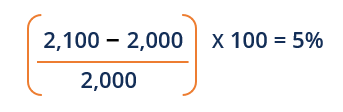
Final value of the investment = $200 + $1,900 = $2,100
3. Annualized rate of return
Annualized Return
In the above example, we calculated the return on the investment over a single period of 12 months. However, in practicality, you invest your money in different assets with different time periods. To compare the returns on such investments with a one-year return, you need to annualize them. The rate of return per year, measured over a period either longer or shorter than a year, is known as the annualized return.
The annualized return incorporates compounding; therefore, it is also known as the Compound Annual Growth Rate (CAGR)CAGRCAGR stands for the Compound Annual Growth Rate. It is a measure of an investment’s annual growth rate over time, with compounding taken into account..
Annualized Return Formula
There are two options for calculating the annualized return depending on the available information.
Option 1: When you are given the annual returns for each year of the investment period, then:

Where:
- R1 – The annual return for year 1, R2 is the annual return for year 2, and so on
- n – The number of years you wish to annualize
For example, assume that you purchased 200 shares at a price of $10 each, and you decided to hold onto the shares for three years. The stock rises 10% in the current year, increases by 14% next year, and falls by 15% in the year after. What is the rate of return during the three years that you’ve owned the shares?
Here, R1 = 15%, R2 = 14%, and R3 = -10%
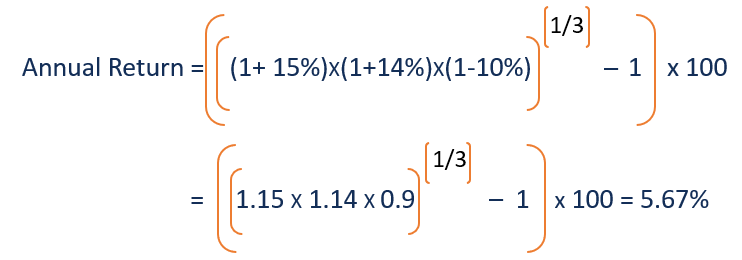
Therefore, you realized an annual return of 5.67% on your investment.
Option 2: When are given a dollar value of returns instead of an annual rate of returns, then:
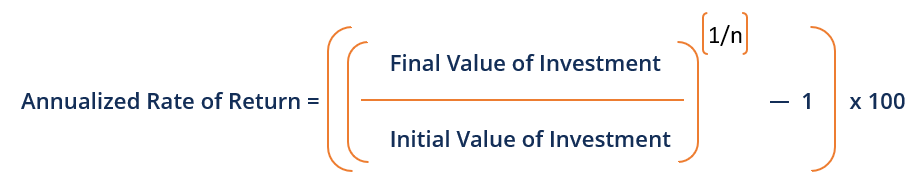
Where:
- n – The number of years you wish to annualize
For example, assume that you purchased 200 shares at a price of $10 each, and you decided to hold onto the shares for three years. You receive $1 per share in cash dividends per year. After three years, you decide to sell all the shares at $12. What is the rate of return during the three years that you’ve owned the shares?
Note that the dollar value of the investments is given here.
1. Initial value of the investment
Initial value of the investment = $10 x 200 = $2,000
2. Final value of the investment
Cash received as dividends over the three-year period = $1 x 200 x 3 years = $600
Value from selling the shares = $12 x 200 = $2,400
Final value of the investment = $600 + $2,400 = $3,000
3. Annualized rate of return
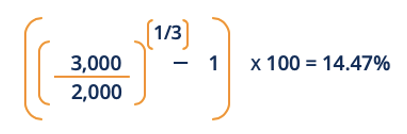
Therefore, you realized an annualized return of 14.47% on your investment.
Additional Resources
CFI offers the Commercial Banking & Credit Analyst (CBCA)™Program Page - CBCAGet CFI's CBCA™ certification and become a Commercial Banking & Credit Analyst. Enroll and advance your career with our certification programs and courses. certification program for those looking to take their careers to the next level. To keep learning and advancing your career, the following resources will be helpful:
- Accounting Rate of ReturnARR - Accounting Rate of ReturnAccounting Rate of Return (ARR) is the average net income an asset is expected to generate divided by its average capital cost, expressed as
- Investment HorizonInvestment HorizonInvestment horizon is a term used to identify the length of time an investor is aiming to maintain their portfolio before selling their securities for a profit. An individual’s investment horizon is affected by several different factors. However, the primary determining factor is often the amount of risk that the investor
- ROI FormulaROI Formula (Return on Investment)Return on investment (ROI) is a financial ratio used to calculate the benefit an investor will receive in relation to their investment cost. It is most commonly measured as net income divided by the original capital cost of the investment. The higher the ratio, the greater the benefit earned.
- Investing: A Beginner’s GuideInvesting: A Beginner's GuideCFI's Investing for Beginners guide will teach you the basics of investing and how to get started. Learn about different strategies and techniques for trading
-
Understanding Rate of Return: A Comprehensive Guide
A Rate of Return (ROR) is the gain or loss of an investment over a certain period of time. In other words, the rate of return is the gainCapital Gains YieldCapital gains yield (CGY) is the price appre
-
Return on Ad Spend (ROAS): Definition & Importance for eCommerce
ROAS stands for “Return on Ad Spend,” a very popular financial metric in the world of digital marketing in particular, and a similar alternative metric to ROI, or “Return on Investme
invest
- Annualized Total Return (CAGR): Definition & Calculation
- Understanding Return on Investment (ROI): A Comprehensive Guide
- Understanding Average Return: A Simple Guide
- Understanding Drawdowns: A Key Investment Risk
- Understanding Expected Return: A Comprehensive Guide
- Holding Period Return (HPR): Definition & Calculation
- Modified Dietz Return: Calculation & Investment Portfolio Analysis
- Understanding Return on Investment (ROI): A Comprehensive Guide
- Mutual Fund Returns: What's a Healthy Annual Return?
-
 Cash-on-Cash Return: Definition, Calculation & Importance
Cash on cash return is a rate of returnRate of ReturnThe Rate of Return (ROR) is the gain or loss of an investment over a period of time copmared to the initial cost of the investment expressed as a p...
-
 Understanding Investments: A Beginner's Guide to Growth & Income
A financial investment is any asset or instrument purchased with the intention of selling said asset for a price higher than the purchase price at some future point in time (capital gains), or with th...