
Return on Total Capital (ROTC): Definition & Calculation
Return on Total Capital (ROTC) is a return on investment ratio that quantifies how much return a company has generated through the use of its capital structureCapital StructureCapital structure refers to the amount of debt and/or equity employed by a firm to fund its operations and finance its assets. A firm's capital structure. This ratio is different from return on common equityReturn on Common EquityThe Return on Common Equity (ROCE) ratio refers to the return that common equity investors receive on their investment. It is different from Return on Equity (ROE) in that it isolates the return that the company sees only from its common equity, rather than measuring the total returns that the company generated on all (ROCE), as the former quantifies the return a company has made on its common equity investment. The ROCE figure can be misleading, as it does not take into account a company’s use of debt. A company that employs a large amount of debt in its capital structure will have a high ROCE.
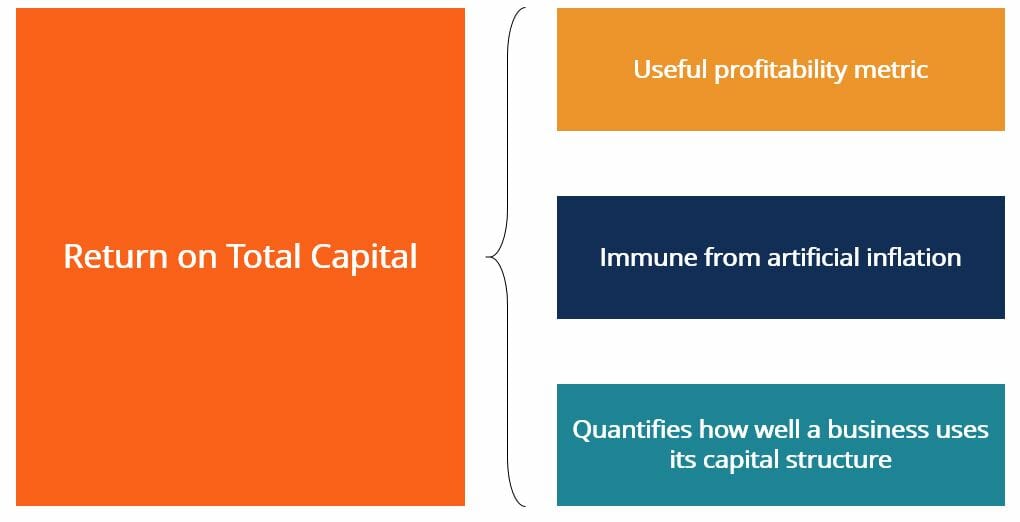
ROTC gives a fairer assessment of a company’s use of funds to finance its projects, and functions better as an overall profitability metric. This ratio is immune from artificial inflationInflationInflation is an economic concept that refers to increases in the price level of goods over a set period of time. The rise in the price level signifies that the currency in a given economy loses purchasing power (i.e., less can be bought with the same amount of money). induced by a capital structure that employs a significantly higher or lower amount of debt capital than equity capital.
Return on Total Capital can be used to evaluate how well a company’s management has utilized its capital structure to generate value for both equity and debt holders. ROTC is a better measure to assess management’s abilities than the ROCE ratio since the latter only monitors management’s use of common equity capital.
How to Calculate Return on Total Capital
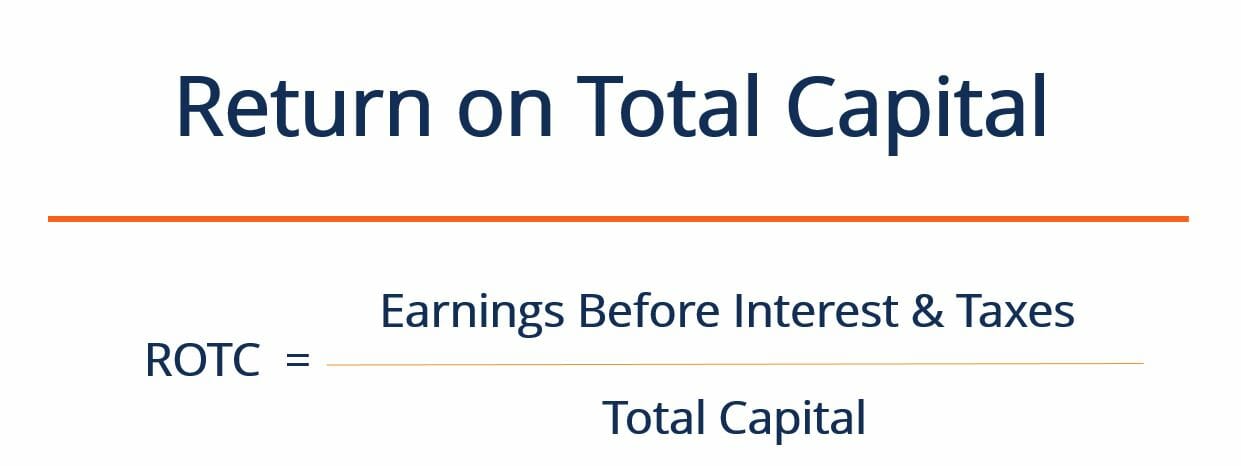
Return on Total Capital can be calculated using the formula below:
Where:
Earnings Before Interest & Taxes (EBIT) – Represents profit that the business has realized, without consideration of interest or tax payments
Total Capital – Refers to the business’ total available capital, calculated as Total Capital = Short Term Debt + Long Term Debt + Shareholder’s Equity
In the case of a business that has no liabilities outside of short-term debt, long-term debt, and total equity, return on total capital is virtually identical to the return on assets (ROA) ratioReturn on Assets & ROA FormulaROA Formula. Return on Assets (ROA) is a type of return on investment (ROI) metric that measures the profitability of a business in relation to its total assets.. This is because the business’ capital structure would make up the entirety of the business’ liability section on its balance sheet. That figure would be equal to the business’ total assets. (Assets = Liabilities + Equity).
While ROA is also a useful profitability metric, it takes a more reactive approach to computing a business’ use of capital. ROA measures the value a business is able to generate based on the assets it employs, rather than on capital allocation decisions.
Return on Total Capital Example
Mark’s Doughnuts wants to assess how well it has deployed its capital structure by calculating the ROTC of the business for the past few years. Below are the business’ financial statements for the past few years:
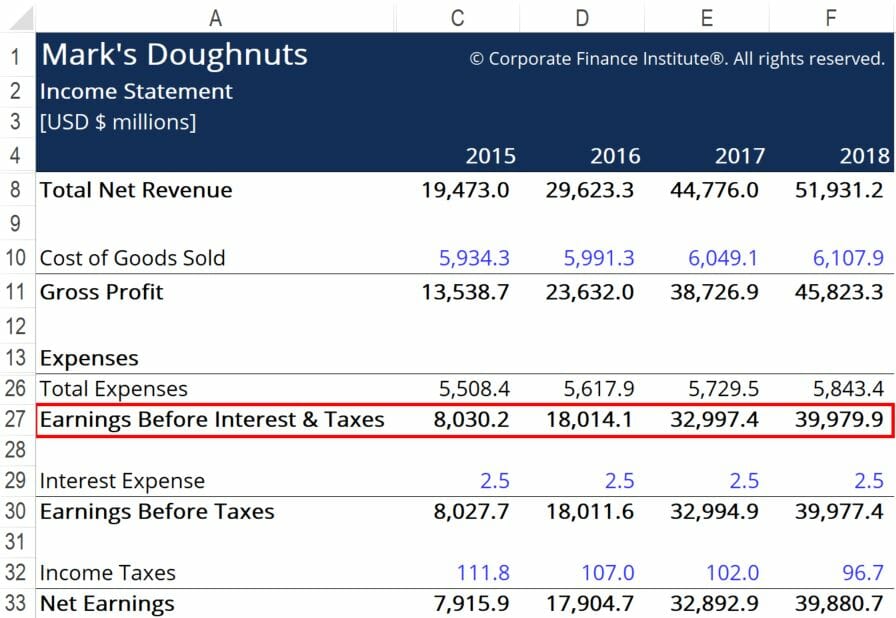
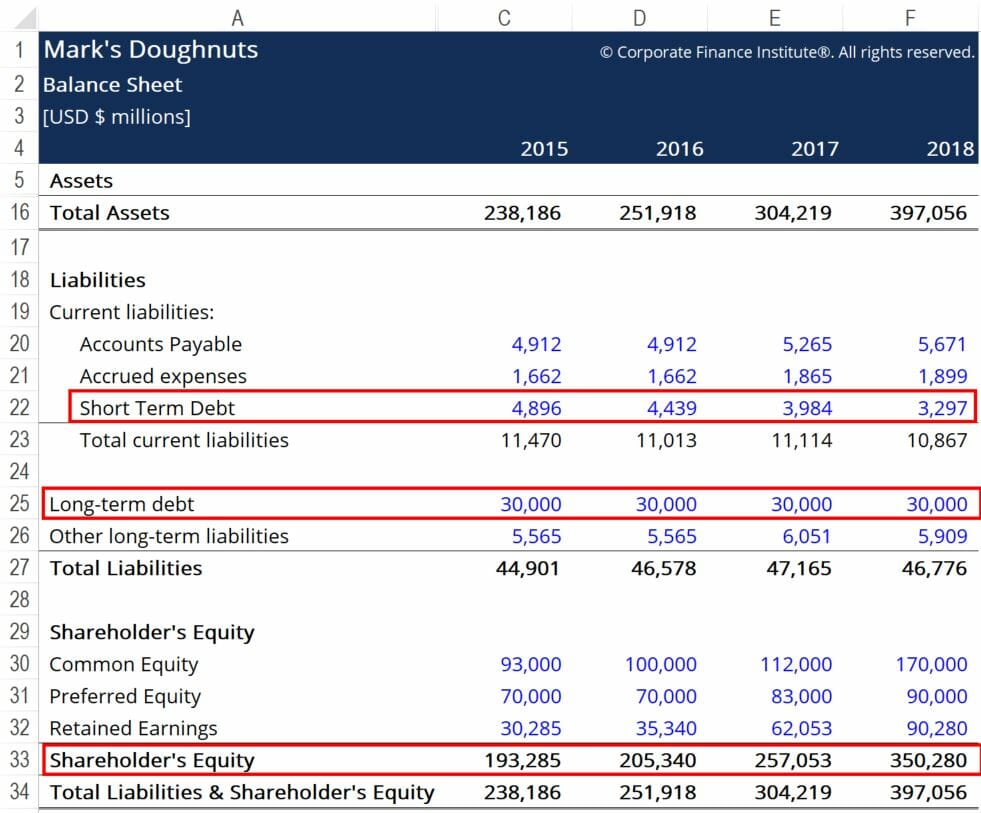
The red boxes highlight the important information we need to calculate ROTC, namely EBITEBIT GuideEBIT stands for Earnings Before Interest and Taxes and is one of the last subtotals in the income statement before net income. EBIT is also sometimes referred to as operating income and is called this because it's found by deducting all operating expenses (production and non-production costs) from sales revenue. and the capital structure. Using the formula provided above, we arrive at the following figures:
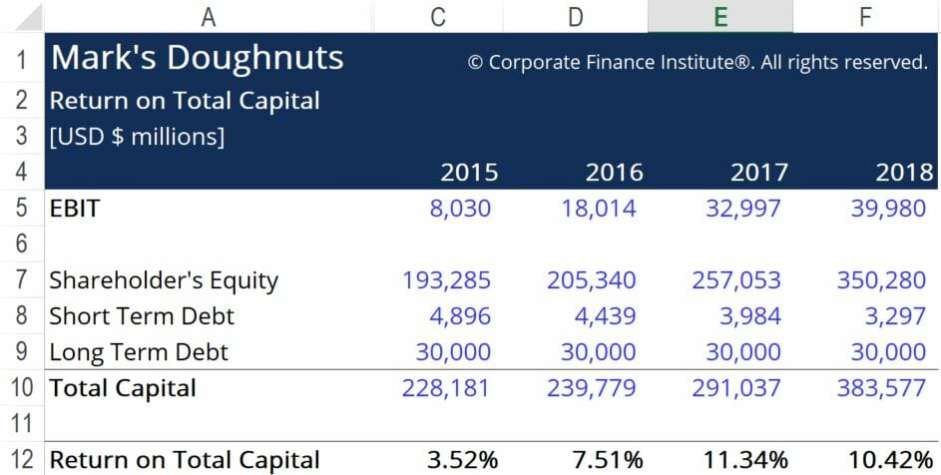
ROTC more than tripled from 2015 to 2017. This indicates the company is making good use of its capital structure and pursuing NPV-positive projects.
Additional Resources
Thank you for reading this CFI article on the Return on Total Capital ratio! CFI offers the Financial Modeling & Valuation Analyst (FMVA)™Become a Certified Financial Modeling & Valuation Analyst (FMVA)®CFI's Financial Modeling and Valuation Analyst (FMVA)® certification will help you gain the confidence you need in your finance career. Enroll today! certification program for those looking to take their careers to the next level. To learn more about related topics, check out the following CFI resources:
- How to Calculate Debt Service Coverage RatioHow to Calculate Debt Service Coverage RatioThis guide will describe how to calculate the Debt Service Coverage Ratio. First, we will go over a brief description of the Debt Service Coverage Ratio, why it is important, and then go over step-by-step solutions to several examples of Debt Service Coverage Ratio Calculations.
- Current Portion of Long-Term DebtCurrent Portion of Long-Term DebtThe current portion of long-term debt is the portion of long-term debt due that is due within a year’s time. Long-term debt has a maturity of
- Defensive Interval RatioDefensive Interval RatioThe defensive interval ratio (DIR) is a financial liquidity ratio that indicates how many days a company can operate without needing to tap into capital sources other than its current assets. It is also known as the basic defense interval ratio (BDIR) or the defensive interval period ratio (DIPR).
- ROAS (Return on Ad Spend)ROAS (Return on Ad Spend)ROAS (Return on Ad Spend) is an important eCommerce metric. ROAS measures revenue generated per dollar of marketing spent. It is a similar and alternative profitability metric to ROI, or "Return on Investment". ROAS is commonly used in eCommerce businesses to evaluate the effectiveness of a marketing campaign.
-
Understanding Expected Return: A Comprehensive Guide
The expected return on an investment is the expected value of the probability distribution of possible returns it can provide to investors. The return on the investment is an unknown variable that has
-
Understanding Mispricing: Market Prices vs. True Value
Mispricing causes a divergence between the market price of a security and the fundamental value of that security. The law of one price states that the market price of a security is equal to the presen
finance
- Understanding Return of Capital (ROC): Definition & Tax Implications
- Understanding Alpha: A Guide to Investment Performance
- Annualized Total Return (CAGR): Definition & Calculation
- Basel I: Understanding Core Banking Regulations & Capital Requirements
- Understanding Capital: Types, Categories & Value Creation
- Return on Capital Employed (ROCE): Definition & Calculation
- Return on Invested Capital (ROIC): Definition & Calculation
- Total Return Swap (TRS): Definition, Mechanics & Uses
- Understanding Total Return Indices: A Comprehensive Guide
-
 Understanding Average Return: A Simple Guide
Average return is the mathematical average of a sequence of returns that have accrued over time. In its simplest terms, average return is the total return over a time period divided by the number of p...
-
 Understanding Capital Losses: Definition, Calculation & Examples
Capital loss is the reduction in the value of a company’s capital, i.e., investments, capital assets, etc. The loss is realized when capital assets are sold for a price lower than the original p...