
Automatic Conversion Clause: Definition & Investor Implications
An automatic conversion clause is a provision that allows for the automatic exchange of preferred stock or convertible debt for common stock in a company. The conversion is considered automatic or mandatory because it does not require a vote of the board of directorsBoard of DirectorsA board of directors is a panel of people elected to represent shareholders. Every public company is required to install a board of directors. for the conversion to take place.
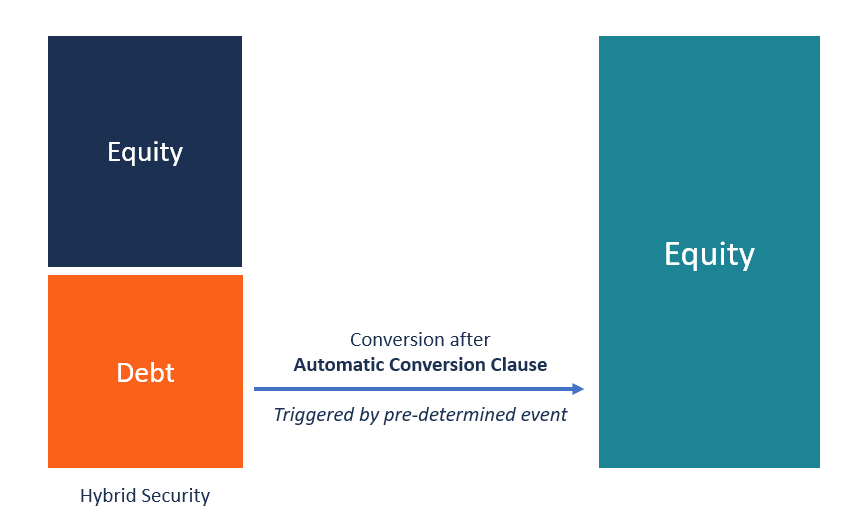
For example, an investor may own preferred stockPreferred SharesPreferred shares (preferred stock, preference shares) are the class of stock ownership in a corporation that has a priority claim on the company’s assets over common stock shares. The shares are more senior than common stock but are more junior relative to debt, such as bonds. in a startup company with an option of automatic conversion of the preferred stock to common stock upon the occurrence of a specified event. The conversion will occur based on a conversion ratio provided in the security purchase agreement.
How Does Automatic Conversion Work
When a company is raising capital, it can opt to issue either equity or debt. When the company chooses to issue equity, it allows the public to purchase shares of the company and own a stake in the company equivalent to their proportion of equity. In return, the company may pay dividends at the end of a financial period, which depends on the appreciation of the company’s share price.
An alternative to issuing equity is issuing debt to the public. An example of debt is bonds that pay periodic interest payments to the bondholders. The interest is calculated as a percentage of the principal amount, which may be agreed upon at the time of purchasing the bonds. The choice of whether to go for equity or debt depends on the cost of each option, as well as the accessibility.
A company may also decide to issue hybrid securities that combine both debt and equity. A hybrid securityHybrid SecuritiesHybrid securities are investment instruments that combine the features of pure equities and pure bonds. The securities tend to offer a higher return than pure fixed income securities such as bonds but a lower return than pure variable income securities such as equities. allows investors to purchase a bond that includes an automatic conversion clause. The clause makes the security convertible to common stock at a predetermined future period. A hybrid security guarantees an investor periodic interest payments on the debt up to the conversion date, after which they will earn dividends on the common stock.
Optional vs. Automatic Conversion Rights
Conversion rights give an investor the benefit of changing their convertible debtConvertible BondA convertible bond is a type of debt security that provides an investor with a right or an obligation to exchange the bond for a predetermined number of shares in the issuing company at certain times of a bond’s lifetime. A convertible bond is a hybrid security or preferred stock to the bond issuer’s equity upon the occurrence of a specified event in the future. Conversion rights can either be optional or automatic.
1. Optional Conversion Rights
Optional conversion rights give the investors the right to convert their debt or preferred stock into shares of common stock when the expected outcomes are more advantageous to them. For example, an investor can choose to convert debt to common stock when the expected return is higher than the return attributable to the debt. The investor can exchange the bond for a predetermined number of common stock when it is more advantageous to him or her.
For example, assume that investor A holds a $1,000 bond certificate from ABC Limited, and it is convertible to 100 ABC shares. Investor A will wait until when the price per share is $10 or higher so that the shares of common stock can be valued at $1,000 or higher.
2. Mandatory Conversion Rights
Mandatory conversion rights require that debt or preferred stock be converted to the issuer’s common stock upon the occurrence of certain events. The automatic conversion can be triggered when a company goes public through an IPOInitial Public Offering (IPO)An Initial Public Offering (IPO) is the first sale of stocks issued by a company to the public. Prior to an IPO, a company is considered a private company, usually with a small number of investors (founders, friends, family, and business investors such as venture capitalists or angel investors). Learn what an IPO is at a predetermined total value and a per share value. The IPO is referred to as a qualified IPO in the articles of incorporation. The price per share of the shares issued to the public for subscription will be a multiple (such as 3x or 5x) of the price of the preferred stock.
Conversion Ratio
The conversion ratio is the number of the debt issuer’s common stocks that a stockholder will receive for each preferred stock held. The ratio is usually determined at the time of purchasing the preferred stock, and it affects the relative price of the hybrid stock. A higher conversion ratio means that stockholders will receive a higher number of common stock per preferred stock. The conversion ratio is obtained by dividing the par valuePar ValuePar Value is the nominal or face value of a bond, or stock, or coupon as indicated on a bond or stock certificate. It is a static value of a convertible bond or preferred stock by the convertible price of the equity.
The formula is shown as follows:

For example, when investors purchase a hybrid security with both debt and equity components, they will receive periodic interest payments before the conversion takes place and will be paid first in case of a liquidation. When the security is converted to equity, the investors will receive voting rights and will benefit from an increased share price.
For example, assume that XYZ Limited issued $100 convertible preferred stocks with an 8% dividend and a conversion ratio of four. The security purchase agreement provides that automatic conversion of preferred stocks to the underlying common stock will only occur when the company holds an IPO. After the company goes public through an IPO, preferred stockholders will receive four common stocks for every preferred stock held.
More Resources
CFI is the official provider of the Financial Modeling and Valuation Analyst (FMVA)™Become a Certified Financial Modeling & Valuation Analyst (FMVA)®CFI's Financial Modeling and Valuation Analyst (FMVA)® certification will help you gain the confidence you need in your finance career. Enroll today! certification program, designed to transform anyone into a world-class financial analyst.
To keep learning and developing your knowledge of financial analysis, we highly recommend the additional CFI resources below:
- Cost of EquityCost of EquityCost of Equity is the rate of return a shareholder requires for investing in a business. The rate of return required is based on the level of risk associated with the investment
- Debt vs Equity FinancingDebt vs Equity FinancingDebt vs Equity Financing - which is best for your business and why? The simple answer is that it depends. The equity versus debt decision relies on a large number of factors such as the current economic climate, the business' existing capital structure, and the business' life cycle stage, to name a few.
- Pro-Rata RightPro-Rata RightA pro-rata right is a legal term that describes the right, but not the obligation, that can be given to an investor to maintain their initial level of percentage ownership in a company during subsequent rounds of financing.
- Supermajority ProvisionSupermajority Voting ProvisionA supermajority voting provision, an amendment to a company’s corporate charter, is a provision that states that certain corporate actions require much more than a mere majority - typically 67%-90% - approval from its shareholders to pass.
-

Stock Indexes Explained: A Beginner's Guide to Market Benchmarks
A stock index, also called a share index or stock market index, consists of constituent stocks used to provide an indication of an economy, market, or sector. A stock index is commonly used by investo
-

Stock Valuation: A Comprehensive Guide for Investors
Every investor who wants to beat the market must master the skill of stock valuation. Essentially, stock valuation is a method of determining the intrinsic valueIntrinsic ValueThe intrinsic value of a
finance
- Understanding Stock Performance: A Guide for Investors
- Authorized Stock: Understanding Share Issuance Limits
- Bail-In Clauses: Understanding Their Role in Financial Stability
- Understanding Common Stock: Ownership and Basics
- Founders Stock: Definition, Vesting, and Key Differences
- Restricted Stock: Definition, Types & How It Works
- Understanding Stocks: A Beginner's Guide to Share Ownership
- Stock Dividends: Definition, Types & How They Work
- What is a Stock Option?
-
 Understanding Non-Assessable Stock: Limited Liability Explained
Non-assessable stock is a class of stock ownership where the stock owner is limited in their liability to the amount paid for the stock. It means that in the instance of bankruptcyBankruptcyBankruptcy...
-
 Understanding Overweight Stocks: A Comprehensive Guide
An overweight stockCommon StockCommon stock is a type of security that represents ownership of equity in a company. There are other terms – such as common share, ordinary share, or voting share ...