
Basis Points (BPS): Understanding Interest Rate Measurement
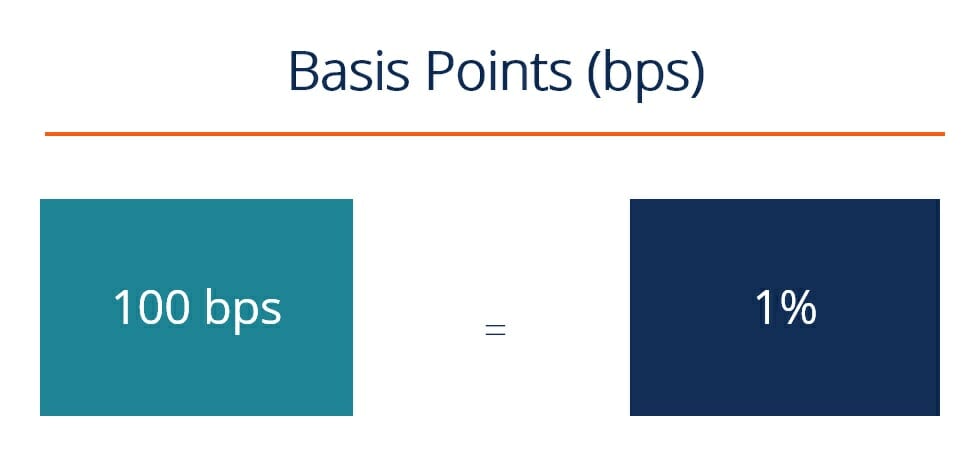
In finance, Basis Points (BPS) are a unit of measurement equal to 1/100th of 1 percent. BPS are used for measuring interest rates, the yield of a fixed-income securityFixed Income Bond TermsDefinitions for the most common bond and fixed income terms. Annuity, perpetuity, coupon rate, covariance, current yield, par value, yield to maturity. etc., and other percentages or rates used in finance.
This metric is commonly used for loans and bonds to signify percentage changes or yield spreads in financial instruments, especially when the difference in material interest rates is less than one percent.
One basis point is equal to .01 percent or 1/100th of 1 percent. The succeeding points move up gradually to 100%, which equals 10000 basis points, as illustrated in the diagram below.
Percentage Basis Points 0.01%10.1%100.5%501%10010%1000100%10000
Examples:
- The difference between bond interest rates of 9.85 percent and 9.35 percent is 0.5 percent, equivalent to 50 basis points.
- The Federal Reserve boosts interest rates by 100 BPS, signaling an increase from 10 percent to 11 percent.
- Due to the growth of iPhone sales, Apple Inc. reported high earnings, more than what was estimated; the stockStockWhat is a stock? An individual who owns stock in a company is called a shareholder and is eligible to claim part of the company’s residual assets and earnings (should the company ever be dissolved). The terms "stock", "shares", and "equity" are used interchangeably. increased 330 BPS, or 3.3 percent, in one day.
Conversion between basis points and percentage
To convert the number of basis points to a percentage and, in turn, a percentage to basis points, without using a conversion template or chart, review the following:
- Basis points to percentage – Divide the points by 100
- Percentage to basis points – Multiply the percentage by 100
Why do investors and analysts use BPS?
The main reasons investors use BPS points are:
- To describe incremental interest rate changes for securities and interest rate reporting.
- To avoid ambiguity and confusion when discussing relative and absolute interest rates, especially when the rate difference is less than 1 percent, but the amount has material importance. For example, when discussing an interest rate that has increased from 11% to 12%, some may use the absolute method stating there is a 1% increase in the interest rate, while some may use the relative method stating a 9.09% increase in in the interest rate. Using basis points eliminates this confusion by stating that there is an increase in the interest rate of 100 basis points.
What instruments does BPS apply to?
The usage of basis points is primarily applied to yields and interest ratesSimple InterestSimple interest formula, definition and example. Simple interest is a calculation of interest that doesn't take into account the effect of compounding. In many cases, interest compounds with each designated period of a loan, but in the case of simple interest, it does not. The calculation of simple interest is equal to the principal amount multiplied by the interest rate, multiplied by the number of periods., but they may also apply to the change in the value of an asset, such as the percentage changes of stock values. Common examples include the following:
- Treasury bonds
- Corporate bonds
- Interest rate derivatives
- Credit derivatives
- Equity securities, such as common stock
- Debt securities, such as mortgage loans
- Options, futures
Additional resources
CFI offers the Capital Markets & Securities Analyst (CMSA)®Program Page - CMSAEnroll in CFI's CMSA® program and become a certified Capital Markets &Securities Analyst. Advance your career with our certification programs and courses. certification program for those looking to take their careers to the next level. To keep learning and developing your knowledge base, please explore the additional relevant resources below:
- Simple InterestBuy Side AnalystA buy side analyst is an analyst who works with fund managers in mutual fund companies, financial advisory firms, and other firms, such as hedge funds, trusts, and proprietary traders. These firms buy large portions of securities for fund management. Recommendations made by buy side analysts are confidential
- Hurdle RatesEBITDAEBITDA or Earnings Before Interest, Tax, Depreciation, Amortization is a company's profits before any of these net deductions are made. EBITDA focuses on the operating decisions of a business because it looks at the business’ profitability from core operations before the impact of capital structure. Formula, examples
- Line of CreditBank LineA bank line or a line of credit (LOC) is a kind of financing that is extended to an individual, corporation, or government entity, by a bank or other
- Investment BankingInvestment BankingInvestment banking is the division of a bank or financial institution that serves governments, corporations, and institutions by providing underwriting (capital raising) and mergers and acquisitions (M&A) advisory services. Investment banks act as intermediaries
-

Understanding Vested Interest: Definition & Implications
Vested interest refers to an entity’s personal involvement in a business project, an investment, or the outcome of a given situation. Usually, they are situations that include the possibility of
-

Understanding Fixed Income Securities: A Comprehensive Guide
Fixed income securities are a type of debt instrument that provides returns in the form of regular, or fixed, interest payments and repayments of the principal when the security reaches maturity. The
finance
- Understanding Competitive Interest Rates: What You Need to Know
- Negative Interest Rates: Explained | Causes, Effects & History
- Basis Point (bp): Understanding Interest Rate Fluctuations
- Interest Tax Shields: Understanding Tax Deductions on Interest Expense
- Negative Interest Rates Explained: How They Work & Impact
- Understanding Forward Points: A Guide for Investors
- Understanding Interest Rate Options: A Comprehensive Guide
- Understanding Basis Points: A Simple Guide
- Understanding Interest Rates: A Simple Explanation
-
 Understanding Interest Rates: A Comprehensive Guide
An interest rate refers to the amount charged by a lender to a borrower for any form of debtCurrent DebtOn a balance sheet, current debt is debts due to be paid within one year (12 months) or less. It...
-
 Mortgages Explained: Your Guide to Home Loans & Financing
A mortgage is a loan – provided by a mortgage lender or a bankTop Banks in the USAAccording to the US Federal Deposit Insurance Corporation, there were 6,799 FDIC-insured commercial banks i...