
Understanding Call Reports: A Guide to Bank Financial Health
A call report is a quarterly report known as the Consolidated Report of Condition and Income that all commercial banksCommercial BankA commercial bank is a financial institution that grants loans, accepts deposits, and offers basic financial products such as savings accounts. and similar financial institutions in the United States are required to file at the end of each calendar quarter. The report, also referred to as the RC report, is required by the Federal Financial Institutions Examination Council (FFIEC), a government interagency authority tasked with prescribing uniform principles and standards for oversight of financial institutions in the U.S.
Summary
- A call report is a quarterly report known as the Consolidated Report of Condition and Income that all banks in the United States are required to file at the end of each calendar quarter.
- The quarterly call reports help to provide a picture of the financial stability and risk exposure of each bank and of the banking industry as a whole.
- Call reports are utilized by various government regulatory authorities and by bank rating agencies.
Understanding Call Reports
Banks that only keep offices within the U.S. are required to file Form FFIEC 041 (Domestic-only banks with assets of less than $5 billion file Form FFIEC 051). U.S. banks that also maintain offices abroad file Form FFIEC 031. The reports are filed with the Federal Deposit Insurance Corporation (FDIC)Federal Deposit Insurance Corporation (FDIC)The Federal Deposit Insurance Corporation (FDIC) is a government institution that provides deposit insurance against bank failure. The body was created. Call reports are legally required, per Section 1817(a)(1) of the Federal Deposit Insurance Act.
Savings and loan associations (more commonly known as “thrifts”) started filing call reports in 2012. Credit unions are also required to file quarterly call reports, but the reports are filed with the National Credit Union Administration rather than with the FDIC.
Call reports must be authorized and confirmed by the signatures of the bank’s Chief Financial Officer (CFO)What Does a CFO DoWhat does a CFO do - the job of the CFO is to optimize a company's financial performance, including: reporting, liquidity, and return on investment. Within and two directors or trustees of the bank. They are reviewed by financial analysts and checked for errors, omissions, and possible audit flags.
Banks were required to file quarterly call reports beginning in 2005. More than 6,000 banks across the U.S. file call reports each quarter.
Purpose of Call Reports
Call reports are a basic oversight tool for governmental authorities charged with regulating the banking industry. The collective call reports from all the various banks provide a picture of the financial stability and risk exposure of each bank and of the banking industry as a whole.
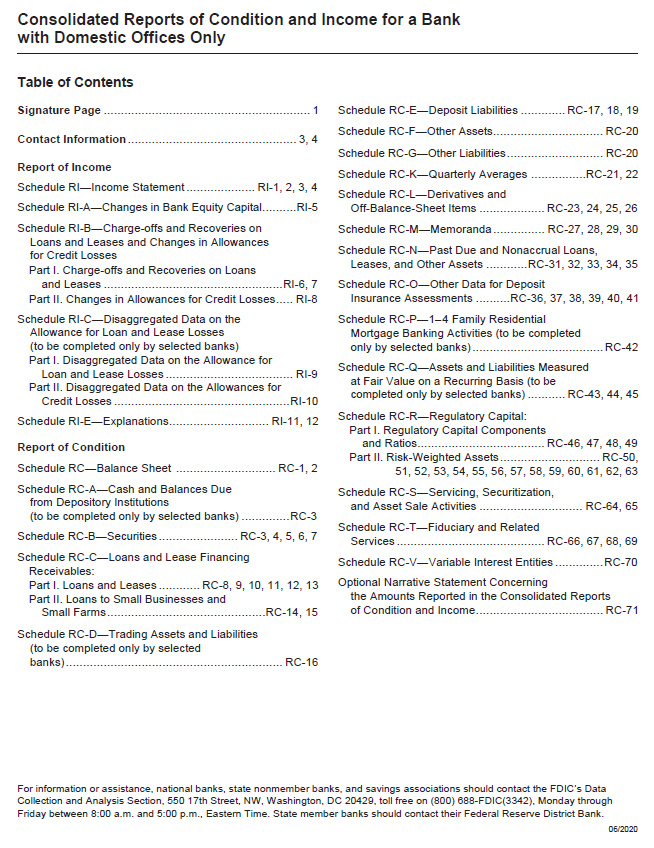
The quarterly reports comprise an income statement, a balance sheet statement, and numerous supporting schedules that detail income, expenses, assets, liabilities, and capital accounts.
Examination and collation of call reports assist the FDIC and other U.S. federal agencies in fulfilling their charged duties to ensure the soundness of financial institutions and of the overall U.S. financial system. They also serve to protect financial consumers and provide deposit insurance. The reports are used to calculate the deposit insurance assessments of each bank and the corresponding semi-annual assessment fees.
Call report data is also made available to, and used by, various economic researchers, bank rating agencies, the U.S. Congress, and state banking regulatory authorities. Call report forms are available through the FDIC’s website.
Attached Schedules
The supporting schedules that must be filed as part of a call report provide extremely detailed information on each financial institution’s operations and financial condition. Below is just a partial list of the required supporting schedules:
- RI-A – Changes in the bank’s equity capital
- RI-B – Charge-offs and recoveries on loans and leases
- RC-C, Part II – Loans made to small businesses and farms
- RC-D – Trading assets and liabilities
- RC-L – Derivatives and off-balance sheet items
- RC-N – Past due and nonaccrual loans
- RC-P – Residential mortgage banking loans
- RC-S – Asset sales
In addition to supplying the required financial statements and supporting schedule information, a financial institution can opt to provide an accompanying explanatory narrative statement that may provide additional insight regarding the reported information.
Additional Resources
CFI is the official provider of the Commercial Banking & Credit Analyst (CBCA)™Program Page - CBCAGet CFI's CBCA™ certification and become a Commercial Banking & Credit Analyst. Enroll and advance your career with our certification programs and courses. certification program, designed to transform anyone into a world-class financial analyst.
To keep learning and developing your knowledge of financial analysis, we highly recommend the additional resources below:
- Credit UnionCredit UnionA credit union is a type of financial organization that is owned and governed by its members. Credit unions provide members with a variety of financial services, including checking and savings accounts and loans. They are non-profit organizations that aim to provide high-quality financial services
- EDGARUS - EDGAREDGAR is a database where U.S. public companies file regulatory documents such as annual reports, quarterly reports, 10-K, 10-Q, prospectus
- Financial ExposureFinancial ExposureFinancial Exposure is a term used to describe investment risk. It is a calculation of the amount of money that an investor might potentially
- Types of SEC FilingsTypes of SEC FilingsThe US SEC makes it mandatory for publicly traded companies to submit different types of SEC filings, forms include 10-K, 10-Q, S-1, S-4, see examples. If you are a serious investor or finance professional, knowing and being able to interpret the various types of SEC filings will help you in making informed investment decisions.
-
YoY Analysis: Understanding Year-over-Year Growth & Financial Insights
YoY stands for Year over Year and is a type of financial analysisAnalysis of Financial StatementsHow to perform Analysis of Financial Statements. This guide will teach you to perform financial stateme
-

Defining Financial Success: Goals & Strategies for a Secure Future
Monetary success is difficult to define in concrete terms. Even though everyone has their own definitions, there is plenty of advice on how to plan for a better financial futu
finance
- Understanding Auditors: Roles, Responsibilities & Audit Processes
- EBITDARM Explained: A Comprehensive Guide to Financial Analysis
- Eurocurrency Explained: What It Is & How It Works
- Factset: Financial Data & Analytics Solutions for Investment Professionals
- Understanding Finance: A Comprehensive Overview of Key Concepts
- Understanding Financial Crises: Causes, Impacts, and Examples
- Financial Engineering: Principles, Applications & Career Paths
- Understanding Your Financial Health: A Comprehensive Guide
- Understanding Auditor's Reports: A Comprehensive Guide
-
 MiFID II Explained: A Comprehensive Guide for Investors
MiFID II is the revision of the Markets in Financial Instruments Directive (MiFID), originally published in 2004. It is the foundation of financial legislation for the European UnionEconomic UnionAn e...
-
 Financial Analysis: A Comprehensive Guide for Professionals
Financial analysis involves using financial dataFinancial DataWhere to find data for financial analysts - Bloomberg, CapitalIQ, PitchBook, EDGAR, SEDAR and more sources of financial data for financial...