
Debt vs. Equity Financing: A Comprehensive Guide for Businesses
Debt vs Equity Financing – which is best for your business and why? The simple answer is that it depends. The equity versus debt decision relies on a large number of factors such as the current economic climate, the business’ existing capital structure, and the business’ life cycle stage, to name a few. In this article, we will explore the pros and cons of each, and explain which is best, depending on the context.
Definition of terms
From a business perspective:
- Debt: Refers to issuing bondsBondsBonds are fixed-income securities that are issued by corporations and governments to raise capital. The bond issuer borrows capital from the bondholder and makes fixed payments to them at a fixed (or variable) interest rate for a specified period. to finance the business.
- Equity: Refers to issuing stockStockWhat is a stock? An individual who owns stock in a company is called a shareholder and is eligible to claim part of the company’s residual assets and earnings (should the company ever be dissolved). The terms "stock", "shares", and "equity" are used interchangeably. to finance the business.
We recommend reading through the articles first if you are not familiar with how stocks and bonds work.
How does capital structureCapital StructureCapital structure refers to the amount of debt and/or equity employed by a firm to fund its operations and finance its assets. A firm's capital structure influence the debt vs equity decision?
To answer this question, we must first understand the relationship between the Weighted Average Cost of Capital (WACC)WACCWACC is a firm’s Weighted Average Cost of Capital and represents its blended cost of capital including equity and debt. and leverageLeverageLverage is a strategy that companies use to increase assets, cash flows, and returns, though it can also magnify losses. There are two main types of leverage. Generally speaking, the best capital structure for a business is the capital structure that minimizes the business’ WACC. As the chart below suggests, the relationships between the two variables resemble a parabola.
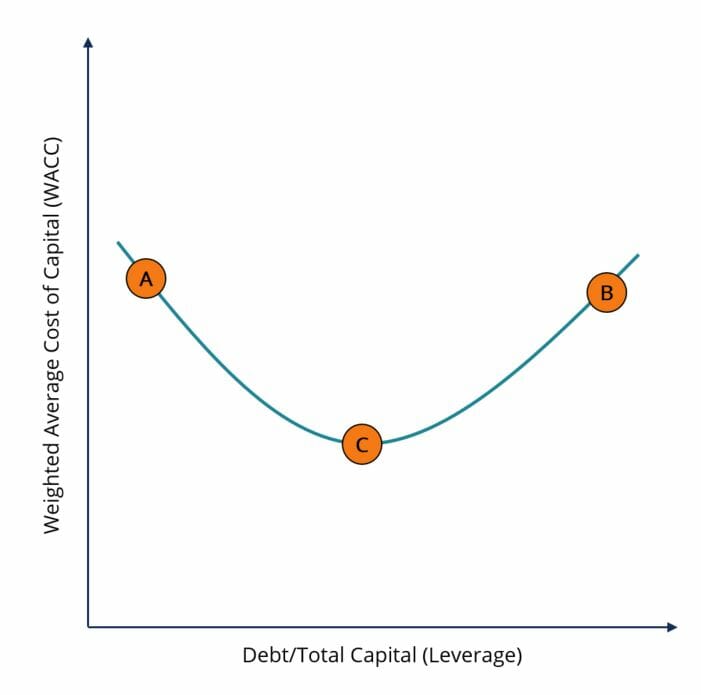
At point A, we see a capital structure that has a low amount of debt and a high amount of equity, resulting in a high WACC. At point B, we see the opposite: a capital structure with a high amount of debt and a low amount of equity – which also results in high WACC. In order to minimize WACC, the capital structure must consist of a balanced combination of debt and equity.
Why is too much equity expensive?
The Cost of EquityCost of EquityCost of Equity is the rate of return a shareholder requires for investing in a business. The rate of return required is based on the level of risk associated with the investment is generally higher than the Cost of DebtCost of DebtThe cost of debt is the return that a company provides to its debtholders and creditors. Cost of debt is used in WACC calculations for valuation analysis. since equity investors take on more risk when purchasing a company’s stock as opposed to a company’s bond. Therefore, an equity investor will demand higher returns (an Equity Risk PremiumEquity Risk PremiumEquity risk premium is the difference between returns on equity/individual stock and the risk-free rate of return. It is the compensation to the investor for taking a higher level of risk and investing in equity rather than risk-free securities.) than the equivalent bond investor to compensate him/her for the additional risk that he/she is taking on when purchasing stock. Investing in stocks is riskier than investing in bonds because of a number of factors, for example:
- The stock market has a higher volatility of returns than the bond market
- Stockholders have a lower claim on company assets in case of company default
- Capital gains are not a guarantee
- DividendsDividendA dividend is a share of profits and retained earnings that a company pays out to its shareholders. When a company generates a profit and accumulates retained earnings, those earnings can be either reinvested in the business or paid out to shareholders as a dividend. are discretionary (i.e., a company has no legal obligation to issue dividends)
Thus, financing purely with equity will lead to a high WACC.

Why is too much debt expensive?
While the Cost of DebtCost of DebtThe cost of debt is the return that a company provides to its debtholders and creditors. Cost of debt is used in WACC calculations for valuation analysis. is usually lower than the cost of equity (for the reasons mentioned above), taking on too much debt will cause the cost of debt to rise above the cost of equity. This is because the biggest factor influencing the cost of debt is the loan interest rateInterest RateAn interest rate refers to the amount charged by a lender to a borrower for any form of debt given, generally expressed as a percentage of the principal. (in the case of issuing bonds, the bond coupon rateCoupon RateA coupon rate is the amount of annual interest income paid to a bondholder, based on the face value of the bond.).
As a business takes on more and more debt, its probability of defaulting on its debt increases. This is because more debt equals higher interest payments. If a business experiences a slow sales period and cannot generate sufficient cash to pay its bondholders, it may go into default. Therefore, debt investors will demand a higher return from companies with a lot of debt, in order to compensate them for the additional risk they are taking on. This higher required return manifests itself in the form of a higher interest rate.
Thus, financing purely with debt will lead to a higher cost of debt, and, in turn, a higher WACC.
It is also worth noting that as the probability of default increases, stockholders’ returns are also at risk, as bad press about potential defaulting may place downward pressure on the company’s stock price. Thus, taking on too much debt will also increase the cost of equity as the equity risk premium will increase to compensate stockholders for the added risk.
Learn more about Warren Buffet’s thoughts on equity vs debt.
Optimal capital structure
The optimal capital structure is one that minimizes the Weighted Average Cost of Capital (WACC) by taking on a mix of debt and equity. Point C on the chart below indicates the optimal capital structure on the WACC versus leverage curve:
If the business is at point A on the curve, issuing debt would bring down its WACC. If the business is at point B on the curve, issuing equity would bring down its WACC. For more details on calculating WACC, click hereWACCWACC is a firm’s Weighted Average Cost of Capital and represents its blended cost of capital including equity and debt..
Other factors to consider
Below are other important factors that need to be taken into consideration when making a financing decision:
- Flotation costs: If investment banks are charging a lot to issue (or “float”) new stock, issuing debt will be cheaper and vice versa.
- Interest rates: High interest rates will require the business to offer high coupon bonds in order to be an attractive investment. This will be more costly, thus issuing equity will be cheaper and vice versa.
- Tax rates: High tax rates will deduct from bondholders’ returns as they will need to give more of their coupon away. Thus, they will demand higher returns to compensate. In this case, issuing equity will be cheaper and vice versa.
- Earnings volatility: If the business is seasonal, or sees volatile revenues each month, it will be difficult to guarantee enough cash will be available for coupon payments. Therefore, issuing equity will be a better decision and vice versa.
- Business growth: If the company is fairly young and is making significant investments in R&D in order to support growth, it may be wiser to reduce monthly claims on cash flows by issuing equity and vice versa.
The table below easily summarizes the debt vs equity decision:
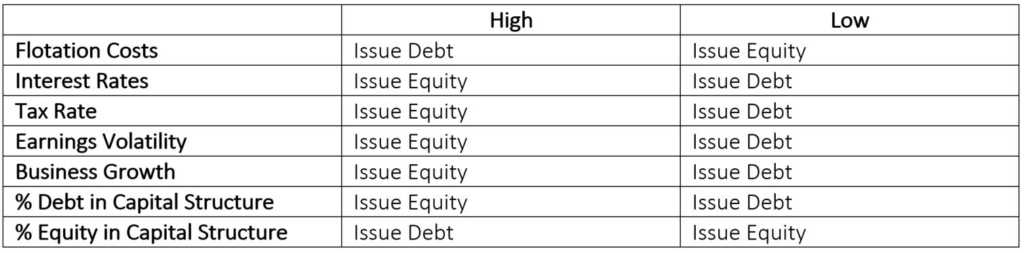
*Assuming all other factors remain the same
More resources
Thank you for reading this guide on debt vs equity and the pros and cons of each type of financing. CFI offers the Financial Modeling & Valuation Analyst (FMVA)™Become a Certified Financial Modeling & Valuation Analyst (FMVA)®CFI's Financial Modeling and Valuation Analyst (FMVA)® certification will help you gain the confidence you need in your finance career. Enroll today! certification program for those looking to take their careers to the next level. To keep learning and advancing your career as an analyst, the following CFI resources will also be helpful:
- Financial modeling for FP&AFinancial Modeling For FP&AFinancial modeling for FP&A is primarily for short to medium-term budgeting, forecasting, and planning. CFI offers online training in building financial models.
- Cost of DebtCost of DebtThe cost of debt is the return that a company provides to its debtholders and creditors. Cost of debt is used in WACC calculations for valuation analysis.
- Cost of EquityCost of EquityCost of Equity is the rate of return a shareholder requires for investing in a business. The rate of return required is based on the level of risk associated with the investment
- InterestInterest ExpenseInterest expense arises out of a company that finances through debt or capital leases. Interest is found in the income statement, but can also
-

Debt Consolidation Loans: Simplify Your Finances & Save Money
Having debt is tough, and it’s even tougher if your financial obligations come from multiple sources. It can be enough to keep track of who you owe, and when you need to pay them, never mind worry abo
-
![Home Renovation Loans: Personal, Credit Card, or Home Equity? | [Your Brand]](https://www.etffin.com/article/uploadfiles/202206/2022061116334113_S.jpg)
Home Renovation Loans: Personal, Credit Card, or Home Equity? | [Your Brand]
Whether its new floors, a new room or just new windows and paint, there are lots of ways to pay for a home renovation project. If youre eager to put in a new bathroom, replace your battered hardw
finance
- Debt Financing: A Comprehensive Guide for Businesses
- Debt-to-Equity Ratio: Definition, Calculation & Importance
- Debt vs. Equity Financing: A Comprehensive Guide for Businesses
- Understanding Business Financing: A Comprehensive Guide
- Mezzanine Financing: Definition, Benefits & How It Works
- HELOC vs. Home Equity Loan: Understanding Your Options
- Equity vs. Debt Financing: Understanding the Key Differences
- Personal Loan vs. Home Equity Loan for Home Improvements: Which is Right for You?
- Debt Snowball vs. Avalanche: Choosing the Best Debt Payoff Strategy
-
Debt Consolidation Strategies: Simplify & Save Money
You may be considering debt consolidation if you have accumulated significant debt and cannot afford the payments. Having large amounts of credit card debt with high interest rates and multiple ...
-
Debt-for-Equity Swaps: Understanding Corporate Restructuring
A company may engage in debt for equity swaps with shareholders for a variety of reasons. The debt for equity swap allows a company to call back a portion of its stock by paying stockholders. Of...