
Mezzanine Financing: Definition, Benefits & How It Works
Mezzanine financing is a layer of financing that fills the gap between senior debt and equity in a company. It can be structured either as preferred stockPreferred SharesPreferred shares (preferred stock, preference shares) are the class of stock ownership in a corporation that has a priority claim on the company’s assets over common stock shares. The shares are more senior than common stock but are more junior relative to debt, such as bonds. or as unsecured debt, and it provides investors with an option to convert to equity interest. Mezzanine financing is usually used to fund growth prospects, such as acquisitions and expansion of the business.
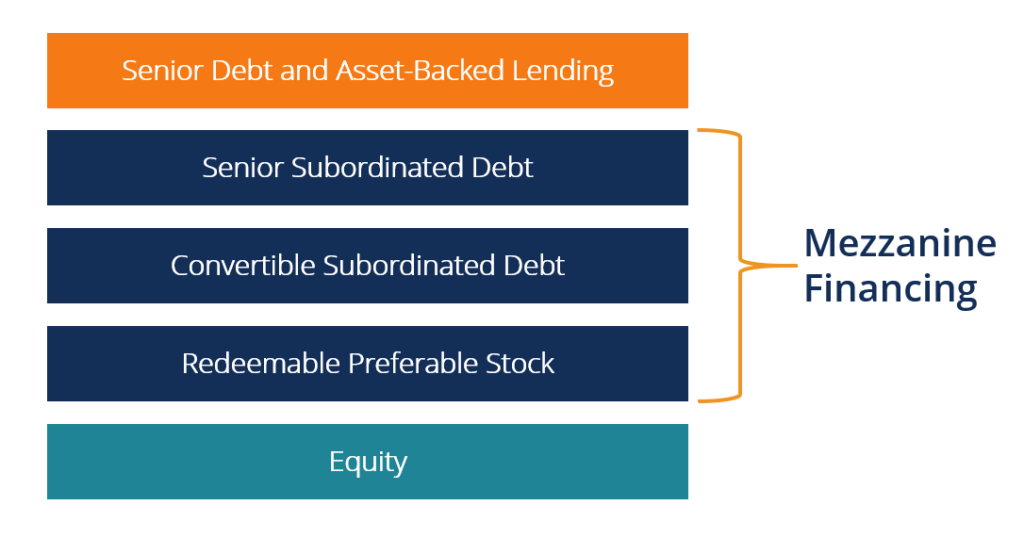
A gap between senior debt and equity financing exists due to the following common reasons:
- Inventory, accounts receivableAccounts ReceivableAccounts Receivable (AR) represents the credit sales of a business, which have not yet been collected from its customers. Companies allow, and fixed assetsFixed AssetsFixed assets refer to long-term tangible assets that are used in the operations of a business. They provide long-term financial benefits are discounted at higher rates for fear of non-recognition of their value.
- There is a substantial volume of intangible assets recorded on the balance sheets.
- To address the rise in defaults and regulatory pressure, banks impose limits on the total debt that a business can acquire.
Mezzanine Financing Rate of Return
The basic form of mezzanine financing is unsecured debt and preferred stocks. As mezzanine financing is unsecured, it carries higher risks, and investors require a higher rate of return than secured lenders. Typically, it pays an investor 12-20%, which is higher than the rate of return on ordinary debt.
Mezzanine investors can earn returns from the following available sources:
1. Cash interest
Based on the portion of the outstanding mezzanine funding balance, investors receive cash periodically. The interest rate may either be set or may fluctuate over the loan period.
2. Payment in Kind (PIK) interest
It is also a periodic method of payment. However, the interest amount is not paid in cash. Instead, it is added to the principal sum of the security, and the total amount is paid at the end of the loan period. For example, a $50 million bond with a 10% PIK interest rate will amount to $55 million at the end of the period, and there will be no cash interest payment.
3. Ownership
Similar to a convertible bond, mezzanine financing often includes an equity interest in the form of a conversion feature or warrant. Usually, the PIK interest or the cash interest follows the ownership portion of the securities.
4. Participation payout
In place of equity, investors may take a return on equity in the form of a percentage of the company’s performance as measured by net sales or EBITDAEBITDAEBITDA or Earnings Before Interest, Tax, Depreciation, Amortization is a company's profits before any of these net deductions are made. EBITDA focuses on the operating decisions of a business because it looks at the business’ profitability from core operations before the impact of capital structure. Formula, examples, or profit.
5. Arrangement fee
Mezzanine investors are also required to be paid an arrangement fee upon closing the transaction.
Benefits of Mezzanine Financing
To the Issuer
1. Increase in total capital
Mezzanine financing can help a company secure more capital and circumvent the under-capitalization of the business. The interest payment on mezzanine funding is also tax-deductible.
Let us assume you want to start your own business and you need $15 million. You plan to raise $5 million through equity and approached a bank seeking a loan of $10 million. However, a bank will usually deem it as unreasonable and will lend only 75% of the required loan. It leaves you with an option to raise $7.5 million through equity.
Suppose a mezzanine investor proposes to lend you $5 million. Since the bank considers mezzanine as equity and sees a trusted partner with the mezzanine component, the bank will ultimately lend you the originally requested amount of $10 million. Therefore, the total capital raised with and without mezzanine will be:
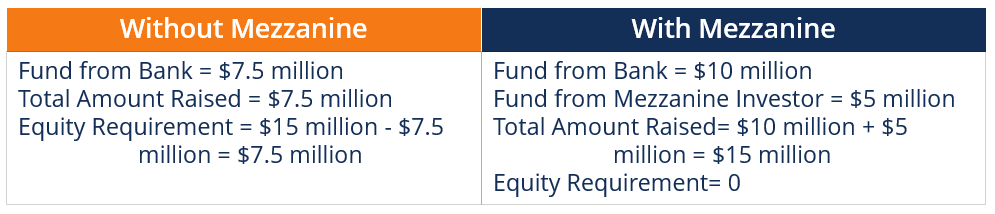
Hence, the mezzanine layer reduces the equity requirement and helps to secure more total capital.
2. Reduction of capital cost and an increase in equity returns
Equity is the costliest source of capital, and it dilutes the current shareholders. Therefore, mezzanine debt may be an attractive alternative for accessing much-needed capital. Companies use an appropriate combination of senior debt, mezzanine debt, and equity to reduce the true cost of capital and increase asset returns.
To the Investor
1. Attractive and safe investment
The mezzanine investor enjoys the advantages of equity investment in the form of high returns and a diverse portfolio. In the case where the borrowing company becomes successful, the mezzanine investor can exercise the equity option and receive the benefits.
In addition, even in the worst case, the mezzanine investor gets at least the interest payment. The interest received for mezzanine financing outperforms the one received against traditional financing.
2. Warrant option
Mezzanine financing often includes warrants or convertible equity options that a mezzanine investor can exercise to earn a stake in the company. The rights can be exercised at a given date or the occurrence of any specific event, as outlined in the agreement.
Mezzanine Financing Limitations
For the Issuer
1. Probability of failure
Mezzanine financing, though readily available, demands high interest rates. In case the project fails to take off, the creditor will need to pay back the extremely costly loan.
2. Potential loss of control and freedom
When creditors take mezzanine debt, they sacrifice freedom and control, as conversion to equity is always a possibility. Moreover, the equity option, when exercised, results in the dilution of EPS, triggering a negative reaction from existing shareholders.
For the Investor
1. High risk
Mezzanine financing is provided without collateral, and the investment is mostly made in high-yield but risky, projects. Thus, investors are exposed to the risk of losing the investment in case the company goes bankrupt.
2. Long time-period for return on investments
Companies usually seek mezzanine financing for the growth or expansion process. Such ventures require some time before they can produce returns. Mezzanine financing is not intended for investors who are looking to make quick money. It is why mezzanine financing agreements specify the interest commencements after a period, not immediately.
Key Takeaways
- Mezzanine financing produces higher returns than traditional debt, and investors can earn returns through cash interest, PIK interest, ownership, and payout as a percentage of the company’s performance.
- It helps a business secure more capital, lower the cost of capital, increase the rate of return, and save tax on interest payments.
- Mezzanine financing includes a convertible option or warrant that provides investors with a right to earn a stake in the business. It, however, results in the existing owners being diluted by the issuance of additional shares.
Additional Resources
CFI offers the Commercial Banking & Credit Analyst (CBCA)®Program Page - CBCAGet CFI's CBCA™ certification and become a Commercial Banking & Credit Analyst. Enroll and advance your career with our certification programs and courses. certification program for those looking to take their careers to the next level. To keep learning and advancing your career, the following resources will be helpful:
- Cost of CapitalCost of CapitalCost of capital is the minimum rate of return that a business must earn before generating value. Before a business can turn a profit, it must at least generate sufficient income to cover the cost of funding its operation.
- Pro-Rata Participation RightsPro-Rata Participation RightsPro-rata participation rights, or pro-rata investing rights, guarantee existing investors the right to participate in future fundraising activities. Pro-
- Rate of ReturnRate of ReturnThe Rate of Return (ROR) is the gain or loss of an investment over a period of time copmared to the initial cost of the investment expressed as a percentage. This guide teaches the most common formulas
- Series A FinancingSeries A FinancingSeries A financing (also known as series A round or series A funding) is one of the stages in the capital-raising process by a startup. Essentially, the series A round is the second stage of startup financing and the first stage of venture capital financing.
-

Understanding Junior Equity: Risks and Returns
Junior equity refers to the equity or shares issued by a company that ranks below other shares or stocks issued by the same company. The stock issued is said to be subordinate to other stocks issued b
-
Pro-Rata Rights: Understanding Investor Ownership in Funding Rounds
Pro-rata right is a legal term that describes the right, but not the obligation, that can be given to an investor to maintain their initial level of percentage ownershipStockholders EquityStockholders
finance
- Backstop: Understanding Financial Safety Nets and Contingency Funding
- Debt Financing: A Comprehensive Guide for Businesses
- Understanding Equity: A Comprehensive Guide for Investors
- Equity Crowdfunding: A Comprehensive Guide for Startups & Investors
- Equity Financing: A Comprehensive Guide for Business Growth
- Understanding Negative Equity: Causes, Risks & Solutions
- Vendor Financing: A Comprehensive Guide for Businesses
- Growth Equity: Investing in Expanding Businesses | [Your Company Name]
- Understanding Home Equity: A Comprehensive Guide
-
 Understanding Business Financing: A Comprehensive Guide
Financing refers to the methods and types of funding a business uses to sustain and grow its operations. It consists of debtSenior and Subordinated DebtIn order to understand senior and subordinated d...
-
 Understanding Horizontal Equity in Taxation
Horizontal equity is an economic theory that is used to assess the fairness of tax burden across a population. The theoretical underpinning of horizontal equity is that the amount of taxes paid should...