
Understanding Debt-to-Income Ratio (DTI): A Comprehensive Guide
The debt-to-income (DTI) ratio is a metric used by creditors to determine the ability of a borrower to pay their debts and make interest payments. The DTI ratio compares an individual’s monthly debt payments to his or her monthly gross incomeGross IncomeGross income refers to the total income earned by an individual on a paycheck before taxes and other deductions. It comprises all incomes. It is a key indicator that lenders use to measure an individual’s ability to repay monthly payments and accumulate additional debt.

Understanding the Debt-to-Income Ratio
The debt-to-income ratio is of utmost importance to creditors that are considering providing financing to an individual. A higher ratio is unfavorable for creditors to see, as it indicates that a higher proportion of an individual’s income goes towards monthly debt payments.
For example, a DTI ratio of 20% means that 20% of the individual’s monthly gross income is used to servicing monthly debt payments. The maximum acceptable DTI ratio varies depending on the lender. As a guideline, it is preferable to achieve a ratio that is lower than 36%.
Front-End vs. Back-End Ratios
There are two main forms of debt-to-income ratios:
1. Front-end ratio
The front-end ratio specifies the percentage of income that goes towards rent, mortgage payments, property taxes, hazard insurance, and mortgage insurance.
2. Back-end ratio
The back-end ratio specifies the percentage of income that goes towards all recurring debt payments (including the ones above). Additional payments are added, such as credit card, car loan, student loan, and child support payments.
Overall, the front-end ratio helps measure the portion of income that goes towards housing costs, while the back-end ratio measures the portion of income that goes towards all costs.
Debt-to-Income Ratio in the Credit Analysis Process
The debt-to-income ratio is used as part of the credit analysisCredit AnalysisCredit analysis helps determine the ability of a company or person to repay their debt obligations. It determines a potential borrower's credit risk or default risk. process to determine the credit riskCredit RiskCredit risk is the risk of loss that may occur from the failure of any party to abide by the terms and conditions of any financial contract, principally, of an individual. It is important to note that, for example, an individual with a DTI ratio of 15% does not necessarily possess less credit risk than an individual with a DTI ratio of 25%.
The DTI ratio only forms part of the credit evaluation of an individual; a thorough credit analysis must be conducted to correctly determine the credit risk of an individual.
Formula for the Debt-to-Income Ratio

Where:
- Monthly Debt Payments refer to monthly bills such as rent/mortgage, car insurance, health insuranceHMO vs PPO: Which is Better?Getting the best healthcare often requires choosing between an HMO vs PPO. You need to be able to make an informed decision on which plan will work best., credit cards, student loans, medical bills, dental bills, car loans, child support payments, and other payments.
- Gross Income is the income of an individual before tax and other deductions.
Practical Example
An individual currently pays $2,000 a month for their mortgage, $100 for car insurance, and $500 in other debts. If the monthly gross income of this individual is $4,500, what is the debt-to-income ratio?
DTI Ratio = ($2,000 + $100 + $500) / $4,500 x 100 = 57.78%
Methods to Decrease the Debt-to-Income Ratio
1. Decrease monthly debt payments
By minimizing the monthly debt payments, an individual can decrease their debt-to-income ratio. For example, in a student loan, an individual has the option of repaying their principal debt to reduce the amount of interest charged.
Consider an outstanding $50,000 student loan with a monthly interest rate of 1%. Scenario one involves an individual who is not repaying their principal debt, while scenario two involves an individual who has paid down $30,000 of their principal debt.
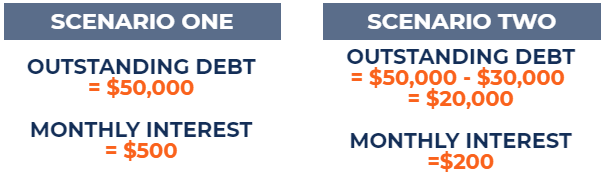
As illustrated above, as an individual pays down more of their principal debt, the monthly interest payments decrease.
2. Increase gross income
By increasing the gross income, an individual can decrease their debt-to-income ratio. The method is self-explanatory – due to the fact that the gross income is in the denominator of the ratio, an individual with a higher income would lower their debt-to-income ratio.
Consider two scenarios with a monthly debt payment of $1,500 each. However, the gross monthly income for scenario one is $3,000, while the gross monthly income for scenario two is $5,000. As such, the debt-to-income ratio would be as follows:
DTI Ratio (Scenario one) = $1,500 / $3,000 x 100 = 50%
DTI Ratio (Scenario two) = $1,500 / $5,000 x 100 = 30%
Related Readings
CFI offers the Financial Modeling & Valuation Analyst (FMVA)™Become a Certified Financial Modeling & Valuation Analyst (FMVA)®CFI's Financial Modeling and Valuation Analyst (FMVA)® certification will help you gain the confidence you need in your finance career. Enroll today! certification program for those looking to take their careers to the next level. To keep learning and developing your knowledge base, please explore the additional relevant CFI resources below:
- Credit RatingCredit RatingA credit rating is an opinion of a particular credit agency regarding the ability and willingness an entity (government, business, or individual) to fulfill its financial obligations in completeness and within the established due dates. A credit rating also signifies the likelihood a debtor will default.
- MortgageMortgageA mortgage is a loan – provided by a mortgage lender or a bank – that enables an individual to purchase a home. While it’s possible to take out loans to cover the entire cost of a home, it’s more common to secure a loan for about 80% of the home’s value.
- Loan CovenantLoan CovenantA loan covenant is an agreement stipulating the terms and conditions of loan policies between a borrower and a lender. The agreement gives lenders leeway in providing loan repayments while still protecting their lending position. Similarly, due to the transparency of the regulations, borrowers get clear expectations of
- Pretax IncomePretax IncomePretax income, also known as earnings before tax, is the net income earned by a business before taxes are subtracted/accounted for.
-

Asset Turnover Ratio: Definition & Calculation - Financial Analysis
The asset turnover ratio, also known as the total asset turnover ratio, measures the efficiency with which a company uses its assets to produce salesSales RevenueSales revenue is the income recei
-

Benefit-Cost Ratio (BCR): Understanding & Calculation
The benefit-cost ratio (BCR) is a profitability indicator used in cost-benefit analysis to determine the viability of cash flows generated from an asset or project. The BCR compares the present value
finance
- Acid-Test Ratio: Understanding Your Company's Short-Term Liquidity
- Advertising to Sales Ratio: Measuring Ad Effectiveness & ROI
- Understanding the CAPE Ratio: A Guide to Cyclically Adjusted P/E
- Current Ratio: Definition, Calculation & Financial Health
- Operating Ratio: Definition, Calculation & Importance
- Quick Ratio: Understanding Your Business's Short-Term Liquidity
- Reserve Ratio Explained: Understanding Bank Reserves
- Understanding the Retention Ratio: Reinvesting for Growth
- Sharpe Ratio: Calculate & Interpret Investment Performance
-
![Shareholder Equity Ratio: Definition & Calculation | [Your Company Name]](https://www.etffin.com/article/uploadfiles/202110/2021100815180064_S.png) Shareholder Equity Ratio: Definition & Calculation | [Your Company Name]
Shareholder Equity Ratio: Definition & Calculation | [Your Company Name]The shareholder equity ratio is a ratio that shows the amount of a company’s assets that have been financed using the owner’s equity instead of debt. It shows the portion of shareholders&r...
-
 Treynor Ratio: Understanding Risk-Adjusted Portfolio Performance
The Treynor Ratio is a portfolio performance measure that adjusts for systematic riskSystematic RiskSystematic risk is that part of the total risk that is caused by factors beyond the control of a spe...