
Understanding Earnings Volatility: Risk & Stock Price Prediction
Earnings volatility is a statistical concept that determines the associated risk and helps predict the market price of a particular stock. Volatility is the risk related to different degrees of change in a security’s value. Higher volatility implies higher risk. A market witnessing sustained rises and falls over a significant period of time is a volatile market.

Summary
- Earnings volatility is a statistical concept that determines the associated risk and predicts the market price of a particular stock. Volatility is the risk related to different degrees of change in a security’s value.
- It is directly correlated with the cost of capital. As earnings feed capital surplus, high volatility implies high chances of insolvency.
- Earnings volatility can be used to predict earnings using financial forecasting models.
Understanding Earnings Volatility
Volatility is determined by measuring the dispersion of returns for a given security or market indexStock IndexA stock index consists of constituent stocks used to provide an indication of an economy, market, or sector. A stock index is commonly used by investors as (which is a section of the stock market) and is calculated using variance and standard deviation. Earnings volatility, in particular, monitors the net earnings of companies on a quarterly or monthly basis to determine the stability or instability of the associated security.
As earnings are a driver of stock performance, inconsistent earnings imply higher risk. As volatility is a comparative metric, yearly data of a company’s performance is compared. Earnings as of January 2019 may be compared to real earnings as of January 2018, or to projected earnings (according to corporate management or financial analysis estimates) of January 2020. These figures are known as historical earnings and implied earnings, respectively.
Impact of Earnings Volatility
1. Cost of capital
Earnings volatility is directly correlated with the cost of capitalCost of CapitalCost of capital is the minimum rate of return that a business must earn before generating value. Before a business can turn a profit, it must at least generate sufficient income to cover the cost of funding its operation.. As earnings feed capital surplus, high volatility implies high chances of insolvency. It also brings into question the business practices of a company’s current management.
External sources of funding are always costlier compared to internal funding, which can be deducted from the net profit in the company’s balance sheet.
2. Earnings predictability
Earnings volatility can be used to predict earnings using financial forecasting models. They impact predictability, due to their relationship with the discount rate or estimated cash flows. Volatility can be due to either external economic shocks faced by the company or inaccuracies in the accounting processAccounting TransactionsAccounting transactions refer to any business activity that results in a direct effect on the financial status and financial statements of the to determine income. Both factors contribute to reduced predictability of earnings.
Earnings with low volatility show high persistence and, consequently, higher predictability. Earnings with high volatility imply little reliable predictability.
Higher volatility may lead to a paucity of internal funding. This would force managers to look for external sources of funding and forego promising investment opportunities due to the higher cost of capital of external financing. Therefore, volatile earnings increase the probability of a lack of access to internal funds and external funds, as well as underinvestment. Such occurrences are called investment distortions, which are negatively related to future earnings.
3. Share prices
Traditionally, earnings volatility adversely affects share price performance. Generally, the more stable the earnings of a company, the more stable the price of its stock. However, biases may arise due to other market factors such as a sudden drop in oil prices that impact both credit earnings volatility and the value of equity.
Therefore, academic circles increasingly believe that the impact of volatility on equity is likely overestimated. For example, Amazon.com reported lower earnings in 2012 than that in the preceding financial year. Yet, the online retail giant’s stock price rose by 8% in 2012 as investors piled on.
Additional Resources
CFI is the official provider of the Financial Modeling and Valuation Analyst (FMVA)®Become a Certified Financial Modeling & Valuation Analyst (FMVA)®CFI's Financial Modeling and Valuation Analyst (FMVA)® certification will help you gain the confidence you need in your finance career. Enroll today! certification program, designed to transform anyone into a world-class financial analyst.
In order to help you become a world-class financial analyst and advance your career to your fullest potential, these additional CFI resources will be very helpful:
- Chandelier ExitChandelier ExitChandelier Exit (CE) is a volatility-based indicator that identifies stop loss exit points for long and short trading positions. Chuck Le Beau, a recognized expert in exit strategies, developed the CE indicator. However, Alexander Elder introduced the strategy to traders
- Long and Short PositionsLong and Short PositionsIn investing, long and short positions represent directional bets by investors that a security will either go up (when long) or down (when short). In the trading of assets, an investor can take two types of positions: long and short. An investor can either buy an asset (going long), or sell it (going short).
- Market Risk PremiumMarket Risk PremiumThe market risk premium is the additional return an investor expects from holding a risky market portfolio instead of risk-free assets.
- VIXVIXThe Chicago Board Options Exchange (CBOE) created the VIX (CBOE Volatility Index) to measure the 30-day expected volatility of the US stock market, sometimes called the "fear index". The VIX is based on the prices of options on the S&P 500 Index
-

Volatility Smile Explained: Understanding Implied Volatility Patterns
A volatility smile refers to a U-shaped graphical representation of the pattern created by the implied volatilities of multiple options contracts that share the same date of expiration. The geographic
-

Volatility Swaps: A Comprehensive Guide for Investors
Volatility swap refers to a financial derivative, the payoff of which is based upon the volatility of the underlying asset of that security, which is a forward contractForward ContractA forward contra
finance
- Understanding Appraisals: A Comprehensive Guide
- Understanding Earnings: A Guide to Financial Profitability
- Understanding Earnings Announcements: A Comprehensive Guide
- Earnings Management: Definition, Techniques & Impact
- Understanding Historical Volatility (HV): A Comprehensive Guide
- Understanding Implied Volatility (IV): A Comprehensive Guide
- Understanding Volatility: A Key Indicator of Investment Risk
- Volatility Ratio: Understanding Price Changes for Trading & Investing
- Understanding Volatility Skew: A Guide for Investors
-
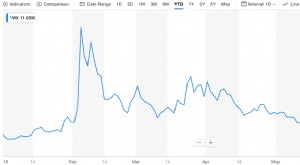 VIX Explained: Understanding the Stock Market Volatility Index
The Chicago Board Options Exchange (CBOE) created the VIX (CBOE Volatility Index) to measure the 30-day expected volatility of the US stock marketStock MarketThe stock market refers to public markets ...
-
 Volatility Arbitrage: A Deep Dive into Options Trading Strategies
Volatility arbitrage refers to a type of statistical arbitrage strategy that is implemented in options trading. It generates profits from the difference between the implied volatilityImplied Volatilit...