
EBIAT Explained: Understanding Earnings Before Interest and Taxes
EBIAT, or Earnings Before Interest After Taxes, is a financial metric that measures a company’s profitability and operating efficiency. The calculation of EBIAT removes the tax benefits gained from debt financingDebt vs Equity FinancingDebt vs Equity Financing - which is best for your business and why? The simple answer is that it depends. The equity versus debt decision relies on a large number of factors such as the current economic climate, the business' existing capital structure, and the business' life cycle stage, to name a few..
EBIAT gives a true financial picture of the company, eliminating all elements that can potentially boost or reduce its financial strength. It shows what the company’s profits would be if it were paying 100% of its proper tax bill.
Formula for EBIAT
The formula for calculating EBIAT is as follows:
Where:
- EBIT = Revenues – Operating Expenses + Non-operating Income
Uses of EBIAT
EBIAT can be useful in the following situations:
1. Evaluating financial performance
Financial analysts use EBIAT to evaluate a company’s financial performance while taking into account the tax environment in which the business operates.
2. Getting a true financial picture
Financial decisions that a company makes are directly under their control. However, tax decisions are not under their control because tax rates and related laws are set by the government. EBIAT helps to analyze a company’s operating costs by taking into account its tax expenses to evaluate its actual operating profit.
3. Intra-company comparison
EBIAT is also useful for intra-company comparisons as it enables the comparison of a company’s profitability over time. It provides a true picture of profitability and facilitates better comparison.
4. Cash flow position
EBIAT helps assess a company’s true cash flow position. It helps to reveal its liquidityLiquidityIn financial markets, liquidity refers to how quickly an investment can be sold without negatively impacting its price. The more liquid an investment is, the more quickly it can be sold (and vice versa), and the easier it is to sell it for fair value. All else being equal, more liquid assets trade at a premium and illiquid assets trade at a discount. or the actual availability of cash that may be used to settle its debt and other financial obligations.
Illustrative Example
Company A generated $1,000,000 in revenues in the previous financial year. During the period, the company also reported a non-operating income of $53,000. The company’s cost of goods soldCost of Goods Sold (COGS)Cost of Goods Sold (COGS) measures the “direct cost” incurred in the production of any goods or services. It includes material cost, direct was $165,000, while its depreciation and amortization expenses were $83,000. Selling, general and administrative expensesSG&ASG&A includes all non-production expenses incurred by a company in any given period. It includes expenses such as rent, advertising, marketing were $180,000 and miscellaneous expenses were $20,000. It also incurred a one-time cost or special expense of $48,000 during the period.
Here, EBIT = $1,000,000 – ($165,000 + $83,000 + $180,000 + $20,000 + $48,000) + $53,000 = $557,000. Now, if the tax rate for the company is 30%, then, the EBIAT is calculated as EBIT x (1 – Tax rate) = $557,000 x (1 – 0.3) = $389,900.
More Resources
CFI is the official provider of the global Financial Modeling & Valuation Analyst (FMVA)™Become a Certified Financial Modeling & Valuation Analyst (FMVA)®CFI's Financial Modeling and Valuation Analyst (FMVA)® certification will help you gain the confidence you need in your finance career. Enroll today! certification program, designed to help anyone become a world-class financial analyst. To keep advancing your career, the additional CFI resources below will be useful:
- EBIT GuideEBIT GuideEBIT stands for Earnings Before Interest and Taxes and is one of the last subtotals in the income statement before net income. EBIT is also sometimes referred to as operating income and is called this because it's found by deducting all operating expenses (production and non-production costs) from sales revenue.
- EBITDALEBITDALEBITDAL stands for Earnings Before Interest, Taxes, Depreciation, Amortization and Special Losses. It is a non-GAAP measure of a company's earnings that also accounts for special losses that it usually does not expect to incur on a regular basis.
- Projecting Income Statement Line ItemsProjecting Income Statement Line ItemsWe discuss the different methods of projecting income statement line items. Projecting income statement line items begins with sales revenue, then cost
- The Ultimate Cash Flow GuideThe Ultimate Cash Flow Guide (EBITDA, CF, FCF, FCFE, FCFF)This is the ultimate Cash Flow Guide to understand the differences between EBITDA, Cash Flow from Operations (CF), Free Cash Flow (FCF), Unlevered Free Cash Flow or Free Cash Flow to Firm (FCFF). Learn the formula to calculate each and derive them from an income statement, balance sheet or statement of cash flows
-

Understanding Financial Hardship: Causes, Impacts & Relief
Different programs make hardship decisions based on different criteria. Financial hardship usually refers to a situation in which a person cannot keep up with debt payments and bills. This pa
-

Defining Financial Success: Goals & Strategies for a Secure Future
Monetary success is difficult to define in concrete terms. Even though everyone has their own definitions, there is plenty of advice on how to plan for a better financial futu
finance
- Understanding Auditors: Roles, Responsibilities & Audit Processes
- EBITDARM Explained: A Comprehensive Guide to Financial Analysis
- Eurocurrency Explained: What It Is & How It Works
- Factset: Financial Data & Analytics Solutions for Investment Professionals
- Understanding Finance: A Comprehensive Overview of Key Concepts
- Understanding Financial Crises: Causes, Impacts, and Examples
- Financial Engineering: Principles, Applications & Career Paths
- Understanding Your Financial Health: A Comprehensive Guide
- Financial Inclusion: Definition, Benefits & Impact
-
 Financial Analysis: A Comprehensive Guide for Professionals
Financial analysis involves using financial dataFinancial DataWhere to find data for financial analysts - Bloomberg, CapitalIQ, PitchBook, EDGAR, SEDAR and more sources of financial data for financial...
-
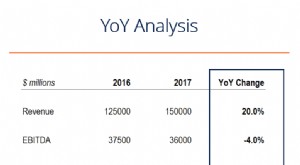 YoY Analysis: Understanding Year-over-Year Growth & Financial Insights
YoY stands for Year over Year and is a type of financial analysisAnalysis of Financial StatementsHow to perform Analysis of Financial Statements. This guide will teach you to perform financial stateme...