
Understanding Financial Statement Footnotes: A Comprehensive Guide
Financial statement footnotes are used as additional information to individuals reading a financial statement. Otherwise known as explanatory notes or notes to the financial statements, the footnotes help add supplementary information to help further explain the related information in the financial statement without clouding the primary information that it is trying to convey.
Understanding Financial Statement Footnotes
Footnotes are often quite long and help to clearly describe the smaller details that connect with specific parts of the financial statements. The financial statement footnotes provide greater information to specific portions of the statements, which helps improve the flow of information for the reader and makes sure the essential explanatory details are included.
Footnotes are mainly used by analysts reviewing the financial statements to give them a much more detailed and comprehensive outlook on the company’s financial situation. It helps the analysts understand the accounting policiesAccounting PoliciesAccounting policies are rules and guidelines that are selected by a company for use in preparing and presenting its financial statements and how they might affect the company’s underlying financial health.
Auditors will also use the financial statements and their footnotes to help understand the company’s financial position. Their findings within the audit will be based almost as heavily on the footnotes as the other core areas of the financial statements.
Footnotes also depend heavily on the accounting framework that is being followed for the specific company. For example, the financial statement footnotes will look different for a company that follows IFRS standards compared to Canadian GAAP. Publicly held companies will require even more extensive financial statements and footnotes mandated by the Securities and Exchange Commission (SEC)Securities and Exchange Commission (SEC)The US Securities and Exchange Commission, or SEC, is an independent agency of the US federal government that is responsible for implementing federal securities laws and proposing securities rules. It is also in charge of maintaining the securities industry and stock and options exchanges.
Drawbacks of Financial Statement Footnotes
Footnotes are an essential part of any financial statement. However, they come with a few disadvantages. Footnotes are required only to the point “beyond the legal minimum” to protect the company from liability. How footnotes are conveyed and which information is included is up to the discretion of management.
Some footnotes will be filled with accounting jargon, which may make the information conveyed difficult for the reader to understand. It could be to hide something from the public, and investors should be wary of any financial statements like them.
Common Types of Footnotes
There is a long list of the different types of financial statement footnotes. Any information that is needed to clarify or add additional detail to a financial statement will be found in the footnotes.
Examples can include references, unexpected changes from the previous year, required disclosures, adjusted figures, accounting policy, etc. Footnotes may also contain notable future activities that are expected to have a significant impact on the company’s future.
Below is a list of some of the common footnotes found on a company’s financial statements. The list below is by no means comprehensive and just an example to showcase a few of the footnotes you might expect to see. Depending on the company and industry, the financial statements can include some very niche explanatory footnotes.
- Accounting policies – The general accounting policies/principles that the company is following
- Depreciation of assets – The depreciation section will explain the company’s method to depreciate its assets over time. The method will depend on the type of asset and industry it works in.
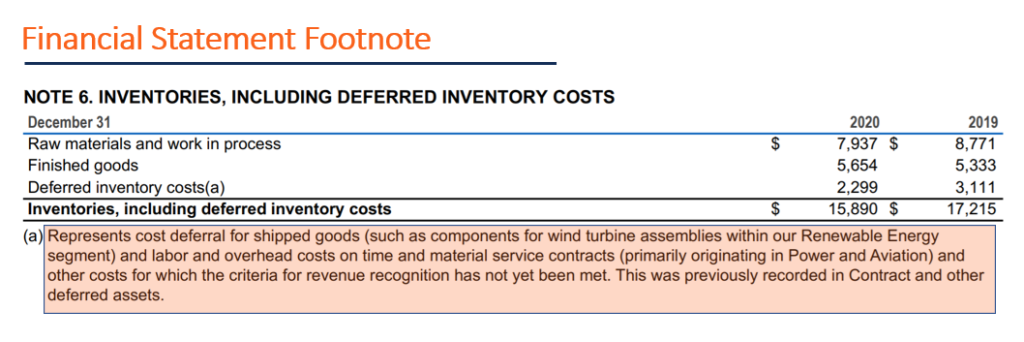
- Inventory valuation – Valuation of inventory can be found in several different ways. This footnote clarifies the valuation method from period to period and makes it easier to compare over time.
- Intangible assets – Intangible assets do not have a physical form and therefore are harder to value. The footnote will clarify how the valuation came to fruition and what it represents.
- Financial investments – All financial investments should have a footnote clarifying their fair value and any unrealized losses or gains from the investment.
- Employee benefits – Companies generally disclose their employee’s health and welfare, medical, vacation, retirement plans, and other benefits.
- Stock-based compensation – A footnote will be included if a company offers stock-based compensationStock Based CompensationStock Based Compensation (also called Share-Based Compensation or Equity Compensation) is a way of paying employees and directors of a plans explaining its stock options, types of restricted stock, and other performance plans.
- Taxes – Tax rates will vary between jurisdictions and industries. Financial statements will clarify the details and breakdown of each portion of their company’s taxes and its overall effect.
- Significant trends or risks – Companies will often disclose important trends or risks that have the potential to impact the future projections of their company.
Again, the list above is only a shortlist of some common financial statement footnotes. The content of each footnote and the different explanatory notes included in a financial statement will vary tremendously between companies and industries, so it is essential to read them whenever analyzing a company’s financials thoroughly.
Real-World Examples
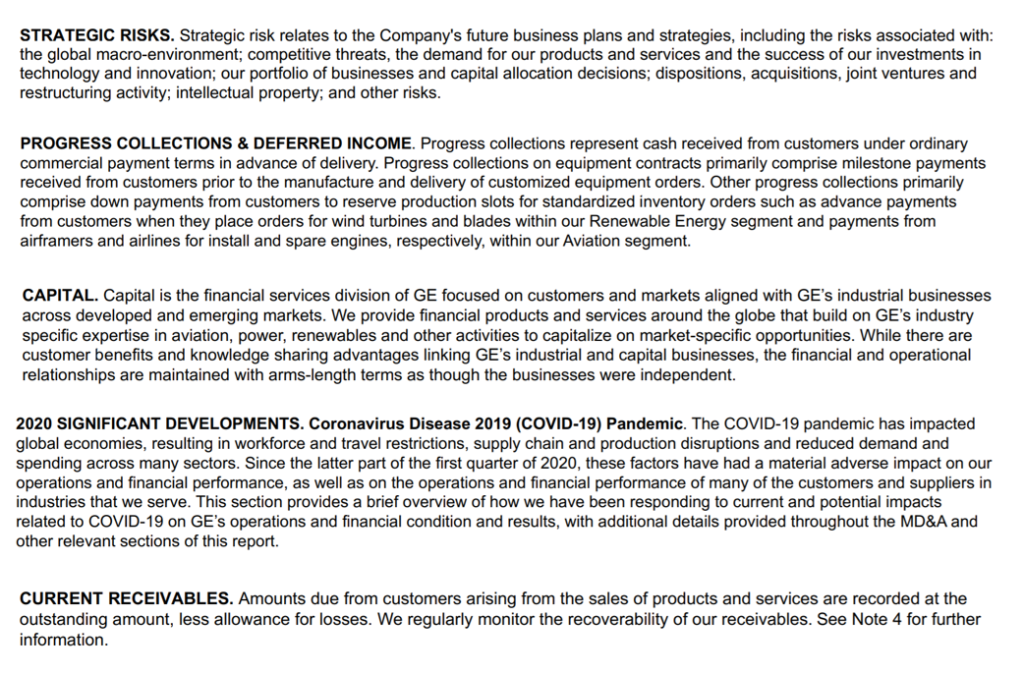
Below are some examples of financial statement footnotes pulled from General Electric Company’s financial statements (fiscal year ended December 31, 2020). Specific line items that require more explanation will almost always come with a related footnote to help clarify any missing information.
More Resources
CFI is the official provider of the global Capital Markets & Securities Analyst (CMSA)®Program Page - CMSAEnroll in CFI's CMSA® program and become a certified Capital Markets &Securities Analyst. Advance your career with our certification programs and courses. certification program, designed to help anyone become a world-class financial analyst. To keep advancing your career, the additional CFI resources below will be useful:
- Analysis of Financial StatementsAnalysis of Financial StatementsHow to perform Analysis of Financial Statements. This guide will teach you to perform financial statement analysis of the income statement,
- IFRS StandardsIFRS StandardsIFRS standards are International Financial Reporting Standards (IFRS) that consist of a set of accounting rules that determine how transactions and other accounting events are required to be reported in financial statements. They are designed to maintain credibility and transparency in the financial world
- Inventory ValuationInventory ValuationInventory valuation refers to the practice of accounting for the value of a business' inventory. Business inventories refer to all the
- Financial HealthFinancial HealthFinancial health is a basic measure of the soundness of an individual’s finances – essentially, it’s about what kind of financial shape
-
Understanding Intersegment Sales: Definition & Reporting
Intersegment sales refer to revenue generated by means of a transaction between segments within the same business. It is generally the case with large conglomerates that engage in several lines of bus
-

Understanding Source Documents: A Comprehensive Guide
Every time a business is involved in a financial transaction, a paper trail is generated. This paper trail is referred to in accounting as source documents. Whether checks are written to be paid out,
finance
- Understanding Financial Barriers: How Costs Impact Your Lifestyle
- Understanding Joint Financial Statements: A Comprehensive Guide
- Understanding Financial Statement Disclosures: A Comprehensive Guide
- Financial Covenants: Definition, Types & Importance
- Robo-Advisors: A Comprehensive Guide to Automated Investment Management
- Understanding Financial Assets: Definitions & Types
- Financial Statement Manipulation: Definition & Examples
- Understanding Financial Statement Notes: A Comprehensive Guide
- Understanding Financial Services: A Comprehensive Guide
-
 Understanding Audit Assertions: A Comprehensive Guide
Assertions are claims that establish whether or not financial statements are true and fairly represented in the process of auditing. Importance of AssertionsAssertions are an important aspe...
-
 Understanding Cash Equivalents: Definition & Examples
Cash includes legal tender, bills, coins, checks received but not deposited, and checking and savings accounts. Cash equivalents are any short-term investment securities with maturity periods of 90 da...