
Financial Stability Board (FSB): Role, Purpose & Key Functions
The Financial Stability Board (FSB) is a global organization that regulates and makes recommendations regarding the global financial system. The FSB’s creation came after the G20 Summit in London in April 2009. Headquartered in Basel, Switzerland, the board includes all G20 major economies. Germany’s Dietrich Domanski is the current Secretary-General of the FSB, as of 2019.
How the Financial Stability Board Works
The Financial Stability Board promotes and ensures global financial stability by monitoring the global financial scenario and making recommendations. The FSB consists of 68 member institutions. It comprises several central banks, ministries of finance, and supervisory and regulatory authorities from 25 jurisdictions, as well as 10 international organizations and six Regional Consultative Groups (RCGs).
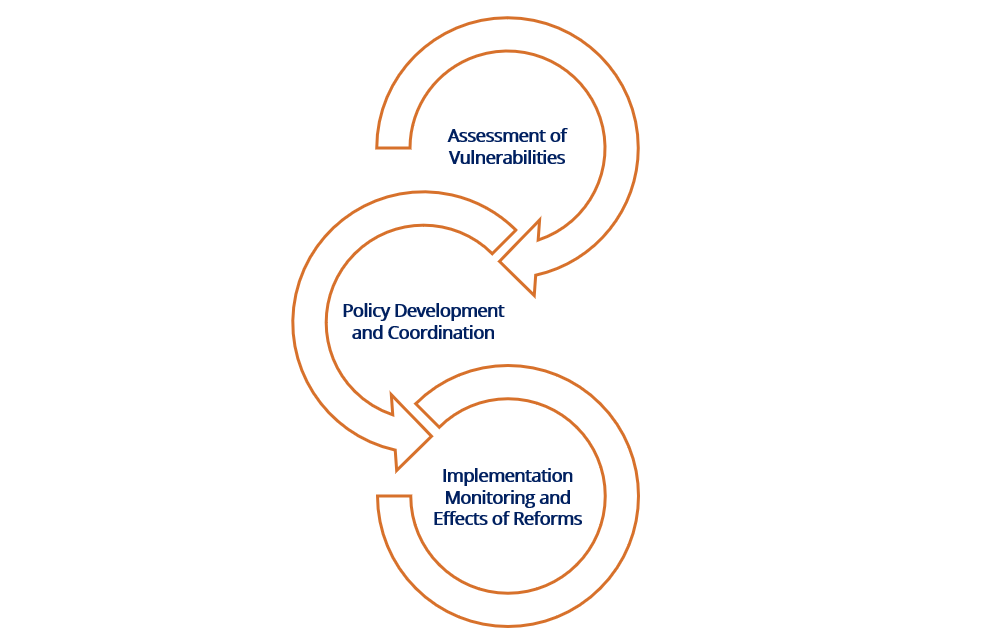
The FSB operates through a three-stage process. The process ensures smooth coordination, cooperation, and consistency throughout its operations.
Summary
- The Financial Stability Board (FSB) is a global organization that regulates and makes recommendations regarding the global financial system.
- The FSB promotes and ensures global financial stability by monitoring the global financial scenario and making recommendations for the same.
- The board consists of 68 member institutions. It comprises several central banks, ministries of finance, and supervisory and regulatory authorities from 25 jurisdictions, as well as 10 international organizations and six Regional Consultative Groups (RCGs).
Functions of the Financial Stability Board
The FSB is responsible for:
- Preparing annual reports on the implementation of reforms and their effects
- Coordinating financial sector policies
- Conducting outreach activities
- Building resilient financial institutions
- Addressing SIFIs
- Supervising the global financial market
- Making the derivates market safer
- Enhancing the resilience of non-bank financial intermediation
- Formulating additional policies on specific areas of the global financial market
- Preparing progress reports to the G20
- Conducting peer reviews
- Analyzing the effects of reforms
Structure of the Financial Stability Board
- The Plenary, which serves as the sole decision-making body
- The Steering Committee, which takes forward operational work in between Plenary meetings
- Three Standing Committees, each with a specific but complementary responsibility assigned which include:
- The Standing Committee on Assessment of Vulnerabilities (SCAV), which is the FSB’s primary body for identifying and assessing risks in the financial system
- The Standing Committee on Supervisory and Regulatory Cooperation (SCSRC), which is responsible for undertaking supervisory analysis and framing a supervisory policy in response to vulnerabilities identified by SCAV.
- The Standing Committee on Standards Implementation (SCSI), which is responsible for monitoring the implementation of the FSB policy initiatives and agreed international standards.
Moreover, the Standing Committee on Budget and Resources (SCBR) provides oversight of the FSB’s budget and resources. The current chair of the FSB is Randal K. Quarles, an American government official and private equity investor.
Regional Consultative Groups (RCGs)
In 2011, the FSB established six Regional Consultative Groups (RCGs) – one each for North America, South America, Asia, The Commonwealth of Independent States, Europe, Middle East and North Africa, and the Sub-Saharan Africa region – to expand and formalize the FSB’s outreach activities beyond the membership of the G20. The RCGs provide a structured mechanism that promotes interactions between the FSB members and non-members regarding the board’s initiatives and implementation of international financial policy.
Assessment of Vulnerabilities
The Standing Committee on Assessment of Vulnerabilities (SCAV) is the FSB’s primary committee for the assessment of risks and vulnerabilities in the global financial system. The assessment focuses on macro-financial vulnerabilities arising from structural flaws in the financial system, such as misaligned incentives, potential market stress, etc.
Policy Development and Coordination
After the evaluation and assessment of vulnerabilities in the financial market and potential risks that can hinder the smooth flow of the global financial system, the FSB focuses on policy development and coordination. The objective is to correct the fault lines that can lead to a financial crisis. The FSB focuses on institutionalizing and regulating resilient financial institutions and markets, using international standards that are designed to be globally applicable.
Implementation Monitoring and Effects of Reforms
The FSB, through the Standing Committee on Standards Implementation (SCSI), oversees the implementation of newly developed policies and financial reforms. The current list of high priority financial concerns, reviewed annually by the FSB in light of policy developments, consists of:
- The Basel IIIBasel IIIThe Basel III accord is a set of financial reforms that was developed by the Basel Committee on Banking Supervision (BCBS), with the aim of strengthening framework
- Compensation practices
- Policy measures for global financial institutions
- Over-the-counter derivatives market reforms
- Non-bank financial intermediation
A designated body set up by the FSB undertakes the monitoring and effective implementation regulations in each priority area.
In addition, the FSB, in collaboration with the SSBs, analyzes the effects of the financial reforms, such as whether the reforms are working together as intended or not, whether policy amendments are needed, and so on. Such periodic reviews on the reforms implemented help the board efficiently regulate the global financial system.
Additional Readings
CFI is the official provider of the global Financial Modeling & Valuation Analyst (FMVA)™Become a Certified Financial Modeling & Valuation Analyst (FMVA)®CFI's Financial Modeling and Valuation Analyst (FMVA)® certification will help you gain the confidence you need in your finance career. Enroll today! certification program, designed to help anyone become a world-class financial analyst. To keep advancing your career, the additional CFI resources below will be useful:
- Bank of International Settlements (BIS)Bank for International Settlements (BIS)The Bank for International Settlements (BIS) started in 1930, and is owned by the central banks of different countries. It serves as a bank for member central banks, and its role is to foster international monetary, financial stability and financial corporation. The Bank for International Settlements is based in
- Basel IBasel IBasel I refers to a set of international banking regulations created by the Basel Committee on Bank Supervision (BCBS), which is based in Basel, Switzerland. The committee defines the minimum capital requirements for financial institutions, with the primary goal of minimizing credit risk. Basel I is the first set of regulations defined by the BCBS
- Capital Adequacy Ratio (CAR)Capital Adequacy Ratio (CAR)The Capital Adequacy Ratio (CAR) sets the standards for banks by looking at a bank's ability to pay liabilities and respond to credit risks and operational risks.
- MIFID IIMiFID IIMiFID II is the revision of the Markets in Financial Instruments Directive (MiFID), originally published in 2004. It is the foundation of financial legislation for the European Union, designed to keep financial markets strong, fair, effective, and transparent.
-

Eurocurrency Explained: What It Is & How It Works
Eurocurrency is a currency that is deposited at a foreign bank outside of its home country. Contrary to its name, the term does not refer to euros that are deposited outside of Europe. It is a general
-

Factset: Financial Data & Analytics Solutions for Investment Professionals
Factset Research Systems is a company that provides software and financial data solutions for investment professionals. The company offers a number of financial services, such as business advisory, da
finance
- Understanding the 2008-2009 Global Financial Crisis: Causes & Impact
- Understanding the Asian Financial Crisis: Causes, Impact, and Lessons Learned
- Asset-Liability Committee (ALCO): Definition & Risk Management
- Basel Accords: Understanding Banking Regulations & Credit Risk
- Understanding the CAPE Ratio: A Guide to Cyclically Adjusted P/E
- Common Size Ratios: Understanding and Application
- Dodd-Frank Act Explained: Impact & Key Provisions
- Understanding the Financial Sector: Institutions and Services
- FASB: Understanding Financial Accounting Standards & GAAP
-
 Understanding Auditors: Roles, Responsibilities & Audit Processes
An auditor is a person or a firm assigned to perform an audit on an organization. An audit is a structured, methodical process that includes an examination of books, accounts, records, or various docu...
-
 EBITDARM Explained: A Comprehensive Guide to Financial Analysis
EBITDARM stands for Earnings Before Interest, Taxes, Depreciation, Amortization, Rent, and Management Fees. It is a financial metricAnalysis of Financial StatementsHow to perform Analysis of Financial...