
Risk-Weighted Assets (RWA): A Comprehensive Guide for Finance Professionals
Risk-weighted assets is a banking term that refers to an asset classification system that is used to determine the minimum capital that banks should keep as a reserve to reduce the risk of insolvency. Banks face the risk of loan borrowers defaulting or investments flatlining, and maintaining a minimum amount of capital helps to mitigate the risks.
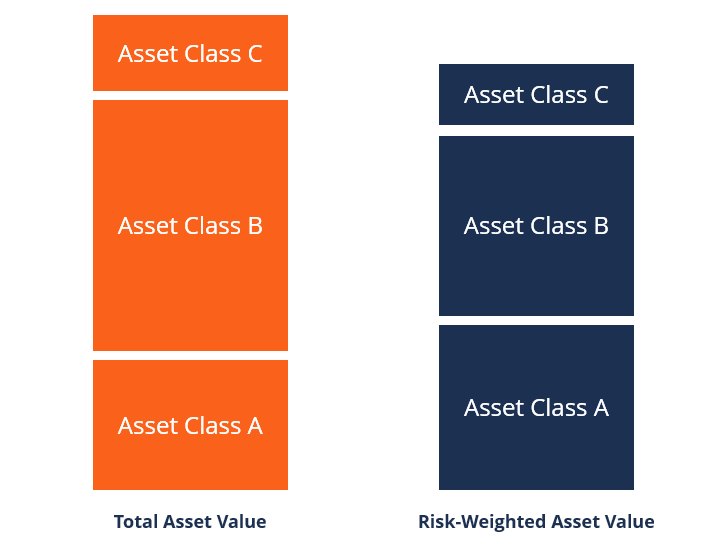
The different classes of assets held by banks carry different risk weights, and adjusting the assets by their level of risk allows banks to discount lower-risk assets. For example, assets such as debenturesDebentureA Debenture is an unsecured debt or bonds that repay a specified amount of money plus interest to the bondholders at maturity. A debenture is a long-term debt instrument issued by corporations and governments to secure fresh funds or capital. Coupons or interest rates are offered as compensation to the lender. carry a higher risk weight than government bonds, which are considered low-risk and assigned a 0% risk weighting.
Understanding Risk-Weighted Assets
When calculating the risk-weighted assets of a bank, the assets are first categorized into different classes based on the level of risk and the potential of incurring a loss. The banks’ loan portfolio, along with other assets such as cash and investments, is measured to determine the bank’s overall level of risk. This method is preferred by the Basel Committee because it includes off-balance sheet risks. It also makes it easy to compare banks from different countries around the world.
Riskier assets, such as unsecured loans, carry a higher risk of default and are, therefore, assigned a higher risk weight than assets such as cash and Treasury billsTreasury Bills (T-Bills)Treasury Bills (or T-Bills for short) are a short-term financial instrument issued by the US Treasury with maturity periods from a few days up to 52 weeks.. The higher the amount of risk an asset possesses, the higher the capital adequacy ratio and the capital requirements. On the other hand, Treasury bills are secured by the ability of the national government to generate revenues and are subject to much lower capital requirements than unsecured loans.
Setting Rules for Risk Weighting
The Basel Committee on Banking Supervision (BCBS) is the global banking regulator that sets the rules for risk weighting. The first step in international banking regulation started with the publication of the Basel I framework, which set the capital requirements for banks. It was followed by the Second Basel Accord of 2004 that amended the banking regulations on the amount of capital banks should maintain against their risk exposure. Basel II recommended that banks should hold adequate capital that is at least 8% of the risk-weighted assets.
The financial crisis of 2007/08 exposed the inefficiencies that existed in the banking industry that led to the collapse of large US banks. The main cause of the crisis was investments in sub-prime home mortgage loans that carried a higher risk of default than bank managers expected – or at least acknowledged.
Following the global financial crisis, the BCBS introduced the Basel IIIBasel IIIThe Basel III accord is a set of financial reforms that was developed by the Basel Committee on Banking Supervision (BCBS), with the aim of strengthening framework, which aimed to strengthen the capital requirements of banks. It also established new requirements for funding stability and liquid assets. Basel III requires banks to group their assets by risk category so that the minimum capital requirements are matched with the risk level of each asset. The framework is scheduled to take full effect on January 1, 2022.
How to Assess Asset Risk
When determining the risk attached to a specific asset held by a bank, regulators consider several factors. For example, when the asset being assessed is a commercial loan, the regulator will determine the loan repayment consistency of the borrower and the collateral used as security for the loan.
On the other hand, when assessing a loan used to finance the construction of coastal condominiums, the assessor will consider the potential revenues from the sale (or rental) of the condos and if their value is sufficient to repay the principal and interest payments. This is assuming that the condos serve as collateral for the loan.
If the asset being considered is a Treasury bill, the assessment will be different from a commercial loan, since a Treasury bill is backed by the government’s ability to continually generate revenues. The federal government has higher financial credibility, which translates to lower risk to the bank. Regulators require banks holding commercial loans on their balance sheet to maintain a higher amount of capital, whereas banks with Treasury bills and other low-risk investments are required to maintain far less capital.
Capital Requirements for Risk-Weighted Assets
Capital requirements refer to the minimum capital that banks are required to hold depending on the level of risk of the assets they hold. The minimum capital requirements set by regulatory agencies such as the Federal ReserveFederal Reserve (The Fed)The Federal Reserve is the central bank of the United States and is the financial authority behind the world’s largest free market economy. and the Bank for International Settlements (BIS)Bank for International Settlements (BIS)The Bank for International Settlements (BIS) started in 1930, and is owned by the central banks of different countries. It serves as a bank for member central banks, and its role is to foster international monetary, financial stability and financial corporation. The Bank for International Settlements is based in are designed to ensure that banks hold enough capital, proportionate to the level of risk of the assets they hold. The capital acts a cushion of cash if the bank incurs operational losses in the course of the operations.
More Resources
CFI offers the Financial Modeling & Valuation Analyst (FMVA)™Become a Certified Financial Modeling & Valuation Analyst (FMVA)®CFI's Financial Modeling and Valuation Analyst (FMVA)® certification will help you gain the confidence you need in your finance career. Enroll today! certification program for those looking to take their careers to the next level. To keep learning and advancing your career, the following CFI resources will be helpful:
- Capital Allocation Line (CAL) and Optimal PortfolioCapital Allocation Line (CAL) and Optimal PortfolioStep by step guide to constructing the portfolio frontier and capital allocation line (CAL). The Capital Allocation Line (CAL) is a line that graphically depicts the risk-and-reward profile of risky assets, and can be used to find the optimal portfolio.
- Capital StructureCapital StructureCapital structure refers to the amount of debt and/or equity employed by a firm to fund its operations and finance its assets. A firm's capital structure
- InsolvencyInsolvencyInsolvency refers to the situation in which a firm or individual is unable to meet financial obligations to creditors as debts become due. Insolvency is a state of financial distress, whereas bankruptcy is a legal proceeding.
- Market Risk PremiumMarket Risk PremiumThe market risk premium is the additional return an investor expects from holding a risky market portfolio instead of risk-free assets.
-

Capital Expenditures (CAPEX): Definition & Examples
Capital expenditures refer to funds that are used by a company for the purchase, improvement, or maintenance of long-term assetsLong Term AssetsLong term assets are assets that a company uses in its p
-

Understanding Current Assets: Definition & Importance
Current assets are all assets that a company expects to convert to cash within one year. They are commonly used to measure the liquidity of a company. A company’s assets on its balance sheetBala
finance
- Investable Assets: A Comprehensive Guide for Investors
- Understanding Household Assets: A Comprehensive Guide
- Fixed Assets: Definition, Examples & Importance for Businesses
- Monetary Assets: Definition, Examples & Key Characteristics
- Understanding Non-Monetary Assets: Definition & Examples
- Understanding Quick Assets: Definition & Examples
- Understanding Hard Assets: Definition, Examples & Investment
- Trading Assets: Definition, Types & How They Work
- Understanding Liquid Assets: A Comprehensive Guide
-
 Understanding Net Foreign Assets (NFA): A Comprehensive Guide
Net Foreign Assets (NFA) refer to the net amount of foreign assets that a country owns or the total value of a country’s foreign assets minus the total value of assets within a country that are ...
-
 Understanding Infrastructure Investments: A Guide to Real Asset Returns
Infrastructure investments are a form of “real assets,” which contain physical assets we see in everyday life like bridges, roads, highways, sewage systems, or energy. Such a type of asset...