
Fixed Asset Turnover Ratio: Calculation & Importance
Fixed Asset Turnover (FAT) is an efficiency ratio that indicates how well or efficiently a business uses fixed assets to generate sales. This ratio divides net sales by net fixed assets, calculated over an annual period. The net fixed assets include the amount of property, plant, and equipmentPP&E (Property, Plant and Equipment)PP&E (Property, Plant, and Equipment) is one of the core non-current assets found on the balance sheet. PP&E is impacted by Capex,, less the accumulated depreciation. Generally, a higher fixed asset ratio implies more effective utilization of investments in fixed assets to generate revenue. This ratio is often analyzed alongside leverageLeverage RatiosA leverage ratio indicates the level of debt incurred by a business entity against several other accounts in its balance sheet, income statement, or cash flow statement. Excel template and profitability ratios.
Learn more ratios in CFI’s financial analysis fundamentals course!
Fixed Asset Turnover Ratio Formula
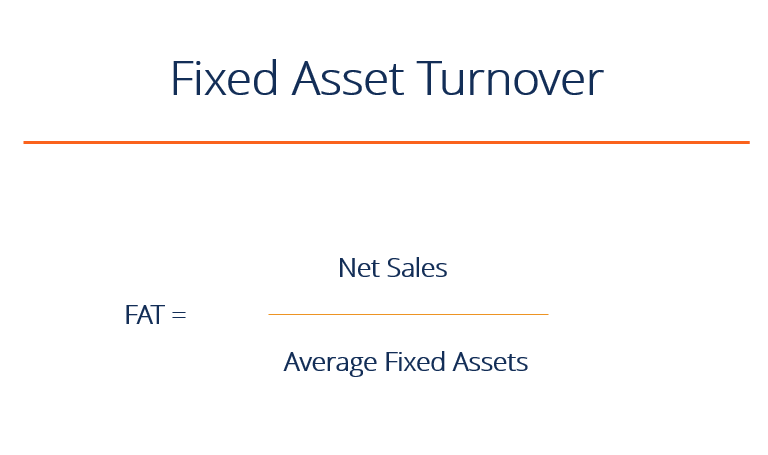
To determine the Fixed Asset Turnover ratio, the following formula is used:
Fixed Asset Turnover = Net Sales / Average Fixed Assets
Example calculation
Fisher Company has annual gross sales of $10M in the year 2015, with sales returns and allowances of $10,000. Its net fixed assets’ beginning balance was $1M, while the year-end balance amounts to $1.1M. Based on the given figures, the fixed asset turnover ratio for the year is 9.51, meaning that for every one dollar invested in fixed assets, a return of almost ten dollars is earned. The average net fixed asset figure is calculated by adding the beginning and ending balances, then dividing that number by 2.
Download the Free Template
Enter your name and email in the form below and download the free template now!
What are Fixed Assets?
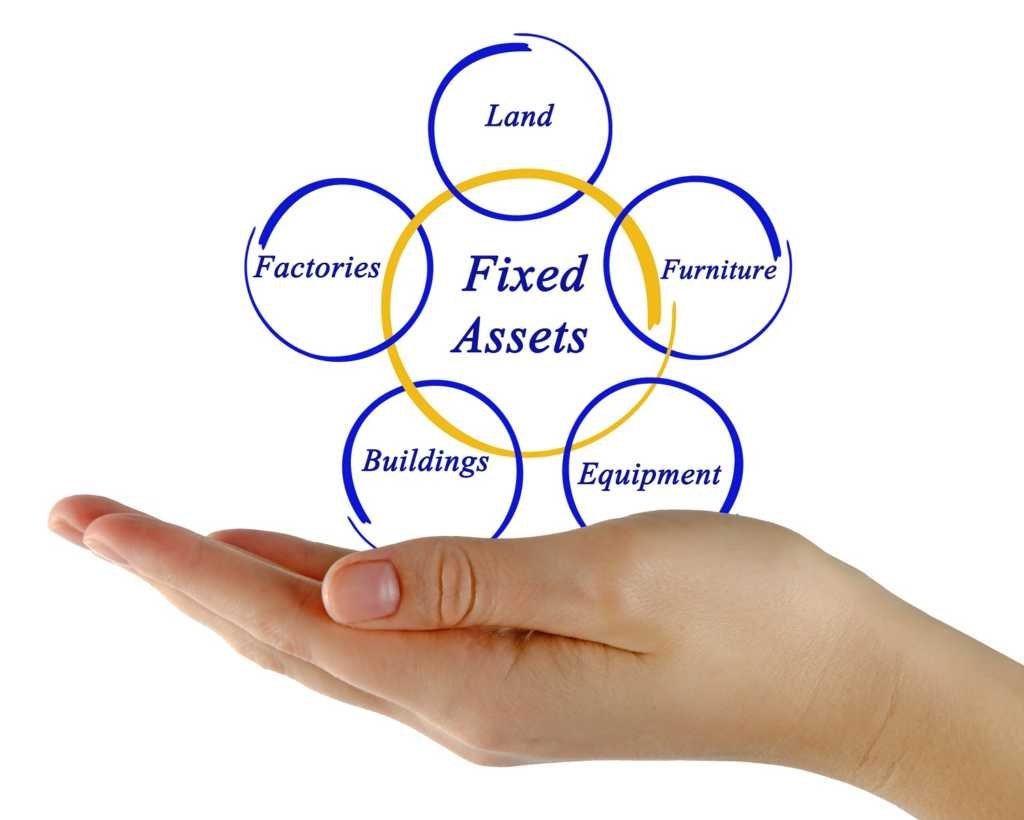
Fixed assets are tangible long-term or non-current assets used in the course of business to aid in generating revenue. These include real properties, such as land and buildings, machinery and equipment, furniture and fixtures, and vehicles. They are subject to periodic depreciation, impairmentsGoodwill Impairment AccountingGoodwill is acquired and recorded on the books when an entity purchases another entity for more than the fair market value of its assets., and disposition. All of these are depreciated from the initial asset value periodically until they reach the end of their usefulness or are retired.
Indications of High / Low Fixed Asset Turnover Ratio
Low Ratio
When the business is underperforming in sales and has a relatively high amount of investment in fixed assets, the FAT ratio may be low.
This is especially true for manufacturing businesses that utilize big machines and facilities. Although not all low ratios are bad, if the company just made some new large purchases of fixed assets for modernization, the low FAT may have a negative connotation.
A declining ratio may also suggest that the company is over-investing in its fixed assets.
High Ratio
A high ratio, on the other hand, is preferred for most businesses. It indicates that there is greater efficiency in regards to managing fixed assets; therefore, it gives higher returns on asset investments.
There is no exact ratio or range to determine whether or not a company is efficient at generating revenue on such assets. This can only be discovered if a comparison is made between a company’s most recent ratio and previous periods or ratios of other similar businesses or industry standards.
Fixed assets vary significantly from one company to another and from one industry to another, so it is relevant to compare ratios of similar types of businesses.
Learn more ratios in CFI’s financial analysis fundamentals course!
How Useful is the Fixed Asset Turnover Ratio to Investors?
Investors who are looking for investment opportunitiesInvestment BankingInvestment banking is the division of a bank or financial institution that serves governments, corporations, and institutions by providing underwriting (capital raising) and mergers and acquisitions (M&A) advisory services. Investment banks act as intermediaries in an industry with capital-intensive businesses may find FAT useful in evaluating and measuring the return on money invested. This evaluation helps them make critical decisions on whether or not to continue investing, and it also determines how well a particular business is being run. It is likewise useful in analyzing a company’s growth to see if they are augmenting sales in proportion to their asset bases.
Learn More
To learn more about assets and financial analysis, see the following CFI resources:
- Inventory TurnoverInventory TurnoverInventory turnover, or the inventory turnover ratio, is the number of times a business sells and replaces its stock of goods during a given period. It considers the cost of goods sold, relative to its average inventory for a year or in any a set period of time.
- Return on assetsReturn on Assets & ROA FormulaROA Formula. Return on Assets (ROA) is a type of return on investment (ROI) metric that measures the profitability of a business in relation to its total assets.
- Return on equityPar ValuePar Value is the nominal or face value of a bond, or stock, or coupon as indicated on a bond or stock certificate. It is a static value
- Analysis of financial statements guideAnalysis of Financial StatementsHow to perform Analysis of Financial Statements. This guide will teach you to perform financial statement analysis of the income statement,
-

Direct Security Explained: Types & How It Works
Direct security is typically collateralCollateralCollateral is an asset or property that an individual or entity offers to a lender as security for a loan. It is used as a way to obtain a loan, acting
-

Understanding Fixed Costs: Definition, Examples & Importance
Fixed costs are a type of expense or cost that remains unchanged with an increase or decrease in the volume of goods or services sold. They are often time-related, such as interest or rents paid per m
finance
- Asset Dissipation: Financing Your Home with Liquid Assets
- Understanding Asset Base: Definition, Value & Significance
- Asset Management: Definition, Types & Importance
- Asset Turnover Ratio: Definition & Importance
- Asset Valuation: Understanding Property Value for Business & Finance
- Fixed Assets: Definition, Examples & Importance for Businesses
- Fixed Capital: Definition, Examples & Importance
- Operating Asset Turnover Ratio: Definition & Analysis
- Non-Financial Assets: Definition, Examples & Value
-
 Understanding Assets: Types, Examples & Importance in Business Accounting
“Asset” is one of those words that has both a casual meaning and a specific definition. As part of everyday speech, asset is used favorably: “He’s a real asset to the community...
-
 Understanding Amortization of Intangible Assets: A Comprehensive Guide
In this article, we will discuss the amortization of intangible assets. Intangible assets refer to assets of a company that are not physical in nature. They include trademarks, customer lists, goodwil...